
What to know about Flying drones to capture the Northern Lights

January 19, 2026
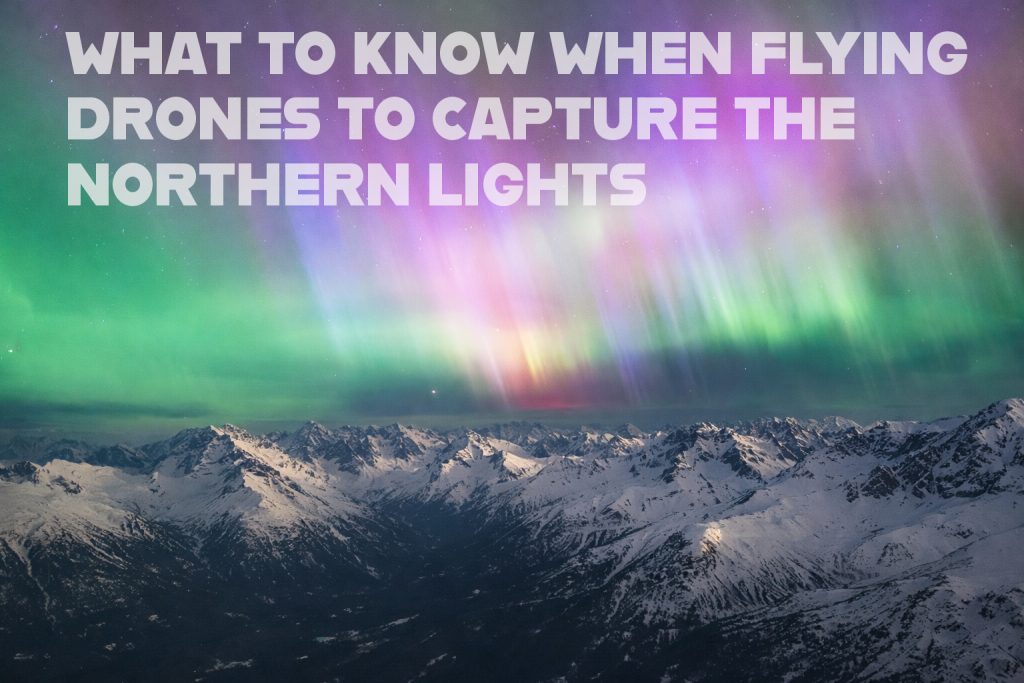
Every time a major geomagnetic storm hits, social media fills with jaw-dropping footage of the Northern Lights (Aurora Borealis)—and inevitably, drone pilots start asking the same question:
Can I fly my drone to capture this?
The short answer is yes—but only if you understand the risks.
The long answer is what this article is about.
Flying during geomagnetic storms is not normal drone flying, and if you rely entirely on GPS without understanding manual flight or flyaway recovery, you may be putting your aircraft (and others) at serious risk.
In the U.S., flying at night is allowed under Federal Aviation Administration regulations, but it comes with specific requirements.
Your drone must have a strobe visible for at least 3 statute miles
The strobe must have a flash rate sufficient for collision avoidance
You are still responsible for:
Visual line of sight
Yielding to crewed aircraft
Operating safely for the environment and conditions
Night flying alone is manageable.
Night flying during a solar storm is a completely different animal.
The same solar activity that creates beautiful auroras also disrupts the systems your drone depends on.
The KP index measures the intensity of geomagnetic interference caused by:
Solar flares
Coronal mass ejections
Charged particles interacting with Earth’s magnetic field
The higher the KP index:
The more intense the aurora
The worse your GPS performance becomes
At elevated KP levels, GPS positioning can become unreliable, delayed, or completely incorrect. It will cause a flyaway.
Most consumer and prosumer drones rely on:
GPS for position hold
GPS for braking
GPS for Return-to-Home logic
GPS for wind compensation
During geomagnetic storms:
Your drone may think it’s drifting when it’s not
Or worse—it may not recognize real drift at all
Position hold can fail
RTH may initiate in the wrong direction
This is where flyaways happen.
If you attempt to fly during a strong geomagnetic storm while relying on GPS, you should assume this:
You are likely to experience a flyaway.
That doesn’t mean you will lose the drone—but it does mean you must be prepared to stop one immediately.
Pilot manually controls drift
GPS loss is inconvenient, not catastrophic
Depend on satellite positioning to remain stable
Can suddenly accelerate, drift, or ignore stick input
Pilots often panic when GPS assistance disappears
If you’ve never flown without GPS, aurora conditions are the worst place to learn.
This is the real dividing line between pilots.
Stopping a flyaway involves:
Understanding wind vs perceived drift
Knowing when to disable GPS assistance
Controlling the aircraft purely by attitude and orientation
Avoiding over-correction and panic inputs
This is something we explicitly teach in:
Flight Mastery
Operations & Emergency Procedures training
And it leads to a hard but necessary question:
If you don’t know how to stop a flyaway, should you even be flying?
Northern Lights flights are tempting because:
The footage is rare
The visuals are incredible
The moment feels fleeting
But these flights combine:
Night operations
Cold weather
Wind at altitude
Severe GPS interference
That’s a high-risk stack of variables—even for experienced pilots.
If you still want to capture the aurora:
Use ground-based long-exposure photography
Fly before or after peak KP activity
Fly lower and closer, where visual reference is stronger
Only fly platforms you can control without GPS
Flying drones during geomagnetic storms to film the Northern Lights is not a beginner activity.
Yes, it’s legal—with the right lighting.
Yes, it’s technically possible.
But it demands:
Advanced situational awareness
Manual flight skills
Flyaway recovery knowledge
A deep respect for how solar activity affects navigation systems
Auroras are beautiful.
Flyaways are not.
 1
1