Waivers that were costing some companies $125,000.00
The Federal Aviation Administration (FAA) has proposed 14 CFR Part 108 to replace this cumbersome process with a standardized, scalable regulatory framework. This new rule aims to transition the industry from “one-off” approvals to routine, high-scale autonomous operations.
Key Operational Roles
A significant shift in Part 108 is the move from individual pilot responsibility to organizational accountability. The “Operator”—typically a company—is the central entity responsible for compliance.
“The Operator is the person, or more often, the company, that is responsible for the drones operating under Part 108… shifting responsibility for enforcement and compliance from the FAA to Operators.”
The Core Mission of Part 108
Part 108 is designed to mainstream autonomous drone flights with minimal human supervision. While Part 107 revolutionized the industry by enabling commercial line-of-sight operations, Part 108 addresses the needs of advanced sectors such as logistics, infrastructure inspection, and large-scale agriculture. By establishing clear safety and performance standards, the FAA intends to reduce the administrative burden on operators while maintaining the highest levels of airspace safety.
It is essential to understand that Part 108 does not replace Part 107; rather, it complements it. The following table highlights the primary distinctions between the two frameworks:
Feature
Part 107
Part 108 (Proposed)
Primary Focus
Visual Line of Sight (VLOS)
Beyond Visual Line of Sight (BVLOS)
Responsibility
Individual Remote Pilot (RPIC)
The “Operator” (Organization)
Aircraft Size
Under 55 lbs
Up to 1,320 lbs
Automation
Pilot-centric control
System-centric autonomy
Approval Basis
Individual waivers for BVLOS
Standardized certification/permits
Regulatory Foundations and Updates
The implementation of Part 108 necessitates updates to existing regulations to ensure a cohesive safety ecosystem.
•Remote ID (Part 89): All BVLOS operations under Part 108 must comply with Remote ID requirements, acting as a digital license plate for drones.
•Registration (Part 48 & 47): While Part 48 has been the standard for small UAS, Part 108 introduces pathways for registering multiple drones under a single Remote ID module. However, even drones under 55 lbs may be required to use the more formal Part 47 paper-based registration process.
•Part 107 Modifications: Once Part 108 is finalized, certain BVLOS waivers will no longer be available under Part 107, and commercial drone delivery will transition entirely to the Part 108 framework.
Essential Personnel
1.Operations Supervisor: The final authority for the safe and secure operation of the UAS fleet. They are qualified through training or experience rather than a specific FAA certificate.
2.Flight Coordinator: Provides tactical oversight of active flights. Unlike traditional pilots, they may monitor multiple autonomous drones simultaneously, aided by Simplified User Interaction (SUI).
3.Other Staff: Depending on the complexity, operators may employ specialized staff for maintenance, ground handling, and emergency response. All personnel must undergo TSA background checks.
The Framework of Operations
Part 108 categorizes operations based on risk, population density, and the nature of the mission. This tiered approach ensures that safety requirements are proportional to the potential hazard.
Population Density Categories
The FAA has established five categories of population density, ranging from Category 1 (isolated areas) to Category 5 (densely populated urban centers). Higher categories require more stringent deconfliction technologies and operational certifications.
Types of Operations
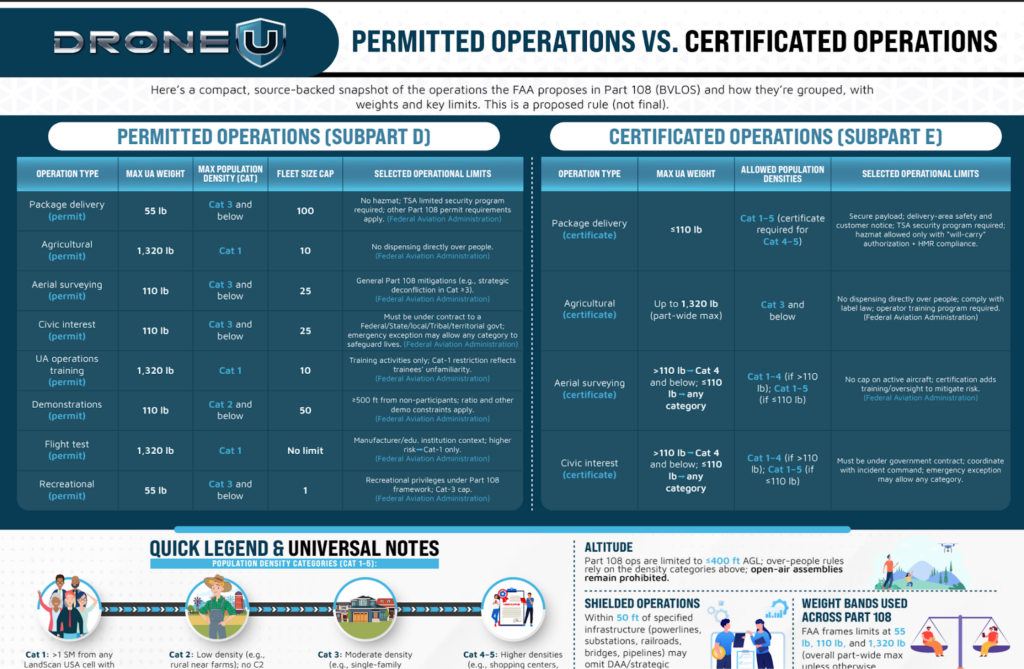
Operations are broadly divided into Permitted and Certificated categories, with a special provision for Shielded flights.
The infographic above succinctly summarizes the differences between Permitted, Certificated, and Shielded operations, including weight limits, population density restrictions, and typical use cases.
Valid for 24 months; specific weight and density limits per mission type.
Certificated
High-risk or high-scale operations (e.g., urban hazmat delivery).
Requires Safety Management Systems (SMS) and enhanced FAA oversight.
Shielded
Flights within 50 feet of structures (e.g., powerlines, bridges).
Leverages obstacles as a buffer; requires owner permission but less FAA coordination.
Advanced Safety and Technology Concepts
To enable safe BVLOS flight, Part 108 introduces several technical requirements:
•Airworthiness Acceptance: A formal recognition that a UAS design meets safety benchmarks. Notably, this currently excludes manufacturers from countries without bilateral agreements with the U.S.
•Detect-and-Avoid (DAA): Automated systems that allow drones to identify and maneuver away from other aircraft or obstacles.
•Strategic Conflict Detection: A process of resolving overlapping “operational intents” (planned flight volumes) before they result in a collision.
•Right-of-Way Evolution: In a major shift, Part 108 proposes that properly equipped drones may have right-of-way over non-equipped manned aircraft in certain low-altitude environments, though they must still yield near airports and in high-density areas.
Aircraft Design and Maintenance
Part 108 sets rigorous standards for the hardware itself. Aircraft are limited to a 25-foot wingspan, a 1,320 lb maximum weight, and a 87-knot ground speed. Redundancy is a core requirement; no single failure in power or propulsion should result in a loss of flight control. Furthermore, manufacturers must provide detailed manuals and establish flight-data collection systems to track performance over time.
Conclusion
The transition to Part 108 represents the “coming of age” for the drone industry. By moving away from the exception-based model of Part 107 waivers and toward a scalable, organization-led framework, the FAA is laying the groundwork for a future where autonomous drone delivery, infrastructure monitoring, and precision agriculture are part of everyday life. As the rule moves toward finalization, staying informed on these shifting responsibilities will be crucial for any organization looking to lead in the autonomous airspace. These rules are supposed to come out in Spring of 2026 with new changes, additions and updates.
Paul Aitken is a Certified Part 107 drone pilot and a Certified Pix4D Trainer. He is a pioneer in drone training and co-founder of Drone U. He created the industry’s first Part 107 Study Guide and co-authored Livin’ the Drone Life.
Paul is passionate about helping students fly drones safely and effectively. With over a decade of experience, he has led complex UAS projects for federal agencies and Fortune 500 clients such as Netflix, NBC, the NTSB, and the New York Power Authority.
Related Articles
The Top 36 Drone Companies in 2025
How to Choose the Best Drone for Cinematic Filmmaking

 0
0