
A More Affordable Alternative to the Mavic 4 Pro: Why the Mini 5 Pro Is the Smart Buy
January 19, 2026
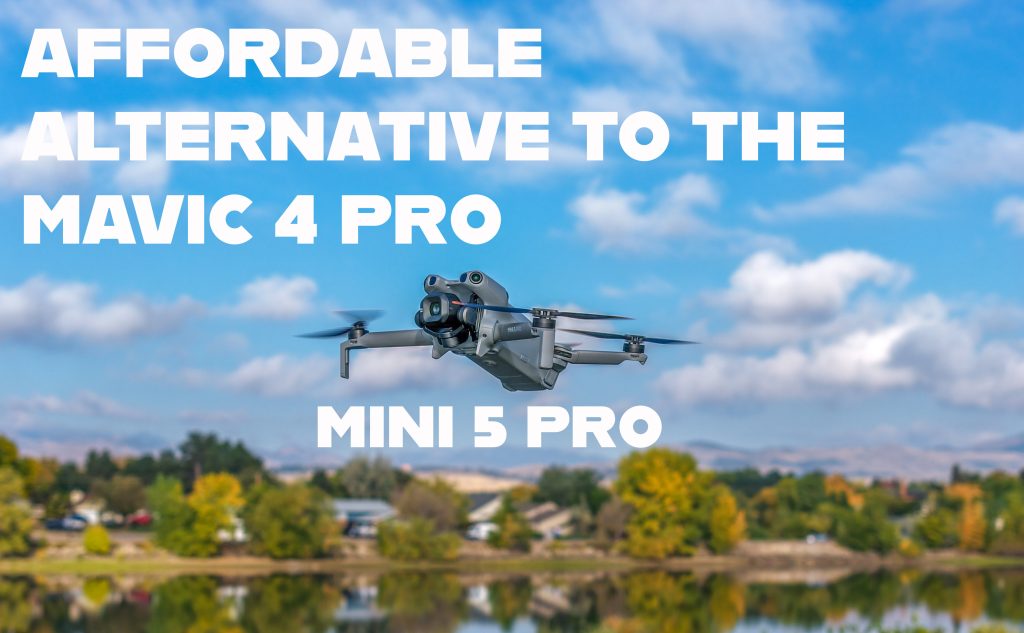
One of the most talked-about features of the Mavic 4 Pro is its ability to roll the gimbal left to right. This simple mechanical move unlocked something creators have used for years across TikTok, Instagram, commercials, and broadcast work: in-camera transitions. By rolling the camera during a shot and pairing it with a speed ramp in post, pilots can create seamless scene-to-scene transitions that feel dynamic, intentional, and professional.
The catch? The Mavic 4 Pro’s price keeps climbing.
The good news: you don’t need a Mavic 4 Pro to get that rolling transition effect.
Enter the Mini 5 Pro—arguably the best affordable drone on the market right now.
The Mavic 4 Pro can roll the gimbal farther and offers more lens options, especially for telephoto and parallax shots. No argument there—it’s a stunning imaging platform.
But here’s what most creators actually need:
Enough gimbal roll to create in-camera transitions
Clean footage that holds up to speed ramps
A reliable, portable drone you’ll actually fly all the time

The Mini 5 Pro delivers exactly that.
While the roll range isn’t as extreme as the Mavic 4 Pro, it’s more than sufficient for the popular rolling-transition workflows used in social media, commercials, YouTube, and news production.

default
The Mini 5 Pro punches far above its weight. Its image quality rivals:
Phantom 4 Pro
Mavic 2 Pro
Early Mavic 3 systems
Despite its size, the footage is broadcast-quality, and we’re already seeing it used across major streaming platforms, YouTube channels, and commercial content.
You lose the telephoto lens—but gain something far more valuable for most creators: portability and frequency of use.
At under 250 grams, the Mini 5 Pro becomes a drone you can:
Keep in your bag at all times
Travel with effortlessly
Deploy quickly without overthinking logistics
For many pilots, this means more flights, more practice, and better footage.
With:
Prop guards installed
The smaller battery to remain under 250g (Always good to confirm the weight, users have reported varying results)
…the Mini 5 Pro can qualify for Category 1 operations over people.
That’s a massive advantage.
It allows you to capture shots that would otherwise require:
Much larger drones
Parachute-based systems
FAA-approved compliance hardware
Significantly higher budgets
For many commercial pilots, this alone makes the Mini 5 Pro a strategic tool—not just a “small drone.”
No telephoto lens? True.
But the digital zoom quality on the Mini 5 Pro is shockingly good. For:
News
YouTube
Social media
Web commercials
…it holds up extremely well and remains clean, sharp, and usable.
At roughly $1,000, some studios treat the Mini 5 Pro as a:
Low-risk
High-reward
Creative utility drone
You can push shots harder, fly into tighter spaces, and experiment more freely—especially knowing:
Footage can be cached directly on the controller
You’re not risking a $4,000–$6,000 platform
This mindset alone leads to better creative output.
Comes with its own remote (no phone battery drain)
Obstacle avoidance
Laser rangefinding for more precise sensing
That said—after decades of training pilots—we still don’t recommend trusting obstacle avoidance near thin branches or complex vegetation. Use it as a safety layer, not a crutch.
Mavic 4 Pro
Superior photo quality
True telephoto lenses
Strong parallax capabilities
Best for high-end cinematic and inspection work
About ¼ the price
Roughly ½ the feature set
Rolling gimbal for in-camera transitions
Extreme portability
Category 1 ops over people potential
Shockingly good video quality
If parallax and long-lens compression are essential to your work, the Mavic 4 Pro still wins.
If you want maximum creative freedom per dollar, the Mini 5 Pro is the clear standout.
If you’re serious about video:
They allow proper shutter speeds
They let you follow proven cinematic formulas
This is exactly what we teach in our aerial videography training—how to consistently get the right shot, in the right conditions, every time.
If you’re looking for a drone to augment your creative or production work, the Mini 5 Pro is a powerhouse for the money.
It’s:
The traveler’s drone of choice
The influencer’s drone of choice
A professional-grade tool hiding in a sub-250g frame
And yes—it can absolutely deliver the rolling gimbal transitions people are raving about on the Mavic 4 Pro.
If you love to fly and want to learn what actually works in the field, become a Drone U member and check out:
We don’t teach hype.
We teach what works—because we fly it ourselves.
 1
1