

DJI Ban Backfires: How DJI Made the Crisis Worse and What Pilots Must Do Next
January 12, 2026
The DJI ban is now reshaping the drone industry, but not for the reasons most pilots think. The real shock isn’t that DJI was banned—it’s how DJI’s own strategy made the crisis explode. Their shell-company gambit backfired, accelerating federal action and cutting off future approvals. With the industry scrambling, pilots must decide whether to evolve with the changing landscape or get left behind.
For years, Drone U has taken heat for saying what very few in the drone industry were willing to say publicly. Now, industry affiliates have gone down the rabbit hole to reveal even more, thanks to publications like DroneXl, we know even more.
We were ridiculed for raising concerns about security.
We were mocked for publishing an early guide on how to avoid security risks with DJI hardware.
We were ostracized for telling pilots, “Be objective. Stop emotionalizing the China issue. Look at the facts.”
People didn’t just disagree—they attacked, dismissed, and name-called.
But now? The truth is finally surfacing, and the industry is seeing what we’ve been pointing out all along.
And @DroneXL1’s recent article perfectly encapsulates the problem:
DJI didn’t just get banned. DJI made the ban much worse on themselves.
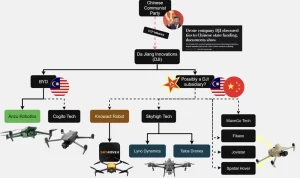
As Haye explains, DJI tried to shortcut their way around U.S. policy by using shell companies to continue pushing new hardware through FCC authorization.
This was not a small miscalculation.
This was a monumental strategic error.
They tried to play sneaky thief with the world’s best police.
They attempted to outsmart Washington—while every American with a backbone knew DC would never allow this kind of side-door maneuvering.
Instead of addressing legitimate security concerns, they tried to game the system.
And when China created shell companies to mask DJI’s involvement, they didn’t just create a loophole—they triggered the most aggressive, irreversible response possible.
They lost trust. They lost credibility. And they lost the ability to influence outcomes ever again.
“American drone operators were never the priority. They were acceptable losses.” – DroneXl.co
That’s the painful part.
DJI could have built a drone that passed true security validations.
Not SOC 1 or SOC 2 compliance (which anyone in cybersecurity knows are laughably insufficient for preventing backdoors).
Not an attestation letter.
Not a clever workaround.
A real solution.
They could have partnered transparently with U.S. agencies.
They could have engineered hardware that passed rigorous inspection.
They could have demonstrated good faith.
Instead, they gambled with the entire industry’s future—and lost.
And this is the part pilots don’t want to admit:
They were the product all along.
They weren’t the customers.
They weren’t the influencers.
They weren’t the decision makers.
They were the fuel.
– The product used to move drones
– The product used to create public pressure
– The product used to try to sway Washington
– The product meant to get emotional, angry, loud, and reactive
Many pilots genuinely believed they had leverage in this political and economic tug-of-war.
They didn’t.
They were pawns in a much larger geopolitical game.
A small group of operators began pivoting early.
They stayed objective.
They watched the trendlines.
They recognized that the “DJI forever” mindset was unsustainable.
Meanwhile, others doubled down emotionally—convinced that outrage could somehow change federal policy.
It didn’t.
It never was going to.
Now the industry is splitting:
Pilots who adapt will win. Pilots who stay emotional will lose.
And the gap between these two groups is widening.
Years ago, we published a DJI Alternatives video.
We were blasted for it.
We were called “alarmists,” “conspiracy theorists,” and “fearmongers.”
But we weren’t anti-DJI. In fact, we genuinely love flying DJI and still do.
We were simply objective—and early.
And we’re grateful we took that stance.
Because today, a massive shift is happening:
? There is now a monumental gap in the industry’s ability to serve clients.
Many pilots are pissed and stuck.
But others are evolving.
They’re doubling down on business.
They’re becoming platform-agnostic.
They’re focusing on deliverables and workflows rather than brand loyalty.
That’s where the opportunity lies.
American tech will rise.
American platforms will mature.
American systems will stabilize, scale, and innovate.
Yes, it will take time.
Yes, 2026 and 2027 may feel like rebuilding years.
But after that?
The industry won’t even remember the DJI ban as a “problem.”
People won’t care about the political drama.
They’ll just fly whatever system delivers the best performance, the best security, and the best reliability.
You can still buy the:
– Mini 5 Pro
– Mavic 4 Pro
– Matrice 4 Enterprise
And if you do, here’s the safest workflow:
Turn on your phone’s hotspot.
Change the hotspot password.
Activate your drone.
Never let the drone touch Wi-Fi again—ever.
Because yes, despite years of denial from online “experts,”
there is a security issue.
And if there wasn’t, Washington would not be taking such an aggressive, bipartisan, multi-agency stance.
The DJI ban didn’t have to be catastrophic.
DJI made it catastrophic.
Now the industry has a choice:
Evolve—or stay angry.
Adapt—or fall behind.
Lead—or get left behind.
At Drone U, we choose to evolve.
We choose to focus on training, objectivity, and long-term success.
We choose to help pilots navigate whatever comes next—because the work still needs to be done, and clients still need real professionals.
The pilots who step up now…
will own the next decade of drone work.
 3
3