

Drone Ban Explained: FCC Covered List What the Law Actually Does.
January 5, 2026
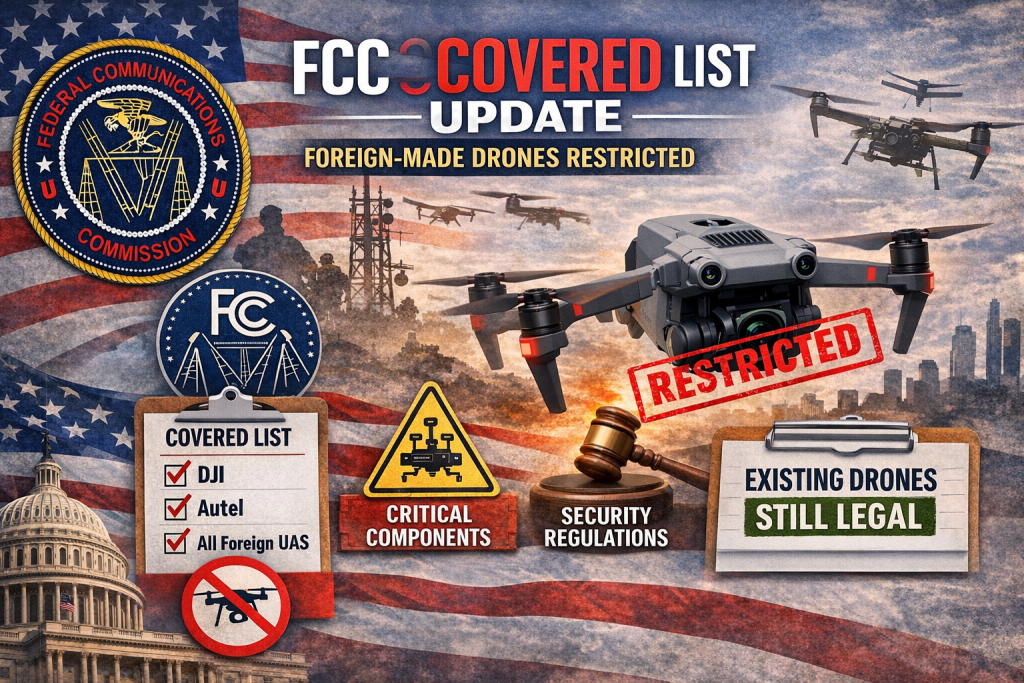
Every drone that transmits radio signals must comply with FCC equipment authorization rules. Before authorization is granted, manufacturers must file an application certifying — among other things — that they are not identified on the FCC Covered List under 47 CFR § 2.911.
Manufacturers like DJI have historically done this successfully. For example, in prior filings, DJI certified that it was not on the Covered List at the time of application — a true statement at the time — and the FCC issued the authorization.
Once authorization is granted (commonly under 47 CFR Part 15):
However, if a company is on the Covered List, the FCC is legally prohibited from issuing authorization.
See 47 CFR § 2.903(a).
Congress passed the Secure and Trusted Communications Networks Act, which created the FCC Covered List framework.
The National Defense Authorization Act for FY2025 directed that DJI and Autel be automatically added to the Covered List, unless a national security agency determined otherwise.
An Executive Branch interagency body, convened by the White House, issued a National Security Determination covering:
All foreign-made uncrewed aircraft and their critical components
This went beyond DJI and Autel.
The FCC formally announced the:
Addition of uncrewed aircraft systems (UAS) and UAS critical components produced in foreign countries to the Covered List, citing unacceptable national security risks.
Three documents were released:
The FCC adopted the following definitions directly from the determination:
An aircraft operated without the possibility of direct human intervention from within or on the aircraft.
The aircraft plus all associated elements required for safe and efficient operation, including:
Defined broadly and explicitly open-ended, including but not limited to:
?? This list can expand in the future.
This is the first time the FCC has added an entire category of equipment to the Covered List — not just specific companies or services.
That matters because:
No — if the drone already has FCC equipment authorization.
No.
The FCC explicitly states:
“This action does not affect any previously-purchased drone. Consumers can continue to use any drone they have already lawfully purchased or acquired.”
?? Some foreign-made drones may not have authorization.
Yes. The FCC states:
“This update does not prohibit the import, sale, or use of any existing device models the FCC previously authorized.”
Yes.
The FCC has independent authority to revoke existing equipment authorizations in the future. This rule change concerns future approvals, but revocation authority already exists.
This is high-risk and fact-specific.
Professional legal review is strongly recommended.
If a device cannot receive authorization:
It is prohibited from being imported for use or sale in the U.S.
Yes.
U.S. manufacturers can be implicated through:
Yes.
There is no weight exemption.
Yes — but it is limited, technical, and case-specific.
The FCC Covered List is publicly available.
Be aware:
This is not a drone usage ban.
It is a forward-looking supply-chain and authorization restriction with real long-term consequences.
This is one of the most consequential regulatory shifts in U.S. drone policy to date.
To stay up to date with all things DJI, make sure you’re staying up to date with our news show on youtube, or through our podcast AskDroneU.com
 0
0