
Harnessing Flow: Why FPV Drones Offer Therapeutic Flight
January 8, 2026
Discover how FPV drones can unlock therapeutic flow states through flight.
Flow state—the sensation of being completely absorbed in an activity—is sometimes described as being “in the zone.” Positive psychology pioneer Mihaly Csikszentmihalyi argued that flow arises when there is a balance between challenge and skill and when the activity itself is intrinsically rewarding. People experiencing flow often lose track of time, feel fully in control of their actions and experience intrinsic motivation says positivepsychology.com. A trauma therapist quoted in Positive Psychology describes flow moments as times when a person stretches beyond their comfort zone and all self consciousness fades.
Flow isn’t just a pleasant state; studies suggest it has measurable mental health benefits. A study of more than 9,000 twins found that people with high flow proneness had a significantly lower risk of depression, anxiety and even cardiovascular disorders. Source: pubmed.ncbi.nlm.nih.gov Another large review noted that people who regularly experience flow are less susceptible to depression, even after accounting for personality traits such as neuroticism. Being deeply engaged in a challenging activity can enhance one’s sense of growth and purpose and calm ruminative thoughts.
Neuroscience helps explain why flow feels so good. According to a WellPower article, flow activates a “cocktail” of neurotransmitters—dopamine, anandamide, noradrenaline, serotonin and endorphins—which boost mood and generate feelings ranging from motivation to euphoria. Some researchers, like Dimitri van der Linden, hypothesize that flow may involve optimal activity of the locus coeruleus (a brainstem region that produces noradrenaline). When baseline noradrenaline levels are moderate, the brain can raise alertness without overwhelming us, allowing deep, engaged processing.
Because of its mood boosting neurochemistry and ability to quiet negative thought loops, flow is increasingly used as a therapeutic tool. Flow?prone individuals show lower rates of depression and anxiety and report higher life satisfaction and self esteem. Flow may also help patients focus on present?moment experiences, which can reduce stress and improve emotional regulation.
Researchers at TU Delft and Erasmus University are developing a small, inexpensive drone to guide autistic children through DMT. The drone’s range of movement and ease of programming make it ideal for personalized therapy; repetitive movements can provide “peace of mind,” and DMT is known to improve concentration, flexibility, engagement and communication. By automating parts of the therapy, clinicians hope to deliver more sessions and reduce therapist workload.
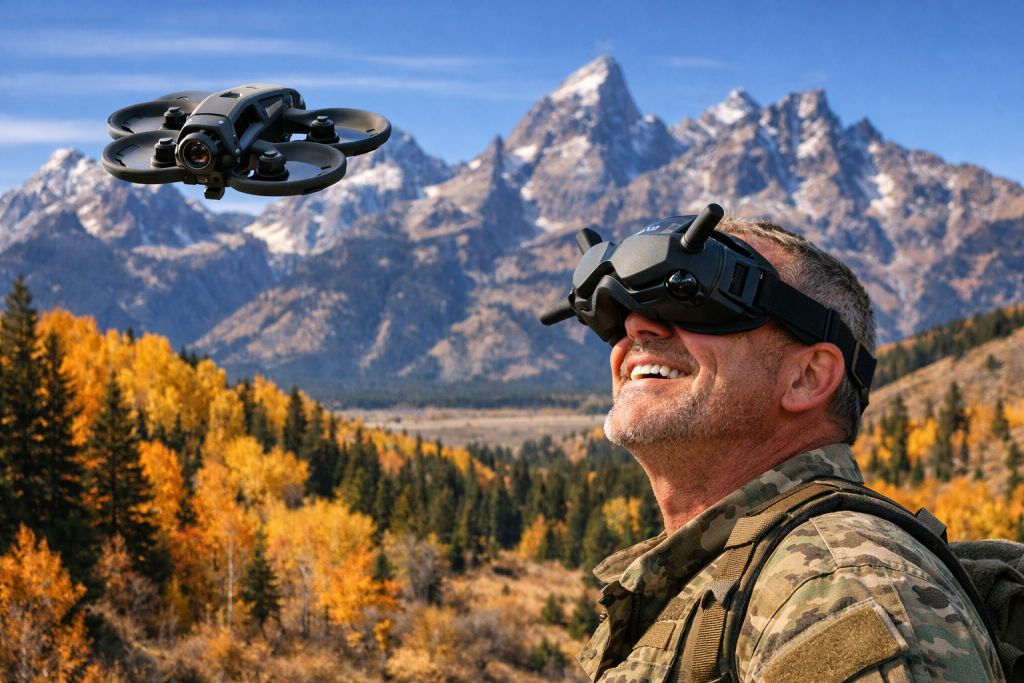
First person view (FPV) drone flying is uniquely suited to inducing flow. Pilots view live video from the aircraft and must react quickly to changing obstacles. This continuous challenge–skill matching, along with immediate sensory feedback, forces pilots to concentrate so fully that distractions fade away—exactly the conditions that produce flow. Pilots often describe FPV flying as an “out-of-body experience.”
Organizations like Drone U, and Wounded Eagle UAS and Vigilante Cares leverage FPV drone flying to help disabled veterans recover purpose and manage post?traumatic stress disorder (PTSD). The Florida based Wounded Eagle program trains disabled veterans to build and fly drones and prepare for the FAA Part 107 certification. Airboss Joseph Dorando says the program’s mission is to “bring purpose and stability and therapy to our disabled veterans” through drone training. Veterans learn to build drones and fly them in FPV, which transforms a wheelchair into a virtual cockpit. For former scout pilot Terry Wallace, the experience was “exhilarating” and gave him the feeling of being in the skies again. Instructor Pat Rushing, himself a veteran with PTSD, notes that piloting a drone makes you “forget your problems … because you have to concentrate on flying”
The program also helps with reintegration into civilian life by providing a pathway to employment. After completing training, veterans can apply their skills in fields such as search?and?rescue, utilities inspection, real estate and aerial mappingweartv.com. An appropriation request to the Florida Senate notes that Wounded Eagle’s training is FDA approved as Drone Adaptive Recovery Therapy (DART) for treating traumatic brain injury (TBI) and PTSD in disabled veterans
David Daly, a Marine Corps veteran, found that flying drones offered relief from PTSD when other treatments failed. He formed Vigilante Cares, a support group that provides veterans with drones and a community. Daly explains that FPV flying offers veterans the chance to “escape the troubles below” and redirect energy consumed by PTSD toward a positive activity. The group’s two?step approach—bringing veterans together and giving them their own drone—offers both social support and a tool for self?therapy.
Beyond mental?health benefits, FPV drone programs offer disabled veterans marketable skills. The Wounded Eagle UAS program provides training at no cost and prepares participants for commercial drone jobs. After earning their FAA license, veterans can pursue careers in construction, surveying, emergency management, utility inspection, and aerial photography. The Florida Senate funding request highlights that salaries in UAS fields range from US$35,000 to US$120,000 Source: flsenate.gov.
FPV drones are also being used to teach self?regulation and STEM skills to neurodivergent youth. A North Carolina State University study works with high?school students on the autism spectrum. Over multiple sessions, students learn drone theory, practice on simulators and eventually fly real drones. Assistant professor Jamie Pearson says the program teaches students how to self?regulate in a simulated STEM workplace. Students identify their own sensory preferences (for example, sitting on the floor) and use strategies like timers or sensory toys to stay calm and focused. The program aims to translate these strategies into future employment, showing that drone flying can help neurodivergent individuals develop self?awareness and workplace readiness.
Flying an FPV drone demands exactly the conditions that produce flow:
Challenge–Skill Balance: Pilots must manage throttle, yaw, pitch and roll while navigating three?dimensional space—constantly stretching their ability but remaining within control. As skills improve, pilots can increase speed or fly through tighter spaces, maintaining the balance between challenge and competence.
Clear Goals and Immediate Feedback: FPV goggles provide real?time video; obstacles and waypoints offer clear objectives; and the drone’s behaviour instantly reflects the pilot’s input. Source: positivepsychology.com.
Total Concentration: The need to avoid crashes demands full attention. Pilots often report that worries about work or health fade away as their mind focuses on the flight path.
Autotelic Experience: Many pilots fly simply for the joy of it, not for external rewards, which aligns with the intrinsic motivation of flow Source: wellpower.org.
These elements make FPV flying an accessible, embodied way to achieve therapeutic flow. Participants, whether veterans, neurodivergent students or hobbyists, experience a sense of freedom and control, gain confidence and build cognitive and motor skills.
The market for cinematic drone tours is booming. FPV drones create immersive videos that traditional camera work can’t replicate—perfect for real?estate walkthroughs, resort promotions or adventure tourism. The DJI Avata 2 is a leading platform for this work. The Avata 2 is lighter and quieter than its predecessor and has improved propulsion, which increases flight time. The drone features integrated propeller guards and backward visual positioning, making it safer for indoor and close?proximity flying. Its new 1/1.3?inch sensor delivers better image quality and dynamic range, and the Rocksteady 3.0 stabilization produces smooth footage.
These capabilities are ideal for drone tours: pilots can fly through tight spaces like stairwells, balconies and corridors, capturing seamless footage without worrying about collisions. Because the Avata 2 is relatively quiet and stable, it’s less disruptive to clients or residents. The drone’s safety features and user?friendly design make it accessible to pilots transitioning from other careers, such as veterans or utility workers seeking creative new pursuits.
Flow state is more than just a feeling; it is a neurochemical cocktail that improves mood, builds resilience and protects against depression and anxiety. Therapeutic programs around the world harness flow by immersing participants in challenging, enjoyable activities—from dance?movement therapy for autistic children. to brain?computer?interface drone games. FPV drone flying is an especially powerful flow trigger because it demands full attention, provides real?time feedback and rewards mastery. Veterans with PTSD have found solace and purpose through programs like Drone U’s Creative Adventure & Online Courses; neurodivergent students use drones to practice self?regulation and develop workplace skills. With modern drones like the DJI Avata 2, these therapeutic flights can also become high?margin businesses, producing cinematic tours that clients will love.
In short, chasing flow isn’t indulgent—it’s therapeutic. Whether you fly to patrol barricaded suspects, record exhilarating boat races or explore luxury homes, the same immersive skills apply. And if you love the feeling of leaving your worries on the ground while your drone soars, there has never been a better time to turn that passion into a profession.
Veterans receive a discount at Drone U. We recommend Membership at the Veteran Rate.
At Drone U, we deeply value the service and sacrifice of our veteran community, which is why we proudly offer a veterans-only discount across all of our online courses and trainings. Over the years, we’ve partnered with numerous veteran-focused organizations to provide accessible, hands-on drone education that helps former service members find purpose, confidence, and new career paths in the drone industry. Veterans can access every class in our online library at a discounted rate, but we especially recommend beginning with the Avata 2 Don’t Crash Course for foundational FPV skills, the Drone Tours Course for turning creative FPV flying into a profitable business, and—even though it’s an older course—our still-relevant How to Build a Drone class for anyone interested in understanding the mechanics behind the aircraft they fly. In addition to online learning, Drone U also offers in-person training, including our most sought-after program: the Creative Adventure Course, where students develop FPV mastery through immersive flight exercises on a dynamic, real-world course. These programs give veterans structured, confidence-building training that channels focus, discipline, and flow into a meaningful new pursuit.
 1
1