

How Firmware Updates Can Quietly Kill Your Drone (And What to Do Instead)
January 26, 2026
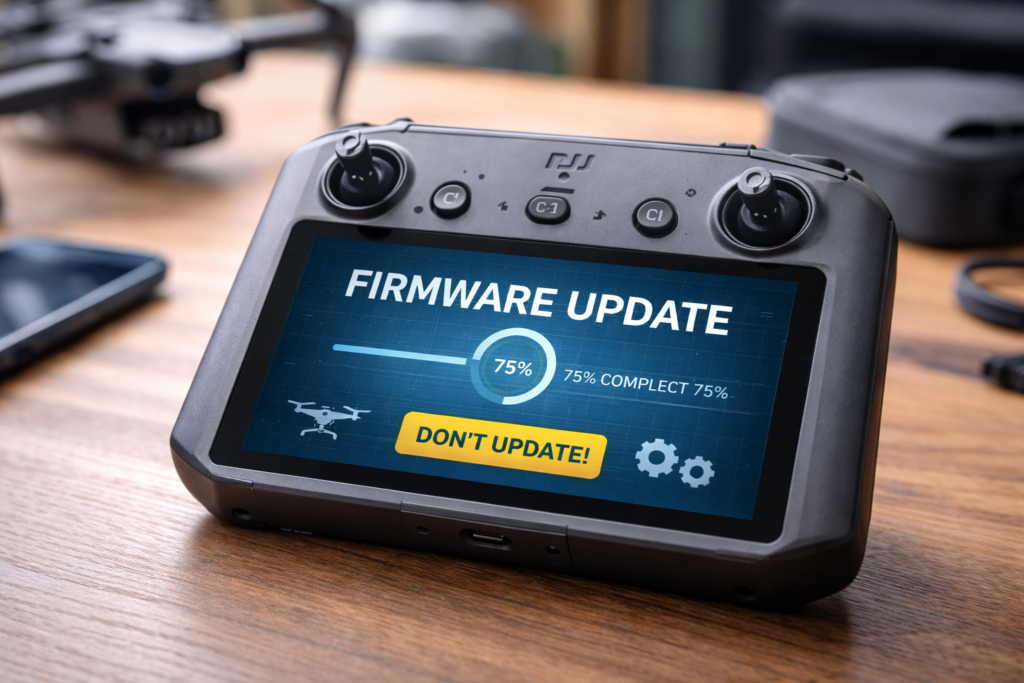
Firmware updates aren’t always upgrades—on aging drones, they can remove features, reduce performance, and quietly kill your drone and the operational life of your aircraft.
For most technology, firmware updates are marketed as progress: improved performance, added features, better security. In the drone world—especially as aircraft age—that assumption can be dangerously wrong.
Over the years, we’ve seen a consistent and troubling pattern: as certain drone models approach end-of-life, firmware updates can actually make them worse. Features disappear. Performance degrades. Battery efficiency drops. And in some cases, aircraft become operationally unreliable or effectively grounded.
This article explains why that happens, when updates become risky, and how experienced drone programs protect their aircraft from unnecessary digital obsolescence and how you can avoid how firmware updates can quietly kill your drone
As drone manufacturers—DJI in particular—sunset older platforms, firmware updates often shift from innovation to containment.
Historically, late-stage firmware updates have been associated with:
Removal or limitation of advanced flight features
Reduced flight efficiency and increased battery consumption
Artificial performance caps
Compatibility issues with older batteries or accessories
Increased reliance on server connectivity and account verification
None of this is usually advertised as such. Updates are framed as “stability improvements” or “compliance changes,” but the real-world result is often a less capable aircraft than the one you originally purchased.
Once a drone is no longer actively supported—meaning:
No new hardware accessories
No meaningful feature development
No future repair pipeline
—firmware updates stop serving the pilot and start serving the manufacturer’s broader ecosystem goals.
At this stage, updating firmware can:
Break workflows that previously worked flawlessly
Introduce new limitations without clear rollback options
Reduce trust in aircraft behavior during critical missions
For enterprise drone programs, predictability matters more than novelty. A stable, known aircraft is far more valuable than one that’s “updated” into uncertainty.
If your drone is:
Working reliably
No longer meaningfully supported by the manufacturer
Performing the missions you need today
More importantly:
Do not allow the aircraft or controller to connect to the internet
Disable automatic updates entirely
If activation or login was required, perform it on a personal hotspot
Then immediately change that hotspot password
Keep the aircraft digitally isolated going forward
This approach has helped countless programs preserve operational drones for years beyond what many assumed was their usable lifespan.
There’s an uncomfortable reality in modern tech: firmware updates are not always neutral.
Across multiple industries—phones, vehicles, smart devices—there are well-documented cases where updates:
Remove features users already paid for
Degrade performance under the guise of “optimization”
Force hardware upgrades through artificial limitations
Even though courts (including the U.S. Supreme Court) have stated that companies cannot legally remove paid-for features after purchase, enforcement in practice often lags reality. In aviation technology, the burden usually falls on the operator to adapt—or lose capability.
DJI firmware updates are expected to continue through approximately 2027, when FCC actions are expected to cut off new authorizations.
Some argue this is purely political. Others see it as a long-standing national security concern. Regardless of where you land, one thing is clear:
Firmware control has always been a powerful lever.
And as timelines tighten, the risk of “updates” that reduce capability—not enhance it—only increases.
The good news?
Drones don’t suddenly stop flying because they’re old. They fail because:
Batteries aren’t managed properly
Motors and props aren’t inspected
Sensors drift without calibration
Firmware changes alter known behavior
A well-maintained drone on stable firmware can remain productive for many years.
In our next article, we’ll break down practical drone maintenance strategies that actually extend aircraft life—without relying on risky updates.
Firmware updates are not inherently good or bad—but timing matters.
When your drone is young, updates can be valuable.
When your drone is aging, updates can quietly shorten its life.
Experienced pilots and mature drone programs know when to stop chasing updates—and start protecting what already works.
If it flies well today, don’t let a firmware update be the reason it doesn’t tomorrow.
 0
0