

Moving Drone No-Fly Zones: New FAA Rules Spark Major Concerns for Pilots
January 27, 2026
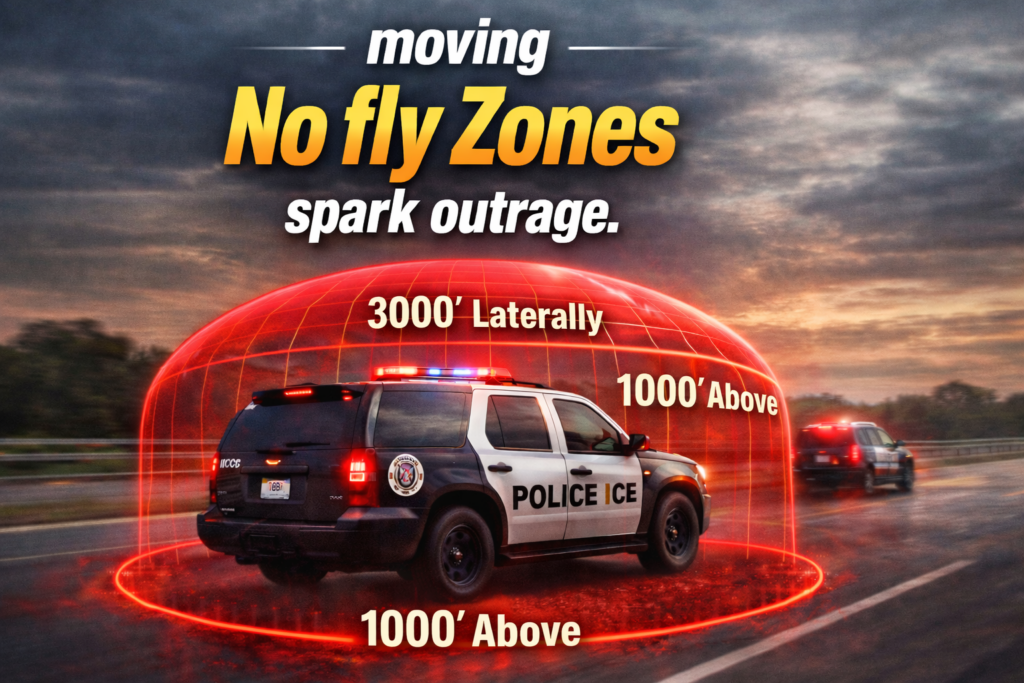
The FAA has introduced “moving drone no-fly zones” around DHS and DoD mobile assets, creating a legal minefield for US drone pilots. Learn how these shifting TFRs impact your flights.
American drone operators are facing a confusing new challenge that could turn a legal flight into a federal offense in seconds. Since mid-January, the Federal Aviation Administration (FAA) has implemented updated Temporary Flight Restrictions (TFRs) that no longer apply only to fixed locations. These moving drone no-fly zones now follow mobile units from the Department of Homeland Security (DHS), the Department of Defense (DoD), and the Department of Energy (DOE), effectively creating “invisible bubbles” of restricted airspace that travel along with convoys and vessels. How will pilots know or see these moving no-fly zones when operating?
The core of the issue stems from NOTAM FDC 6/4375. This notice mandates that all unmanned aircraft are prohibited within a distance of approximately 3,000 feet (914 meters) horizontally and 1,000 feet (305 meters) vertically from specific facilities and mobile assets.
Crucially, “mobile assets” explicitly includes ground vehicles, security convoys, and US Coast Guard vessels. Because these targets are constantly in motion, the restricted airspace around them shifts in real-time. For a pilot on the ground, a moving drone no-fly zone could suddenly overlap with their flight path without any prior warning or visual indicator.
This lack of transparency is what worries the drone community most. Commercial operators, hobbyists, and even “Drone as First Responder” (DFR) programs are at risk of violating federal law. Even if a pilot checks all traditional maps, and most digital apps and NOTAMs before takeoff, a passing DHS vehicle or a Coast Guard ship can instantly render their operation illegal.
The FAA’s NOTAM suggests that pilots should coordinate with the relevant agencies in advance. However, because the routes and real-time locations of these security convoys are classified or non-public, such coordination is practically impossible for the average operator.
The stakes for entering these moving drone no-fly zones are incredibly high. The FAA has warned of:
Administrative Actions: Civil fines and the potential revocation of pilot certificates.
Criminal Prosecution: Possible federal charges under national security laws.
Drone Mitigation: The government maintains the authority to disrupt, seize, damage, or even destroy any drone perceived as a “credible safety or security threat.”
By classifying this restricted airspace as “National Defense Airspace,” the FAA is signaling that enforcement will be strict and immediate.
The good news is that the FAA has acknowledged the practical difficulties these rules create. Following backlash from industry leaders, the authority stated it is internally discussing “mitigations” to make these restrictions more workable. Potential solutions could include better communication channels or digital alerts that don’t rely on pilots guessing the location of undercover convoys.
Until a solution is implemented, the drone industry remains in a state of uncertainty. For now, pilots are advised to exercise extreme caution near any government activity, as moving drone no-fly zones have turned the sky into a moving target for legal compliance.
 0
0