
U.S. Drone Executive Order 2025: Impact on DJI and Domestic Industry
August 24, 2025
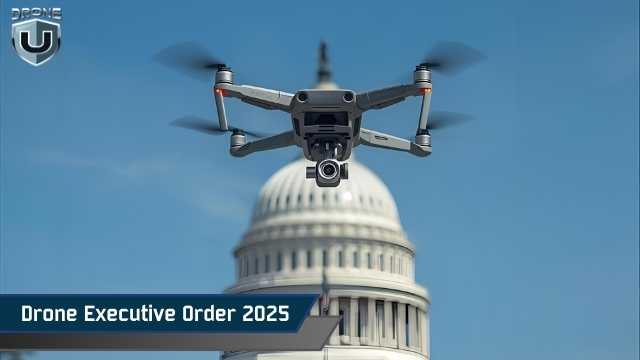
What if the drones you use today weren’t available in the U.S. next year? It sounds dramatic, but it’s exactly what could happen under the new rule.
In June 2025, President Trump signed the “Unleashing American Drone Dominance” Executive Order (EO). This order will support the use of U.S.-made drones and eliminate the use of foreign drone technology.
The EO and the 2025 National Defence Authorization Act require the authorities to complete a national security review of DJI by December 2025. If DJI is deemed a threat to U.S. national security, new models could be blocked from sale in the U.S.
Whether you’re a commercial drone pilot or a hobbyist, you need to be prepared for a future where purchasing DJI drones may become difficult or impossible.
In this article, we’ll break down what the executive order means, what it means for DJI, and how drone pilots and businesses can stay ahead of the changing rules.
Let’s start with the executive order itself.
Trump’s executive order is a blueprint for two major goals: accelerating drone innovation in the U.S. and ensuring that most drones are manufactured domestically, not overseas.
The key elements include:
The FAA must propose rules for Beyond Visual Line of Sight (BVLOS) flights within 30 days and finalize them within 240 days. This offers a huge advantage for commercial pilots and public safety teams.
In simple terms, this executive order allows drone pilots to run more routine, long-range operations without waiting years for regulatory updates.
The order encourages the FAA to use Artificial Intelligence (AI) to speed up Part 107 waiver approvals, which previously took weeks or months.
By identifying common scenarios and automating those approvals, pilots can spend more time flying and less time waiting.
The order launches an Electric Vertical Takeoff and Landing (eVTOL) pilot program for air taxis and rapid cargo delivery. But here’s the catch: only U.S.-developed technology can be used in these projects.
This indicates that the government wants to build the future of aviation domestically rather than import it.
Section 7 of the order conveys the government’s clear intention. It directs federal agencies to source drones from U.S. manufacturers “to the maximum extent permitted by law”.
It also intends to reduce high dependence on foreign supply chains that could lead to national security risks.
According to this executive order, the Department of Defense must expand its “Blue UAS” list of approved, secured drones and update it every month.
The list already excludes DJI. Also, adding new U.S.-made drones to the list will serve to further eliminate Chinese-made models from defense contracts.
The aim is clear: create a homegrown and secure drone network while simultaneously keeping foreign-made models, particularly from China, on the sidelines.
But one section of the order stands out for its high impact on the drone industry. We’ll explore that in the next section.
Section 7 of the executive order highlights one of the most immediate changes for the U.S. drone market. It directs all federal agencies to prioritize U.S.-manufactured drones and instructs the Federal Acquisition Security Council (FASC) to publish its Covered Foreign Entity List within 30 days.
Both DJI and Autel are strong candidates for inclusion as they are also included in the Commerce Entity List and the DoD’s 1260H List.
Once listed, agencies must immediately stop buying from these companies. On top of that, by December 22, 2025, they must end operations of their drones under the FY24 NDAA’s American Security Drone Act.
This creates a high-stakes “flashpoint” where policy, commerce, and technology collide.
Federal agencies worry that some foreign drones, especially those manufactured by Chinese brands, could transmit sensitive data to servers outside U.S. Government authorities repeatedly flag DJI, the world’s largest drone manufacturer, for national security risks. This has led to an increase in government monitoring of certain manufacturers.
These security risks reach far beyond government contracts. Regulators increasingly limit the use of foreign drones in critical areas like infrastructure, energy, and public safety missions. Companies that keep using listed drones risk stricter regulations, higher insurance costs, or project disqualification.
Cutting out foreign UAVs gives US manufacturers room to innovate while keeping security standards high.
This also encourages investment in local production, American-made drones. Today, domestic drones are used for mapping, logistics, search and rescue, and defense missions.
The “foreign drone flashpoint” doesn’t just ban products from the market. Policymakers want to protect national security, safeguard sensitive data, and build a domestic industry that can compete globally. With Section 7 in place, the next question is how these policies will lead to actual legal action against specific foreign drones.
We’ll examine that in the upcoming section.
The EO doesn’t ban DJI outright. It sets the legal and policy framework for such a ban to happen. The legal path unfolds in several steps.
Congress already prohibited federal agencies from buying or operating DJI drones through the FY24 NDAA. Several states, including Florida and Arkansas, have passed similar laws that ban or restrict Chinese-made drones for government agencies.
The FY25 NDAA gives federal agencies until December 2025 to determine if DJI drones are a security risk. If a security risk is found or the review isn’t completed, the FCC can add DJI to the Covered List.
The FCC Covered List prevents DJI from getting approvals for new drones in the US. Once that happens, no new DJI drone models can get FCC equipment authorizations, effectively blocking future sales in the US.
Existing models can still fly, but with fewer firmware updates and limited support over time. This could create operational issues for current DJI drone owners.
DJI has publicly welcomed a security audit and says its drones are safe, affordable, and don’t pose a national security risk. They argue that removing DJI from the US market would harm industries from public safety to agriculture, with limited domestic alternatives.
While there’s no doubt the removal of Chinese-made drones, DJI in particular, would harm many industries in the US, national security is a concern and must be addressed.
As of the writing of this article, the review mandated by the NDAA for 2025 is underway as a Section 232 national security investigation.
The new executive order and NDAA deadline are changing the U.S. drone market. It affects how drones are bought, used, and supported in the U.S.
From federal procurement to consumer purchases, the impact touches every level of the drone industry. Here’s how:
Federal agencies are accelerating the adoption of U.S.-made drones from companies such as Skydio, Teal Drones, and Quantum Systems. New government rules and the ongoing DJI review are forcing agencies to move away from Chinese drones, creating new opportunities for domestic manufacturers.
Many states follow the same buying rules as the federal government. As states adopt bans, police departments, utilities, and universities will have to replace Chinese-made drones.
If the FCC includes DJI on the Covered List, future models may not be available or sold in the U.S. This will make it more difficult to obtain insurance, loans, or favorable resale prices for your drones. So, as buyers, you may have to think twice before investing in DJI drones.
U.S. drone manufacturers are winning sales, but they still can’t match DJI’s price and performance. Also, scaling U.S. manufacturing to compete with DJI’s 85% U.S. market share will take time.
For now, industries that need affordable high-capability drones, like farming, construction, and real estate, may have to pay more or work with drones that have limited features.
The rules for drone use in the U.S. are rapidly changing. This shift in the drone policy creates both challenges and opportunities for drone pilots. To keep your operations running smoothly and avoid costly surprises later, you need to plan.
Here’s how you can prepare:
The goal here is to protect your current operations from sudden disruptions.
The main objective of understanding the executive order is to prepare your fleet and business for the changes following the drone security investigation.
To build long-term resilience:
Don’t get caught off guard by rule changes. This is about being able to prove you’re operating by the book if anyone asks.
Your clients care about results, not which drone you’re flying. But they will care if your work gets disrupted.
Switching to a new gear always takes longer than you think. The last thing you want is to be learning a new controller on a job site.
Money is where most operators get blindsided. Budgeting ahead means you won’t be scrambling if bans or restrictions hit.
The June 2025 executive order marks a major shift in U.S. drone policy. The focus is on building a self-reliant drone industry, reducing security risks, and creating space for domestic manufacturers to grow.
The December 2025 NDAA deadline can be a defining moment. If DJI drones face restrictions, the market will further move toward American drone platforms.
This shift brings the policy, technology, and market forces together in a way rarely seen. Adopting compliant platforms, building strong teams, and securing supply chains will define the next phase of the U.S. drone industry.
Stay ahead of these changes.
Join Drone U today and prepare your business for the future.
 1
1