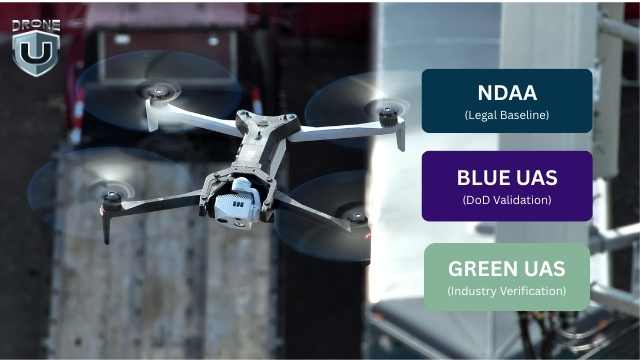
NDAA-compliant drones are aircraft that do not violate federal procurement restrictions under the National Defense Authorization Act and the American Security Drone Act (ASDA). Compliance depends on three factors: who manufactures it, where its critical components come from, and how its software routes data. Where a drone is assembled does not determine compliance, ownership structure, supply chain sourcing, and data pathways do.
Buying a drone in 2026 isn’t just about flight time, camera specs, or range. It’s about compliance.
If a drone is not NDAA-compliant, you could lose access to federal funding, contracts, or approvals. Even a powerful drone can become unusable if it fails a compliance review.
At its core, NDAA compliance answers one clear question:
Can you legally buy and use this drone without creating a supply chain or security risk?
The answer depends on more than where the drone is built or assembled.
In this guide, we’ll explore what makes a drone NDAA-compliant in 2026, how the rules actually work, and how to verify compliance before you buy.
Let’s start with the laws that define compliance.
The Legal Framework for NDAA Compliant Drones
Legal Framework for NDAA Compliant Drones
NDAA compliance comes from federal law, not from agency policy or manufacturer claims. If you buy drones for government, public safety, or federally funded work, these laws govern.
1. The National Defense Authorization Act (NDAA)
The NDAA is an annual federal law governing defense spending and national security. Some of its sections directly affect which drones federal agencies can buy and use.
The most important provision for drones is Section 848 of the FY2020 NDAA. This section initially restricted the Department of War from buying or operating drones manufactured by certain foreign entities deemed national security risks. While Section 848 originally applied to DoW, subsequent legislation and policies expanded similar restrictions across federal agencies.
The law focuses on procurement and use, not how you fly. The FAA still regulates airspace, pilot certification, and operational rules.
If a drone is tied to a covered foreign entity, federal agencies cannot buy it, operate it, or fund its use. This restriction also applies to contractors and grant recipients.
NDAA compliance does not work like a certification. There’s no official “NDAA-approved” label. Instead, compliance depends on whether the drone’s manufacturer, components, and software avoid restricted sources.
Subsequent legislation, including Section 1825 of the FY2024 NDAA (ASDA), expanded these restrictions beyond DoW to all federal agencies and federally funded programs. A drone that passed review years ago might not pass today.
2. The American Security Drone Act (ASDA)
The American Security Drone Act, often called ASDA, builds on the NDAA framework. While NDAA set the foundation, ASDA widened the scope.
ASDA applies NDAA-style drone restrictions across all federal agencies, not just defense-related ones. It also limits how federal funds can be used to buy and operate drones. ASDA’s procurement prohibitions took full effect on December 22, 2025, making compliance mandatory for any federal funding use cases.
This means even if you’re not a defense agency, your funding source can trigger compliance requirements.
ASDA makes one thing clear. NDAA compliance is no longer optional or limited to defense use cases. It is now a baseline expectation for government-related drone procurement.
Critical point for 2026: ASDA full enforcement began December 22, 2025. Any federally funded drone program that has not reviewed its fleet against the updated restrictions is now operating with compliance exposure. This is not a forward-looking risk; it is a current one.
Now, let’s understand how NDAA compliance differs from Blue UAS and Green UAS.
NDAA-Compliant Drones vs Blue UAS and Green UAS
NDAA-Compliant Drones vs Blue UAS and Green UAS
These three terms are frequently confused. Each serves a different function. Understanding the difference determines which one you actually need for your procurement context.
DIMENSION
NDAA COMPLIANCE
BLUE UAS
GREEN UAS
What it is
A federal legal requirement
A DoD security validation program
An industry-led verification program
Who defines it
US Congress (NDAA / ASDA)
Defense Contract Management Agency (DCMA)
AUVSI (Association for Unmanned Vehicle Systems)
Required by Law?
Yes — for federal/funded programs
No — voluntary validation
No — voluntary validation
Who it applies to
All federal agencies + federally funded programs (post ASDA Dec 2025)
Cybersecurity, sourcing practices, and data handling
Does it prove NDAA compliance?
Yes — it is the legal standard
Partial — adds assurance, not the legal test
Partial — adds assurance, not the legal test
Can a drone be NDAA-compliant without it?
N/A as NDAA is the law itself
Yes. Many compliant drones aren’t on the list
Yes — verification is optional
Best used for
Any government or funded procurement decision
DoD contracts, defense-adjacent work
Public safety, state/local agencies, enterprise
Updated how often
As legislation changes (annually via NDAA cycle)
Cleared List updated by DCMA as drones are reviewed
Verified manufacturers updated by AUVSI
The key relationship: NDAA compliance is the legal baseline. Blue UAS and Green UAS add assurance. A drone can be NDAA-compliant and not appear on either list. For DoD procurement, Blue UAS is effectively required. For public safety and enterprise, Green UAS is a more practical assurance standard.
Which Compliance Standard Do You Need by Use Case?
NDAA requirements vary based on who is buying, who is funding the purchase, and what the drone will be used for. This table maps compliance requirements to the most common buyer types.
BUYER/USE CASE
NDAA REQUIRED?
BLUE UAS NEEDED?
GREEN UAS RECOMMENDED?
KEY CONSIDERATION
Federal agency (direct purchase)
Yes
If DoD
Optional
ASDA fully enforced Dec 2025 — all agencies covered
State/local government-federal grant funded
Yes
No
Recommended
Funding source triggers NDAA regardless of agency level.
State/local government – own funds
Check funding
No
Recommended
May still apply if any federal funds are involved; best practice to comply
Public safety (police, fire, EMS)
Check funding
No
Recommeneded
Many departments receive DHS or DOJ grants that trigger NDAA
Federal contractor / prime contractor
Yes
Contract-specific
Optional
NDAA flows down through contract terms — verify before procurement
Enterprise/commercial (no federal funds)
Not required
No
Optional
No legal requirement — but increasingly a client expectation
Critical infrastructure operators
Check funding
No
Recommeneded
Energy, utilities, and telecoms face growing federal security expectations
Academic / research institutions
Check grants
No
Optional
Federal research grants trigger NDAA for funded portions of the program
To determine whether a drone is truly compliant, you need to know what the government actually looks for during a compliance review. Let’s examine that in the next section.
What Makes a Drone NDAA Compliant?
A drone isn’t NDAA-compliant because it says so on a brochure. You determine compliance by evaluating the entire system, such as the company behind it, the components inside it, and how the software handles data.
A drone achieves NDAA compliance only when it avoids restricted ownership, restricted components, and restricted data pathways. Failure in any single area disqualifies the entire system.
1. Manufacturer Ownership and Control
Start with the manufacturer.
NDAA rules prohibit drones made by covered foreign entities. These are companies owned, controlled, or substantially influenced by foreign governments that U.S. law designates as national security concerns.
If the manufacturer falls into this category, the drone is not compliant. Where the drone is assembled or sold does not change this.
Branding, resellers, and distribution partners do not affect compliance. The company that designs and controls the product determines compliance status. A drone assembled in the United States by a US subsidiary of a covered foreign parent company is not NDAA-compliant.
2. Component and Supply Chain Restrictions
Next, look at the components.
NDAA compliance depends on the source of critical components. These include flight controllers, radios, communication modules, cameras, gimbals, and navigation systems.
If even one critical component comes from a restricted source, the entire drone system may become non-compliant. Partial compliance is not enough.
This is why “assembled in the USA” does not guarantee compliance. Final assembly hides supply chain risk. True compliance depends on where key electronics are designed, manufactured, and sourced, not where the final product is assembled..
Manufacturers that meet NDAA requirements can explain their supply chain clearly. If a vendor cannot answer these questions, that is a red flag.
3. Software, Firmware, and Data Flow
Hardware alone does not determine compliance. Software plays a major role.
You need to understand how the drone’s software is built, updated, and connected. Cloud services, remote servers, and update pipelines all matter.
If firmware updates or data storage rely on infrastructure controlled by restricted entities, the drone may fail compliance, even if the hardware looks acceptable.
In 2026, compliance reviews focus heavily on data flow. You need to know where flight data, images, and telemetry go, and who can access them. Secure and transparent software supply chains are now a core requirement for NDAA compliance.
Are You Operating the Way Serious Clients Expect?
Many pilots focus solely on the gear rather than mastering the operations. To get hired, you should know
Experienced pilots approach safety and planning
What enterprise-ready operations look like in the field
How professional systems support consistent, reliable missions
Thank you!
Thank you. You will now be redirected to your requested resources.
Now, let’s look at where buyers often make compliance mistakes.
Payloads, Accessories, and System-Level Compliance
NDAA compliance does not stop at the airframe. It applies to the entire drone system — including payloads, sensors, radios, and accessories.
A drone can meet the requirements on its own. But once you attach a restricted payload, the entire system can fail compliance. This is a common issue during audits.
Why Payloads Matter
Payloads often contain the same electronics that trigger NDAA restrictions. Cameras, sensors, communication modules, and data transmitters can all introduce risk if they come from covered foreign entities.
If a payload collects flight data, imagery, or communications, it becomes part of the regulated system. Its ownership, component sourcing, and software behavior matter just as much as the drone itself.
Third-Party Add-Ons Can Break Compliance
Many operators add third-party payloads after purchase. This is where compliance risks increase.
Even if the base drone meets NDAA requirements, a non-compliant camera, radio, or sensor can invalidate the entire setup. You cannot assume an accessory is compliant just because it is widely used or commercially available.
You should verify each add-on the same way you verify the drone. Check ownership structure, component sourcing, and data flow.
Managing Payload Compliance
Treat payloads as part of your procurement process, not an afterthought.
Ask manufacturers for compliance statements for every payload. Confirm how data moves from the payload to storage or ground control. If it connects to cloud systems or receives remote updates, evaluate that carefully.
Audits now focus on system-level integrity. If one component fails, the entire system fails.
Next, let’s understand how you can verify if a drone is NDAA-compliant or not.
How to Verify NDAA-Compliant Drones
Legal compliance is only meaningful if you can document it. Marketing language is not documentation. Here is the verification process that holds up during an audit.
1. Request a Written Compliance Statement from the Manufacturer
Do not rely on a brochure that says “NDAA compliant.”
Ask for a formal written compliance statement that addresses manufacturer ownership, critical component sourcing, and software/data infrastructure. A credible manufacturer can produce this. If they cannot provide specific sourcing documentation or avoid naming component suppliers, treat that as a compliance risk.
2. Review Ownership and Corporate Structure
Compliance depends on who controls the company.
Confirm the ultimate parent company and governance structure, not just the brand name or US subsidiary. Ask specifically whether any parent company is headquartered in or substantially controlled by a covered foreign entity.
3. Verify Critical Component Sources
Ask for documentation on where the flight controller, radios, navigation system, and camera originate. You do not need every serial number, but you need clarity on which countries and which manufacturers produced the key electronics.
If the manufacturer cannot explain this clearly, you cannot verify compliance.
4. Evaluate Software and Data Routing
Ask where flight data, images, and telemetry are stored and who has access. Confirm whether firmware updates are delivered through infrastructure controlled by restricted entities. Review the software architecture documentation, not just the privacy policy.
5. Check Blue UAS and Green UAS as Supporting Evidence
Validation programs can strengthen your review.
If the drone appears on the Blue UAS Cleared List (maintained by DCMA) or holds Green UAS verification, that adds confidence. But absence from those lists does not automatically mean non-compliance. Use them as supporting evidence, not as the compliance determination itself.
6. Document Everything and Repeat at Renewal
Save all compliance statements, supplier disclosures, and your internal verification notes.
Compliance is not permanent. Manufacturers can change suppliers, update firmware, or restructure ownership. Build a periodic review into your procurement cycle, not just the initial purchase decision.
Next, let’s address the most common NDAA compliance myths.
Common Myths About NDAA Compliant Drones
Many procurement problems start with assumptions. If you rely on common myths instead of legal criteria, you can approve the wrong system.
Myth 1: NDAA-compliant means American-made
Final assembly in the United States does not guarantee compliance. NDAA restrictions focus on ownership and critical component sourcing.
Fact: A drone assembled in the US using restricted electronics or controlled by a covered foreign parent is not NDAA-compliant. Supply chain integrity and corporate control are what matter, not a “Made in USA” label. See our American-made drones, guide for what assembly location does and doesn’t tell you.
Myth 2: If It’s Not on the Blue UAS List, It’s Not Compliant
Blue UAS is a Department of Defense(DoD) validation program, not the legal definition of NDAA compliance. Many manufacturers that fully meet NDAA requirements don’t pursue Blue UAS listing because they serve state, local, or enterprise markets rather than defense contracts.
Fact: NDAA compliance is determined by the law, ownership structure, component sourcing, and software infrastructure. A drone can be legally NDAA-compliant without appearing on the Blue UAS Cleared List.
Myth 3: Once Compliant, Always Compliant
Compliance is not permanent.
Manufacturers change suppliers. Firmware updates introduce new infrastructure. Ownership restructuring changes corporate control. Any of these can affect compliance status without any public announcement.
Fact: Treat NDAA compliance as a periodic review requirement, not a one-time purchase check. A drone that was compliant at purchase may not be compliant 18 months later if the manufacturer has made material changes to its supply chain or software.
Myth 4: NDAA Only Applies to Defense Agencies
This was true before ASDA. As of December 22, 2025, ASDA extended NDAA-style restrictions to all federal agencies. It now also applies to programs that use federal funds, including public safety agencies, state and local governments, and federal contractors.
Fact: If any federal money is in your procurement chain, NDAA compliance applies, regardless of whether your organization is a defense agency. Check your funding source, not just your agency type.
Next, let’s look at how NDAA compliance is evolving.
The Future of NDAA Compliance (2026 and Beyond)
NDAA compliance is no longer a one-time purchase check. It is becoming a lifecycle requirement.
In 2026, buyers expect ongoing visibility into key risk areas, including:
where critical components are sourced
how software and firmware updates are managed
whether supply chain documentation remains current
Audits increasingly focus on transparency over time, not just what was true at the moment of purchase.
Manufacturers are responding by building compliance controls into product architecture from the start. Instead of relying on final assembly claims or post-sale statements, they are building clearer supply chain controls and documentation processes into the product itself.
For buyers, this changes procurement strategy. Agencies and enterprises are moving toward platforms that:
lower the risk of future disqualification
reduce the likelihood of forced fleet replacement
align with tightening security and funding expectations
Compliance is moving upstream from paperwork to product architecture.
Key Takeaways
NDAA compliance determines whether you can legally purchase, fund, and operate certain drone systems. In 2026, it directly influences contract eligibility and long-term fleet viability. When you evaluate compliance early, you avoid costly replacements and procurement setbacks later.
Compliance is not about labels. It is about ownership, sourcing, and system control. If you cannot clearly explain how a drone and its components meet federal standards, you assume risk, especially during audits or grant reviews.
If you want hands-on guidance on selecting NDAA-compliant drones, join Drone U. Drone U provides structured training for public safety, enterprise, and government teams.
You learn how to review manufacturers, verify system-level compliance, and document due diligence properly. Instead of guessing, you can build a fleet strategy that holds up during audits, grant reviews, and procurement scrutiny.
Enterprise-Ready Operations Go Beyond Equipment
When the work carries more responsibility, how you operate matters just as much as what you fly.
Learn how experienced pilots make decisions on site
Learn how clear systems reduce risk and uncertainty
Learn what builds trust with serious clients
Thank you!
Thank you. You will now be redirected to your requested resources.
0
FAQs
1. Do you need NDAA-compliant drones for all commercial operations?
No. The NDAA does not apply to every commercial drone flight. You need NDAA-compliant drones when federal agencies, federal funds, or certain grants are involved.
That said, many companies still choose NDAA-compliant drones to reduce long-term risk. It helps you avoid forced replacements if regulations tighten later.
2. Is Blue UAS approval required for NDAA-compliant drones?
No. Blue UAS is a Department of Defense program. It is not the law. A drone can meet the legal requirements for NDAA-compliant drones without appearing on the Blue UAS Cleared List. Blue UAS adds a security review for defense use, but it does not define compliance.
3. Can NDAA-compliant drones lose compliance over time?
Yes. Compliance is not permanent.
If a manufacturer changes suppliers, updates firmware, modifies hardware, or shifts ownership, the drone’s compliance status can change. You should review firmware updates, payload changes, and sourcing disclosures over the life of the drone, not just at purchase.
4. How do you verify NDAA-compliant drones?
Start with the manufacturer. Ask for sourcing disclosures and documentation for critical components. Review ownership structure and supply chain details. You can also check trusted programs like Blue UAS or Green UAS for additional assurance. Remember that these lists provide validation, not the law itself.
5. Does ASDA affect state and local government drone purchases?
Yes, if federal funds are involved. ASDA, fully enforced as of December 22, 2025, applies to any program receiving federal funding. A city police department purchasing drones with a DHS grant, or a county using federal infrastructure funds, is subject to the same restrictions as a federal agency. The funding source, not the agency type, determines applicability.
6. Does adding a third-party payload affect NDAA compliance?
Yes. Payloads are evaluated as part of the complete system. A compliant base drone fitted with a non-compliant camera, radio, or sensor becomes a non-compliant system. Verify every payload using the same ownership, component sourcing, and software criteria you apply to the drone itself. Do not assume commercial availability implies compliance.
Author
Paul Aitken
Co-Founder and CEO
Paul Aitken is a Certified Part 107 drone pilot and a Certified Pix4D Trainer. He is a pioneer in drone training and co-founder of Drone U. He created the industry’s first Part 107 Study Guide and co-authored Livin’ the Drone Life.
Paul is passionate about helping students fly drones safely and effectively. With over a decade of experience, he has led complex UAS projects for federal agencies and Fortune 500 clients such as Netflix, NBC, the NTSB, and the New York Power Authority.
Related Articles
The Top 36 Drone Companies in 2025
How to Choose the Best Drone for Cinematic Filmmaking