
Best Thermal Drones for Construction: Guide & Expert Picks (2026)
December 25, 2025
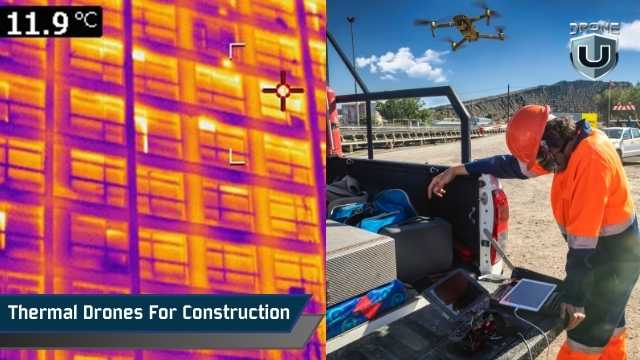
Thermal drones for construction help you go beyond visual inspections. They are used to check electrical systems, insulation, moisture, and equipment heat across active job sites.
If you fly drones professionally, thermal imaging provides a safer, faster way to inspect buildings, monitor progress, and support site decisions. You collect temperature data that project managers, engineers, and inspectors can rely on.
This guide explains how thermal drones fit into real construction workflows. You’ll learn which use cases matter most and which thermal drones make sense in 2026, based on real performance.
Now, let’s look at where thermal drones add the most value on construction sites.
Thermal drones earn their place on construction projects because they help you inspect faster and work more safely. Instead of climbing scaffolding, shutting down systems, or guessing where issues might be, you fly once and collect clear data.
You rely on thermal imaging to support safety checks, inspections, and documentation across active job sites. The value lies in observing temperature differences that point to real conditions on the ground.
You use thermal drones to check site safety. Overheated electrical panels, stressed machinery, and friction points are clearly visible in thermal imagery. By conducting regular safety checks, you can identify abnormal heat patterns early and alert site managers before equipment fails or sparks a fire.
This matters even more on large or fast-moving job sites where visual inspections often miss early warning signs.
You use thermal drones to inspect walls, roofs, and facades. Instead of tearing into finished surfaces, you can pinpoint problem areas precisely. Insulation gaps and moisture appear as clear temperature patterns.
You pair thermal and visual images so engineers and inspectors can review the data and act quickly.
You use thermal drones to check energy performance. You don’t rely on estimates. Leaking ductwork, uneven heating, and thermal bridging stand out right away. This makes thermal drones especially valuable during commissioning and retrofit projects.
You provide clients with proof that systems work as designed. You show performance in the field, not just on plans.
You use thermal data to add context to progress reports. Thermal maps can show curing concrete, heat loss in temporary enclosures, and active systems during phased construction.
When you combine thermal data with 3D models or orthomosaics, project managers get a clearer picture of what’s working and what needs immediate attention.
You deploy thermal drones when speed matters most. After a fire or equipment failure, you scan the site from a safe distance. Lingering heat and unsafe areas are clearly visible.
This enables teams to make informed, rapid decisions and operate safely, even in unstable conditions.
Before you choose a drone, you need to know which features actually matter on a construction site.
Not all thermal drones are built equal, especially for construction projects. Specs that look good on paper often fail in real-world site conditions. For active job sites, you need a drone that delivers reliable thermal readings, clear imagery, and workflows.
The foundation of that reliability begins with the drone’s thermal sensor, which determines the accuracy and actionable value of your field data.
You want a radiometric thermal sensor, not just a thermal camera. Unlike conventional thermal cameras, it measures the exact temperature for every pixel. This allows you to detect insulation gaps, water leaks, or overheating electrical components and report them accurately.
Aim for a thermal resolution of at least 640×512. Higher resolution is better for large sites or when you need to see small details from a distance. Also, ensure the thermal data works easily with your reporting software.
Construction sites demand stable, predictable flight. Look for drones that fly steadily in wind and have sufficient battery life to inspect multiple buildings without frequent battery swaps.
If you need to carry additional sensors, such as a video camera, check the payload capacity. Always match the drone’s flight abilities to your typical site size and inspection needs.
Thermal images are only useful if you can turn them into insights. Choose drones with built-in analytics, easy temperature measurements, and exportable reports.
If your clients use BIM or construction management software, ensure your drone data works with it. This avoids manual work and errors.
Construction sites are tough. Dust, vibration, wind, and light rain are normal. Select a drone that is rugged and weather-resistant so it continues to perform in real-world conditions. This saves time and protects your investment.
Next, let’s look at which thermal drones actually perform well on construction sites.
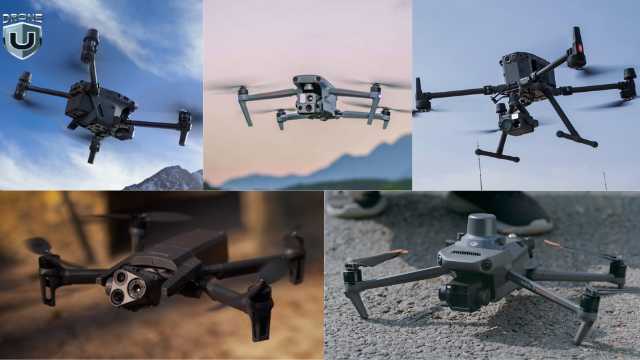
Top 5 Thermal Drones for Construction
Choosing the right thermal drone depends on your project size, how often you fly, and the level of data your clients expect. Some drones are designed for large infrastructure sites, while others are better for daily inspections and quick turnarounds. Here’s a look at the top options for construction workflows in 2026.
The DJI Matrice 350 RTK is built for large construction projects and long flights. It carries high-resolution thermal and visual sensors. The RTK system gives accurate mapping and GIS-ready data. This setup is strong for infrastructure, big commercial sites, and multi-building inspection work.
Pros:
Cons:
Best for: Large construction sites, detailed mapping, and GIS-ready data.
The Autel EVO Max 4T XE fits right into mid-to-large construction projects where flexibility matters. It has both thermal and visual camera system that captures detailed inspection data without requiring payload swaps. Its obstacle avoidance and AI-assisted features help when you’re flying near structures, façades, or active equipment.
Pros:
Cons:
Best for: Mid- to large construction sites that require flexibility and rapid deployment.
The DJI Matrice 30T is a compact enterprise drone. It combines thermal, visual, and zoom cameras into a single unit. It flies well in wind, light rain, and cold weather. This makes it reliable for daily checks, site progress updates, and safety monitoring.
For daily construction inspections, safety monitoring, and progress documentation, the M30T offers a practical balance between capability and efficiency. It’s especially useful when you need consistent results without the overhead of a larger modular system.
Pros:
Cons:
Best for: Daily inspection workflows, safety checks, and progress reporting.
The DJI Mavic 3T is compact, lightweight, and quick to deploy. It gives radiometric thermal data applicable to roofs, small commercial sites, and specific safety checks. It is great if you need to inspect many sites in one day or take quick readings on short notice.
While it’s not designed for massive mapping projects, it excels at fast, focused thermal inspections where efficiency matters more than scale.
Pros:
Cons:
Best for: Quick inspections, roof work, and short-notice site checks.
The Parrot Anafi USA is a lightweight, travel-friendly drone. It is quiet and fits into tight spaces. Its thermal resolution is lower than that of other options, but it is still useful for basic checks. It makes a good second drone or a backup system.
Pros:
Cons:
Best for: Lightweight travel use, tight spaces, or backup inspections.
When you’re deciding between thermal drones for construction, specs matter, but context matters more. Here’s a quick way to compare flight time, thermal resolution, and ideal use cases to narrow your options before diving deeper into each platform.
| Model | Thermal Resolution | Flight Time | Best Use Cases |
| DJI Matrice 350 RTK | Up to 1280×1024 | ~55 minutes | Large construction sites, infrastructure inspections, RTK mapping |
| Autel EVO Max 4T XE | 640×512 | ~42 minutes | Building envelope inspections, HVAC analysis, and electrical surveys |
| DJI Matrice 30T | 640×512 | ~41 minutes | Daily site inspections, safety monitoring, progress tracking |
| DJI Mavic 3T | 640×512 | ~45 minutes | Roof inspections, small commercial projects, and quick surveys |
| Parrot Anafi USA | 320×256 | ~30 minutes | Rapid site checks, tight spaces, lightweight deployment |
Thermal drones for construction are now an essential tool in modern job sites. When you use them correctly, you catch safety risks early, verify building performance, and deliver inspection data your team and clients can trust. You do all this without slowing down your site or putting anyone in danger.
The best thermal drone for construction in 2026 isn’t the one with the highest specs. It’s the one that fits your project size, inspection schedule, and reporting needs. Whether you inspect large infrastructure sites or perform quick roof checks, the right drone delivers clearer insights and greater confidence on every flight.
Choosing the right drone is only part of the equation. You also need the right skills.
Join DroneU’s thermography and construction inspection courses to understand thermal data, avoid costly interpretation mistakes, and build workflows clients actually pay for.
When you pair the right thermal drone for construction with proper training, thermal imaging becomes a real business advantage, not just another tool.
 1
1