
FPV vs Thermal Drones: Which One Should You Choose?

August 4, 2026
Quick Answer:Thermal drones earn 3–10x more than FPV drones ($1,500–$4,000/day vs. $500–$1,200/day) but require $10,000–$25,000 in upfront capital and 12–18 months to reach ROI. FPV drones cost $2,000–$5,000 to start, suit creative/content-driven work, and reach ROI faster (6–12 months) but have a lower revenue ceiling. Choose thermal for recurring B2B inspection contracts; choose FPV for lower barrier to entry and creative flexibility. Full breakdown below. |
If you are contemplating choosing between FPV drones vs Thermal Drones, you’ve come to the right place. In this guide, we take a deep dive into both these drone categories and help you choose the right one based on a well-researched and logical approach.
First, let’s talk about why these two categories of drones exist and the purpose of each.
Let’s begin our analysis with FPV drones.
FPV technology has taken off in a significant way worldwide. FPV (First Person View) enables drone pilots to navigate their drones in real-time via goggles. This allows the pilot to enjoy an immersive flying experience and greater control over the drone.
FPV drones are being increasingly used for immersive aerial cinematography, drone racing, shooting marketing videos, freestyle acrobatic performances, and filming action sports.
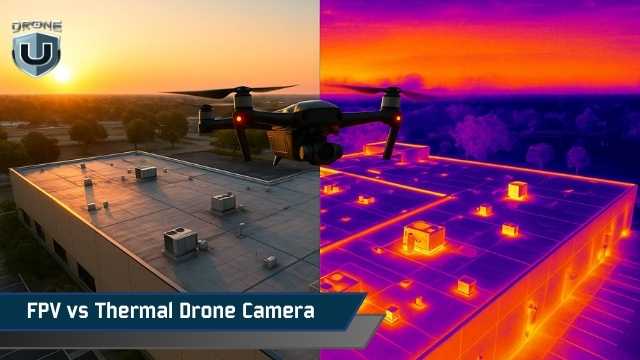
On the other hand, thermal drones are built for industrial applications. They are equipped with thermal imaging cameras that create heat-based images, revealing aerial data invisible to the naked eye.
Thermal drones are now a standard part of the tooling used in a variety of industries and applications, such as:
Also, read our detailed guide on the Top 10 Thermal Drone Applications to see how they’re used in real-world scenarios.
Now that we’re clear about what each of these drone types is capable of doing, let us explore the commercial aspects.
| FPV Drones | Thermal Drones | |
| Startup cost | $2,000–$5,000 | $10,000–$25,000 |
| Entry-level hardware | $199–$418 (e.g., DJI Neo) | $3,359+ (e.g., Autel EVO Lite 640T) |
| Professional-tier hardware | $1,000–$2,000 | $15,000–$30,000+ |
| Typical daily rate | $500–$1,200 | $1,500–$4,000 |
| Monthly revenue (small operator) | ~$5,000/month | ~$25,000/month (mid-range) |
| Client type | Primarily B2C | Primarily B2B |
| Competition level | High (low barrier to entry) | Lower (higher barrier to entry) |
| ROI timeline | 6-12 months | 12-18 months |
| Best-fit buyer | Creative/content-focused, existing filmmaking skills | Capital-ready, wants recurring B2B contracts |
| Best-fit U.S. regions | LA, NYC, Nashville, Atlanta | Texas, California, Midwest, Northeast |
As you can see, FPV drones are great for creative production and filmmaking. The FPV drone market is valued at $139-558 million in 2024-2025, and is expected to grow at a 13.7-19.06% CAGR. That’s a fraction of the market size of Thermal Drones.
While the opportunities in commercial video products using drones are vast, the barrier to entry is relatively low. We’ll address that later, but first, let’s examine the opportunities and income potential.
The most interesting (rewarding) career using FPV drones is film and content creation. There is almost always someone in need of a shot worthy of the algorithm’s attention.
FPV drones have already revolutionized cinematography and are actively used in movie production, action sports, and music videos. One can expect to earn anywhere from $500 to over $6,000 per day. Not bad if you really enjoy the creative aspect.
Real Estate is another industry where FPV drone pilots can expect to earn anywhere from $75 to $400 per listing. If you venture into Commercial Real Estate, you’ll go higher up the value chain and can make up to or even more than $1,200-$1,500 per project. Then you can go even higher up with Luxury Real Estate, which can be a gratifying and fulfilling career as a drone pilot.
Drones are now an integrated part of events and the entertainment industry. Whether it’s a wedding or a sports event, filming through drones is becoming increasingly common. Drone light shows have gained so much popularity globally. For drone light shows, you can command $15,000-$150,000+ per event, depending on the size of the fleet.
However, the FPV drone market comes with its own limitations. Firstly, it is primarily a B2C market with an extremely low entry barrier. As a result, the demand-supply gap favors the customer, resulting in increased competition and subsequently lower profit margins.
That being said, you can still carve out your unique positioning and command premium rates if you properly market yourself and target high-value areas such as commercial/luxury real estate.
Now, let’s examine the commercial aspects and marketing opportunities for Thermal Drones.
The opportunities in Thermal drone-related applications are exploding. The thermal drone inspection market is valued at $362.7 million in 2025. It is projected to reach $1.2 billion by 2035, growing at a 13.4% CAGR.
The first and foremost in the list is our favorite – energy and utilities.
The energy and utilities sector is the highest revenue-generating industry in terms of drone services. It holds the largest market share of the global market at around 35%. Drone pilots performing utility and infrastructure inspections charge between $1,500 and $4,000 per day. The opportunities are wide open in areas such as solar inspections, powerline monitoring, and substation assessments.
The infrastructure sector is the second-largest consumer of drone inspection services, and it is expected to reach $34.4 billion by 2031, growing at a 16.8% CAGR. America’s aging infrastructure presents significant opportunities in bridge inspections, tower assessment, and pipeline inspection. Moreover, the FAA increased approvals for BVLOS operations from 1,229 in 2020 to 26,870 in 2023. This has fueled a demand for drone pilots in this industry.
Drones are already an integral part of the construction industry. Construction progression videos are one of the most lucrative opportunities in this market, with drone pilots charging $600-$800 per month, typically over an 18-24 month contract. Building energy audits and insulation inspections are also emerging as new areas with strong growth potential.
In the public safety and emergency response field, drones have already proven their life-saving capabilities. Firefighters use thermal drones to identify hotspots in burning buildings and monitor wildfire perimeters without entering unsafe areas. Drones are proving to be a valuable addition to search and rescue operations as well as law enforcement surveillance.
Thermal drones are used in farming to fine-tune watering schedules, improve fertilizer usage, and monitor crop health. They can also be used to detect the presence of pests and irrigation system leaks. Catching some of these issues early proves to be cheaper for farmers as they can adjust quickly before too much damage is done.
Think of locusts and how quickly they can go from a disparate group of grasshoppers into a large swarm capable of upending your entire year.
In 2024, the US drone inspection market alone was valued at $4.3 billion. It goes without saying that we’re perhaps in the most exciting times when it comes to exploring opportunities related to Thermal Drones.
Both FPV and thermal drones have a wide range of options, right from entry-level to professional tiers. Let’s begin by looking at the cost of FPV drones as it stands.
Both FPV and thermal drones require identical licensing. To operate drones commercially under Part 107, pilots need a remote pilot certificate with a small UAS
Most Part 107 restrictions can be waived, including operations from moving vehicles, beyond visual line of sight, during nighttime, and over people.
For more information on US Drone laws, click here.
To learn more about Part 107 certification, click here.
ROI Timeline: 12-18 months with active marketing
ROI Timeline: 6-12 months, but lower ceiling
If you have $15,000 to $25,000 and want to build a sustainable, high-revenue drone business, consider investing in thermal drones. The US market is experiencing explosive growth in inspection services, with supportive FAA regulations, BVLOS approvals increasing dramatically, and market value projected to grow from $362.7M (2025) to $1.26B (2035). The US market rewards thermal drone operators with 3-10x higher rates, recurring B2B contracts, and less competition.
If you have between $2,000 and $5,000 and a passion for creative work, start with FPV. Build your skills, portfolio, and client base. The creative market is competitive but accessible, allowing you a smoother transition to thermal inspection as your flying skills sharpen.
 3
3