
Best Agriculture Drones 2026: Top 7 Picks by Task and Terrain

June 20, 2026
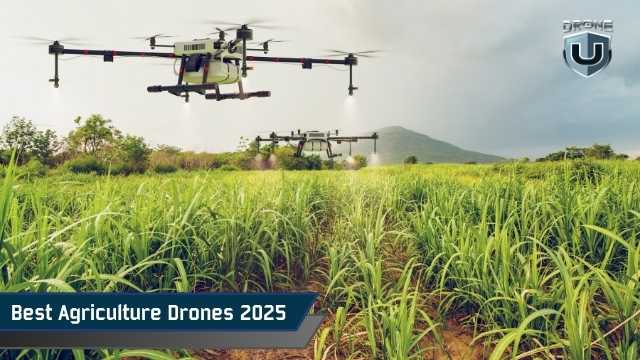
Quick Answer: Best Agriculture Drones in 2026Agriculture drones are used for spraying, spreading, mapping, and crop monitoring. Here are the top picks by task: Best for large-scale spraying: DJI Agras T100: 100L tank, up to 80 acres/hour, contact dealer for pricing |
Labor shortages are rising, the weather is more unpredictable, and input costs keep climbing. All of this puts more pressure on farms than ever before. Not to mention reduced orders from some of our largest exporters.
Tractors and sprayers still do the heavy lifting. But agricultural drones are quietly changing how that work gets done.
These aren’t hobby drones with cameras. Today’s AG drones can spray 100 acres in under an hour. They can detect plant stress before you can see it. And they can run autonomous flights with minimal oversight.
But with so many new models hitting the market, figuring out what’s actually worth your money has become its own challenge.
Not every tool fits every job. Some drones live up to the hype. Others don’t.
Some models are built for high-volume spraying, others for high-precision data collection, and many fall somewhere in between.
So what matters now isn’t just owning a drone, it’s owning the right one for the job.
This guide is here to make the decision easier.
We have evaluated the top ag drones of 2026 based on real-world performance in fields, orchards, and rugged terrain.
Here is what actually matters when choosing an agriculture drone.
Choosing the right drone comes down to one thing: its intended use. What the spec sheet says is only relevant in what it tells you about the expected performance of the drone in your specific environment, crop system, and workload.
Here’s how to think about the decision, broken down by real-world goals and constraints.
Look for high tank capacity, fast flow rate, and efficient refueling.
For large-scale spraying or spreading, you want fewer refill stops and the ability to keep batteries rotating without downtime.
A model like the DJI Agras T100 offers a 100-liter spray tank and quick-swap 30,000?mAh batteries. Those batteries can recharge in under 10 minutes.
However, the drone won’t save you time if your ground crew is chasing water or chemicals across the property.
Field Tip: Calculate your real-world coverage not just per flight, but per hour of complete workflow; battery swaps, tank fills, flight plan updates.
Prioritize drones with intelligent flight controls, radar, and real-time terrain adaptation.
Flying over terraces, vineyards, or tree-dense areas?
You’ll need a drone that sees and reacts to its environment.
That means LiDAR-based terrain following, RTK positioning for centimeter-level accuracy, and obstacle detection that works at all altitudes.
The T70 and T100 combine multiple sensor types to adjust height, spray width, and avoid collisions without needing a manual course correction.
Field Tip: For orchards or irregular fields, terrain-following matters more than raw coverage. A smarter, smaller drone will outperform a bulky one that can’t fly close to the canopy.
Go with durability first, focus on IP ratings, wind stability, and sealed electronics. Coastal wind, dust-heavy plains, or hot, humid summers can shut down sensitive drones.
Models with high Ingress Protection (IP55 or better), sealed motors, and intelligent wind correction are designed to stay in the air when the weather gets rough.
Also, consider altitude hold features that stabilize spray patterns during gusts or slope shifts.
Field Tip: Ask the dealer what wind speeds, temperatures, and dust levels void the warranty. You’ll learn fast which models are made for tough environments.
Choose a drone that focuses on data capture, not just flying time.
For this, you need high-resolution RGB or multispectral cameras, reliable PPK/RTK positioning, and a software pipeline that actually processes the data.
Drones like the WingtraOne Gen II or eBee X are made to fly long, capture clear data in a single pass, and deliver georeferenced outputs.
Field Tip: More megapixels or longer flight time doesn’t mean better maps. Look for sensor quality, Ground Sample Distance (GSD), and how cleanly the drone lands.
Here are the top agriculture drones of 2026, grouped by task.
We’ve grouped the top-performing agricultural drones of 2026 by category, so you can match your needs to the right drone.
If your priority is fast, efficient spraying or spreading with minimal downtime, these are the drones for you:
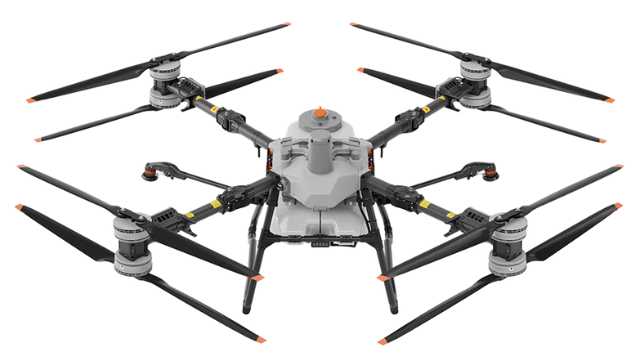
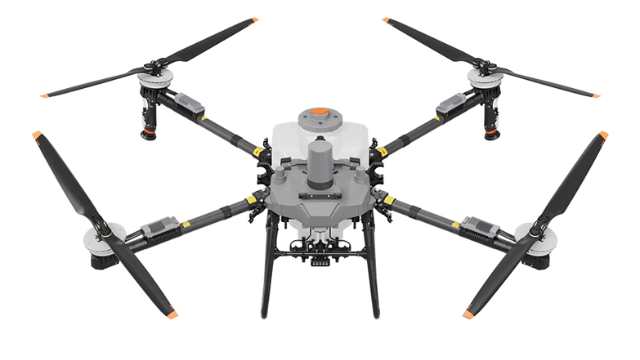
Source: DJI Agriculture
DJI’s top-tier agriculture drone, the T100, offers modular capabilities for spraying, spreading, and lifting. It pairs large capacity with fast charging and robust navigation features designed for demanding operations.
| Feature | Details |
| Spray Capacity | 100 L, up to 40 L/min with 4 nozzles |
| Spread Hopper | 100 L, up to 400 kg/min |
| Battery & Charging | Fast charging (~8–9 min) |
| Navigation & Safety | RTK, radar, terrain-following, 360° obstacle avoidance |
| Weight (MTOW) | High, requires robust logistics |
Source: DJI Agriculture
T70P is a mid-tier option that brings many of the T100’s key features, like radar, a spread system, and modular design. But it comes in a lighter, more agile frame, making it a better fit for orchards and medium-scale farms.
| Feature | Details |
| Tank Capacity | 70 L |
| Payload (Spray/Spreading) | up to 70 kg |
| Flow Rate | Spray: 30 L/min standard; 40 L/min with 4 nozzles |
| Spread Rate | 400kg/min, width 3–10 m |
| Navigation & Safety | Radar visual system 360°, RTK, phased-array radar |
| Battery & Charging | Fast charging in ~7–9 min, dual-battery setup |
| Mobility | Lighter frame than T100, more portable |
When data is your output (mapping, multispectral scouting, prescription modeling), choose any of these drones:
Source: WingtraOne Gen II
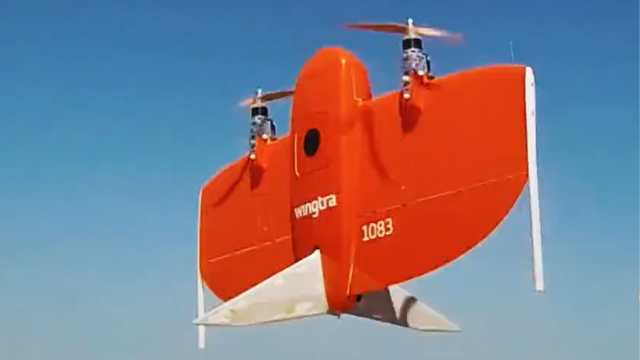
WingtraOne Gen II is a tail-sitting VTOL fixed-wing UAV combining easy vertical takeoff/landing with efficiency, high-resolution payloads, and centimeter-level accuracy.
| Feature | Details |
| Flight Time | ~59 minutes |
| Payload Capacity | Up to 800 g; supports high-res cameras |
| Navigation Accuracy | ~1 cm horizontal (Post-Processed Kinematic: a GPS accuracy method applied after the flight) |
| Range & Wind Resistance | 10 km link, handles 12 m/s sustained, 18?m/s gusts |
| ID & Durability | IP54, operational –10 to +40°C |
Source: eBee X
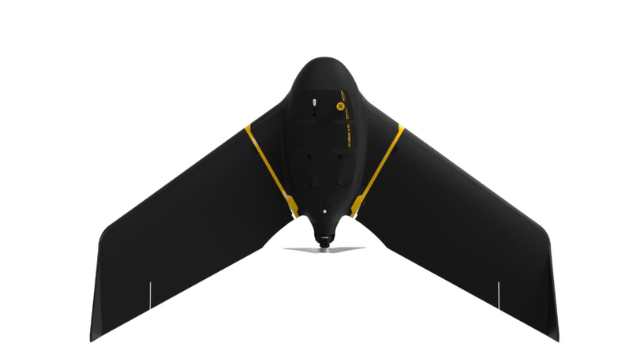
eBeeX is a lightweight NDAA-compliant fixed-wing drone, built specifically for large-area mapping. It includes RTK/PPK support, long flight endurance, and modular camera options. You can use it for multispectral, thermal, or RGB workflows depending on your mapping needs.
Source: Quantum Systems
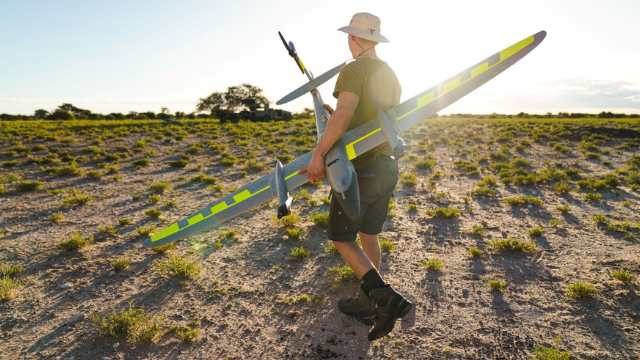
The Trinity Pro from Quantum Systems is a next-generation eVTOL fixed-wing drone built for high-efficiency mapping and data collection. It combines extended range, flexible payload options, and full integration with the QBase 3D mission control software.
With up to 90 minutes of flight time and 700 hectares of coverage, it’s designed for serious agricultural professionals managing large tracts of land.
It comes with downward-facing LiDAR for safer low-altitude flight and BVLOS-ready operations.
| Feature | Details |
| Flight Time | Up to 90 minutes |
| Max. Coverage | ~700 hectares per flight |
| Max. Altitude (MSL) | 5,500 m (18,045 ft) |
| Max. Take-Off Weight | 5.75 kg (12.68 lbs) |
| Cruise Speed | 17 m/s (38 mph) |
| Wind Tolerance (hover phase) | Up to 11 m/s (21.4 knots) |
| Command & Control Range | 5–7.5 km (3.1–4.7 miles) |
| Payloads | Swappable: RGB, oblique, multispectral, LiDAR (quick-lock system) |
| Software Integration | QBase 3D (for planning, execution, diagnostics) |
| IP Rating | IP55 (dust and water resistance) |
Consider these drones for operations that need heavy payload capacity, minimized labor, and advanced automation.
Source: hylio
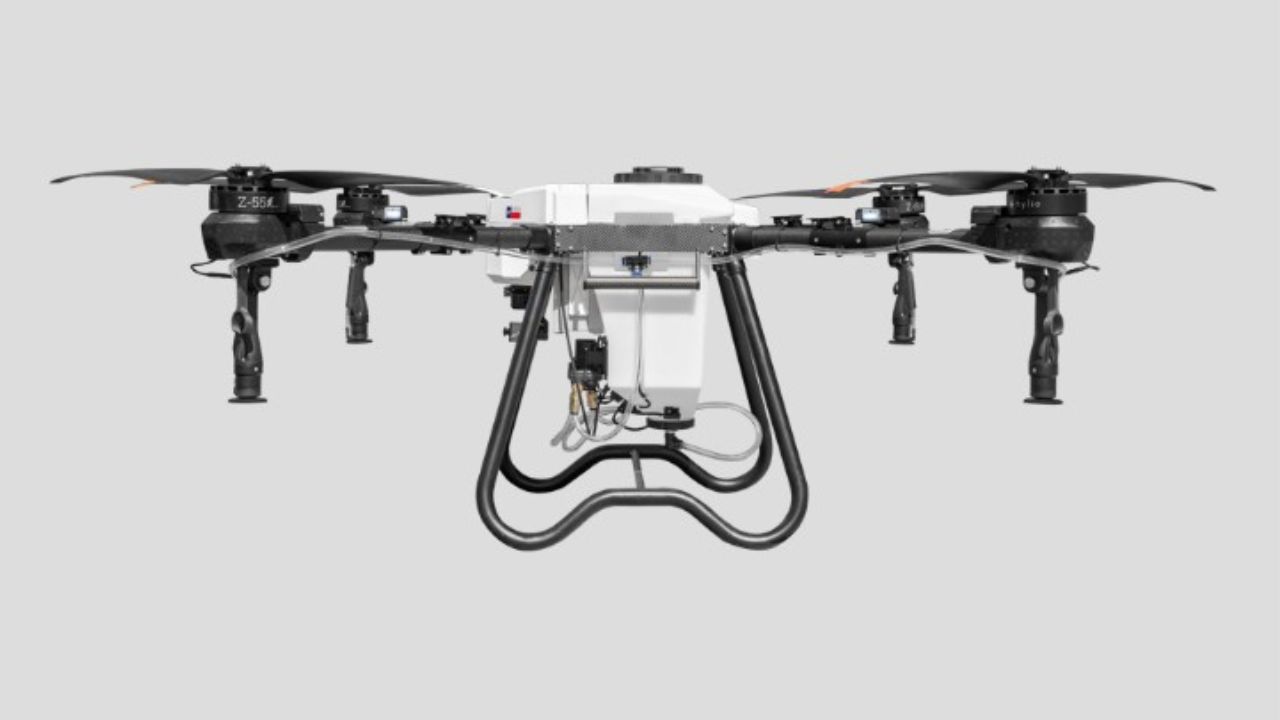
The ARES is built at Hylio’s headquarters in Richmond, Texas. It reflects a decade of agricultural drone experience. The platform pairs a heavy payload with rugged components and AgroSol Ground Control Software, which supports swarm flying.
The ARES targets large US farms needing NDAA-compliant equipment. Its modular system can switch between hydraulic nozzles, rotary atomizers, and a granular spreader without changing the airframe. This makes it one of the most versatile US-made agricultural drones available.
| Feature | Details |
| Liquid Tank Capacity | 13 gallons (50 liters) |
| Spreader Tank Capacity | 20 gallons (76 liters) |
| Liquid Payload Weight | Up to 110 lbs (50 kg) |
| Coverage (Liquid) | Up to 70 acres/hour at 2 gallons per acre |
| Coverage (Spreader) | Up to 120 acres/hour at 20 lbs per acre |
| Swath Width | Up to 40 feet (12 meters) |
| Flight Modes | Fully autonomous, position hold, manual, GPS-denied manual |
| Obstacle Avoidance | 4 lateral 62 GHz radars, 1 upward 62 GHz radar, 1 downward 24 GHz radar |
| Navigation | RTK-compatible GPS, centimeter-level accuracy |
| Empty Weight | 80 lbs (36 kg) |
| Max Takeoff Weight | 220 lbs (100 kg) |
| Max Operating Speed | 30 mph (48 km/h) |
| Battery Charge Time | 20 to 25 minutes (pair); 10 to 12 minutes (single) |
| Compliance | NDAA-compliant, FY2019 NDAA Sec. 889 and FY2020 NDAA Sec. 848 |
Source: Robinson Unmanned
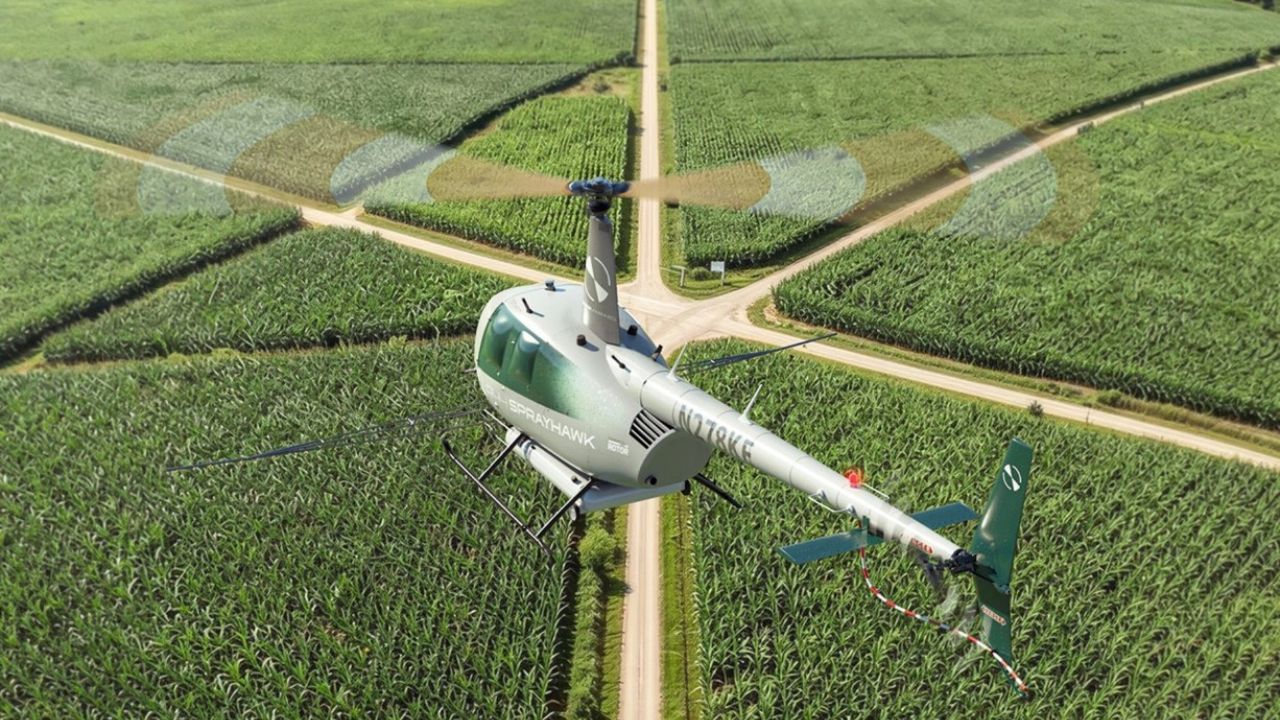
Rotor Technologies originally built the Sprayhawk. Robinson Helicopter now produces and sells it through its Robinson Unmanned division. Rotor still supplies the autonomy system. It is a gas-powered, unmanned helicopter built on the Robinson R44 platform. It fills the gap between small multirotor drones and full-cost manned spraying.
| Feature | Details |
| Spray Capacity | 110-gallon useful capacity |
| Coverage | Over 200 acres per hour |
| Flight Time | ~50 minutes per fuel cycle |
| Platform | Robinson R44 airframe with Rotor’s RPX autonomy |
| Sensors | Forward and downward cameras, tail camera, forward LiDAR, 360-degree collision LiDAR, radar altimeter |
| Navigation | AG-NAV GUIA Platinum and AgMission software |
| Flight Modes | Stability augmentation, precision positioning, waypoint navigation, automated spray path, return-to-home |
| Operation | Single remote pilot. Pilot needs a commercial rotorcraft license plus applicator licensing. |
| Regulatory Status | ANAC-approved in Brazil. U.S. FAA approval still in progress. |
| Price | Contact Robinson Unmanned for pricing |
| Drone | Category / Best For | Type | Payload | Flight Time | Price |
| DJI Agras T100 | High-volume spraying/spreading | Multirotor | 100L spray / 150L spread | ~18 min (full load) | Contact dealer |
| DJI Agras T70P | Orchard/mixed-use, portable spraying | Multirotor | ~60–70L tank | 15–18 min | USD 53,999 |
| WingtraOne Gen II | Precision mapping/survey | VTOL fixed-wing | Mapping sensors only | ~59 min | USD 19,900 |
| eBee X | Professional data collection/mapping | Fixed-wing | Multiple sensor modules | Up to 90 min | Not disclosed |
| Trinity Pro | Large-scale agricultural surveying/mapping | eVTOL | ~1 Kg | Up to 90 min | USD 24,160 |
| Hylio ARES (HYL-150) | Autonomous spraying and spreading, NDAA-compliant, US-made | Quadcopter | 13 gal (50L) liquid / 20 gal (76L) spreader | 15 min per charge; 20 to 25 min recharge | Get a quote |
| Robinson R44 Sprayhawk | Large-scale aerial spraying | Helicopter | 110 gallons | ~50 min | Contact dealer |
This section breaks down how top agricultural drones handle different real-world conditions, from broadacre crops to vineyards, and mapping to spraying. The goal is to help you match the right machine to the right job, with fewer surprises in the field.
In the heart of America’s row-crop belt, where fields stretch for hundreds or even thousands of acres, speed and scale are everything.
These operations need broad herbicide, pesticide, or nutrient coverage with minimal downtime. The DJI Agras T100 and Hylio ARES stand out here.
Both drones minimize chemical waste, reduce soil compaction, and boost application timing precision, critical for ROI in large-field agronomy.
In perennial crops like grapes, apples, or citrus, drone spraying requires more finesse than brute force. The terrain is often rugged or sloped, and canopy heights vary across rows and varieties.
A large, bulky sprayer that’s perfect for flat cornfields may be inefficient or even dangerous. That’s why the DJI Agras T70 and T60 are better suited for these environments.
These drones use high-precision terrain-following radar. They’re also more agile during takeoff, especially in tight field margins. That makes them a practical choice for growers working on hilly or segmented plots.
If your work revolves around high-value, specialty crops, this class of drone offers a significant edge in both yield protection and chemical efficiency.
When the goal is insight, not application, mapping drones become essential. These platforms help operators detect crop stress, variability, and terrain changes long before issues show up at harvest.
Fixed-wing drones like the WingtraOne Gen II and eBee X are purpose-built for NDVI imagery, prescription maps, and elevation models. NDVI (Normalized Difference Vegetation Index) measures crop health using light reflection.
Both support modular sensors, including RGB, multispectral, and thermal options. This flexibility helps agronomists and service providers get detailed crop health and water stress data.
If your operation depends on actionable data, these platforms return their value in both flight time and the decisions they unlock.
In hilly regions from California almond groves to Appalachian orchards, terrain introduces serious complexity for unmanned spraying.
Stable altitude hold, terrain sensing, and rotor thrust matter far more than they do on level ground.
In hilly terrain, the DJI Agras T70 shines. Its onboard radar and RTK system let it follow elevation contours with precision.
For bigger, industrial-scale jobs, the Robinson R44 Sprayhawk offers significantly higher capacity. This autonomous helicopter, built on the Robinson R44, handles slopes well with high lift.
Although still awaiting U.S. approval, the Sprayhawk has already proven effective in Brazil, flying rugged landscapes with little pilot intervention.
The best agriculture drone isn’t defined by specs alone; it’s defined by how well it fits your task, terrain, and workflow.
For high-volume spraying across large fields, the DJI Agras T100 or Hylio ARES offers speed and efficiency at scale.
If you’re dealing with hills, orchards, or confined areas, the Agras T70 provides more precision and agility.
For mapping, platforms like WingtraOne, Trinity Pro, or eBee X deliver the data quality needed for serious agronomy and variable-rate planning.
And for operators managing thousands of acres or replacing manned aerial applicators, the Robinson R44 Sprayhawk leads this category. It covers over 200 acres an hour with a 110-gallon tank.
Beyond performance, long-term value comes from support. Look for brands with reliable parts access, responsive service, and software that stays updated.
Many suppliers offer field demos or pilot programs before purchase.
 1
1