

Drone Regulations 2026: How Part 108, Section 2209, and Part 146 Work Together

October 5, 2026
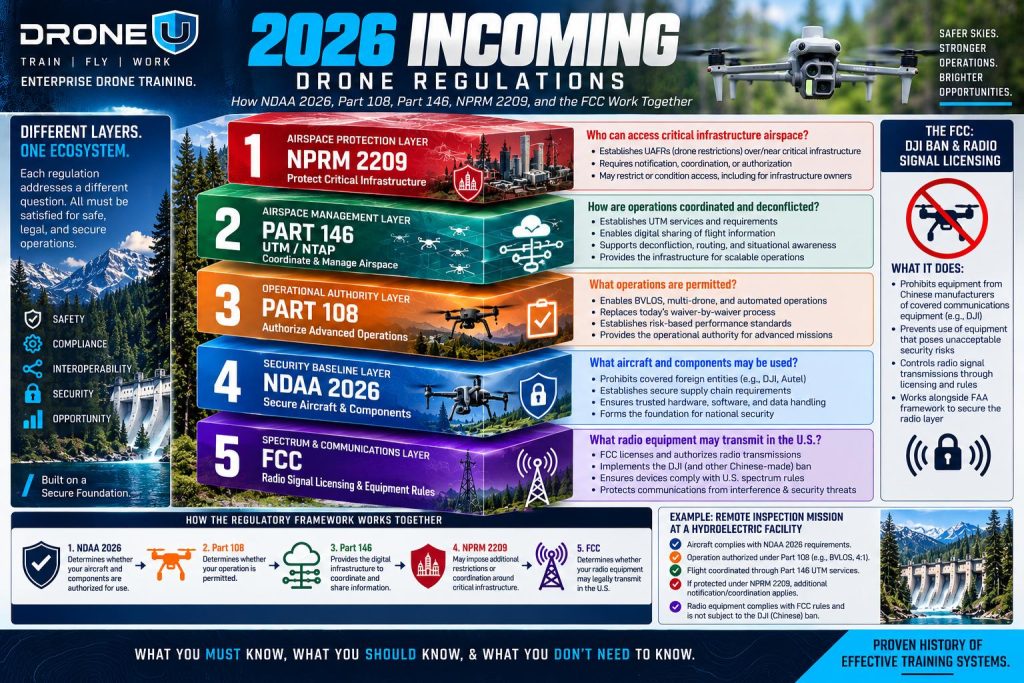
The drone regulations 2026 stack is not one rule. It is several layers that work together: proposed Part 108 for beyond visual line of sight (BVLOS), proposed Part 146 for traffic-management services, the Section 2209 critical-infrastructure proposal, and security rules from NDAA provisions and the FCC Covered List. Together, they reshape who can fly advanced missions near government sites, utilities and other fixed facilities—and under what conditions.
Here is the hard subline. Under the Part 108 proposal, certain BVLOS flights would need detect-and-avoid (DAA) capability against aircraft that are not broadcasting their position. Most aircraft flying today were not built to that standard. At the same time, traditional manned aircraft still do not read drone Remote ID the way they read ADS-B, and they generally do not consume Part 146 UTM feeds. So the framework aims high, while key pieces of awareness and deconfliction are still unfinished.
Many details still need to be hashed out. Even so, the Trump Administration has pushed hard for routine BVLOS and scaled drone delivery under a federal path, rather than waiting while a patchwork of local rules slows aviation growth. Below we map the layers, the gaps and what utility and government programs should do now. For more Part 108 detail, see our post on new FAA regulations: Part 108. Still building the Part 107 foundation? Our Part 107 certification course covers airspace, Remote ID and the rules this stack builds from.
Think of the new framework as stacked layers. Each answers a different question:
A utility inspection over a hydroelectric site is a good mental model. The aircraft may need to clear the security and radio layers. The mission may need Part 108 authority for BVLOS. Flight intent may need Part 146-style strategic deconfliction. And if a Unmanned Aircraft Flight Restriction (UAFR) exists under Section 2209, the crew may still owe notice and coordination even when flying for the facility itself.
That is how these drone regulations 2026 limit—or at least tightly condition—operations for government organizations, regulated entities and utilities in particular. The same stack also creates the opening for major change: routine corridor inspections, delivery and civic missions that Part 107 was never built to scale.
On August 7, 2025, the FAA and TSA published the Notice of Proposed Rulemaking titled “Normalizing Unmanned Aircraft Systems Beyond Visual Line of Sight Operations” (90 FR 38212, Docket FAA-2025-1908, RIN 2120-AL82). The NPRM proposes a new 14 CFR Part 108 for low-altitude BVLOS design and operations, plus a new Part 146 for automated data service providers that support those flights.
As of early October 2026, no final Part 108 rule has been published in the Federal Register. Nothing in the proposal is a current operating requirement. The NPRM is public, limited comments were reopened in January 2026 on electronic conspicuity and right-of-way, and a final rule text is not yet law. Trade coverage has also reported a final package under White House regulatory review since mid-2026; treat that as status reporting, not as an effective date.
What the proposal would do, in plain terms:
The catch is detect-and-avoid. The NPRM’s proposed §§ 108.180(b) and 108.185(d)(5)(ii) would require unmanned aircraft operating in Class B or Class C airspace, or over Category 5 population areas, to detect and avoid non-cooperative aircraft—traffic that is not broadcasting ADS-B Out or an approved alternate electronic conspicuity (EC) signal. Commenters told the FAA that those DAA provisions point to expensive, still-maturing technology. The FAA reopened the docket in January 2026 specifically because right-of-way, ADS-B/EC and DAA drew heavy pushback.
So the operational truth—even if the final rule still changes—is this: there is no widely accepted, off-the-shelf consumer or prosumer fleet today that clearly meets the proposed Part 108 non-cooperative DAA bar for those environments. Consensus standards and FAA-accepted means of compliance are still being worked. Until those exist, nobody should pretend their current kit is “Part 108 ready” for Class B/C or Category 5 areas.
Proposed Part 146 is the airspace-management layer. The FAA would certificate automated data service providers and authorize services such as strategic deconfliction and conformance monitoring. Those services are meant to share flight intent digitally and keep BVLOS traffic from colliding with other unmanned operations as volume grows.
Two naming notes matter:
Here is where deconfliction gets difficult in practice. Part 146-style services mainly serve unmanned operators and their service providers. Most traditional aircraft still navigate with eyes, ATC and ADS-B—not a UTM dashboard. Remote ID, under Part 89, is closer to a digital license plate for FAA, law enforcement and security partners. It is not a cockpit traffic display for a Cessna or helicopter pilot.
That mismatch sits at the center of the “set up to fail” concern. When drones broadcast Remote ID and share intent through Part 146 services, but manned traffic in the same low-altitude band often sees neither feed, deconfliction leans on drones yielding to ADS-B Out / EC traffic, DAA against non-cooperative aircraft in the hardest places, unmanned-to-unmanned strategic separation, and procedural limits. The NPRM itself says the FAA considered mandating ADS-B Out for manned operations below 500 feet and did not propose it, citing cost and burden. Until electronic conspicuity, right-of-way and DAA are settled, this part of the drone regulations 2026 stack remains a gap.
Section 2209 started in the FAA Extension, Safety, and Security Act of 2016. On May 6, 2026, the FAA published a proposed rule to implement it (91 FR 24650, Docket FAA-2026-4558). The proposal would create a new 14 CFR Part 74 and let eligible fixed-site critical infrastructure request Unmanned Aircraft Flight Restrictions (UAFRs) over their property.
Key proposed points:
Comments closed August 5, 2026. As of early October 2026, no final Section 2209 rule has published, so UAFRs are not live yet. Utilities and government facility owners should still watch closely: the proposal can condition access even for work that serves the site, and recreational 44809 flying is not on the proposed allowed list inside a standard UAFR. Executive Order 14305, “Restoring American Airspace Sovereignty” (June 6, 2025), directed the FAA to move Section 2209 promptly—which is why this layer sits beside Part 108 in the same 2026 conversation.
Part 107 creators can mostly keep flying VLOS jobs while they watch the NPRMs. Utility, energy, water, rail and public-safety programs cannot ignore the stack as easily. Those organizations often need long linear BVLOS inspections, flights near sites that may someday sit under UAFRs, aircraft that clear NDAA / Covered List procurement rules, and SMS or training controls that look more like Part 108 certificates than a solo Part 107 ticket.
So the same drone regulations 2026 environment that raises the bar also creates the opening for major change. A workable Part 108 BVLOS path plus mature Part 146 services can move utilities from waiver theater to repeatable programs. Clean Section 2209 notice rules can clarify site access. Shifting security rules will still force procurement and training to keep up. Enterprise programs should plan the whole stack, not chase one acronym.
The ecosystem also includes NDAA security rules and the FCC. Those are not airspace rules, but they decide which aircraft can be bought, authorized and flown for sensitive work. NDAA covered-foreign-entity restrictions push government and many critical customers toward trusted supply chains. The FCC Covered List and follow-on proposals affect which UAS radios and critical components can get new authorizations—and, in some cases, how previously authorized foreign-produced UAS may be imported or marketed. Exact lists and dates move. Advanced Part 108 missions and critical-infrastructure work will increasingly demand aircraft that clear both the FAA operational stack and the security/spectrum stack.
On June 6, 2025, President Trump signed Executive Order 14307, “Unleashing American Drone Dominance.” It directed DOT/FAA to propose routine BVLOS rules quickly and to publish a final rule within 240 days “as appropriate,” and it frames scaled domestic commercialization—including consumer goods delivery—as national policy. The same day, EO 14305 pushed airspace sovereignty and Section 2209.
Read together, the Administration wants federal BVLOS and delivery frameworks in place so aviation growth is not trapped under conflicting local expectations. States and cities still do not control the airspace—the FAA does—but a patchwork of facility policies, state statutes and municipal ground rules can slow programs almost as much as a missing federal BVLOS rule. The push is to finish the federal aviation pieces before that friction becomes the de facto national system.
It can fail in practice if people treat proposals as finished products. The honest status in October 2026:
That is not a reason to freeze. It is a reason to stop buying “Part 108 magic” marketing and start building programs that can absorb final-rule changes: trusted aircraft paths, Remote ID discipline, SMS, training records, and vendor due diligence.
While the drone regulations 2026 rules finish hashing out, we would keep Part 107 sharp (airspace, charts, Remote ID), inventory the fleet against security and spectrum rules, map sites that would likely seek UAFRs, watch UTM / NTAP providers without assuming Part 146 certificates exist yet, and train for the BVLOS jobs you will actually fly—not just a knowledge-test pass. Waivers remain the BVLOS path until Part 108 is final and effective.
Drone U has 10+ years of in-person drone training and 14+ years of online drone education. We teach the rules the way working programs use them, not as hype.
If you run drones for a utility, city, agency or critical facility, you do not need another rumor thread. You need a training and compliance plan that can move when the final rules publish.
Explore our Enterprise Drone Programs, or book a consultation to map Part 107 foundations, BVLOS readiness and site-specific policy against the coming stack.
Still need the certificate first? Enroll in Drone U’s Part 107 course for $147 (regularly $197)—lifetime access, FAA-aligned quizzes and a 14-day money-back guarantee.
We don’t teach hype. We teach what works—because we fly it ourselves.
 1
1
