

Drone Delivery Pushback: 15 States Sue the FAA as Towns Ask What They Can Control

October 8, 2026
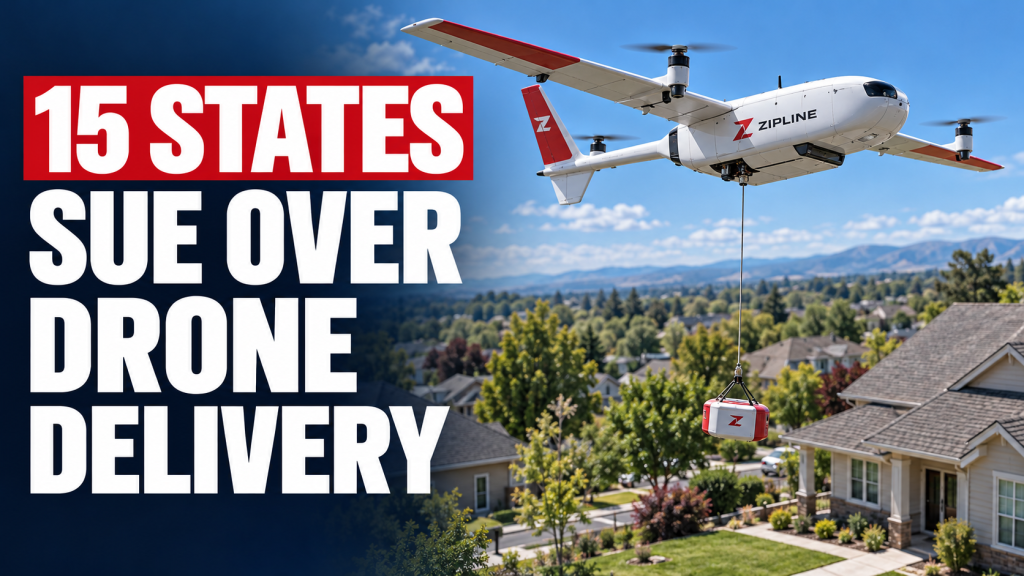
Drone delivery is expanding fast, and so is the pushback. Fifteen states have taken the FAA to federal court over how it approved delivery operations nationwide. Meanwhile, towns in Massachusetts are asking a blunt question: can we actually stop this?
The answers come down to one of the most important ideas in drone law, which is who controls the airspace. Here’s what’s happening and why it matters even if you never fly a delivery drone.
On September 28, a coalition of 15 states plus Harris County, Texas, filed a petition for review in the U.S. Court of Appeals for the Second Circuit. The states are Arizona, California, Colorado, Delaware, Illinois, Maine, Maryland, Massachusetts, Michigan, New Mexico, New York, Oregon, Rhode Island, Washington and Wisconsin.
Their target is the FAA’s Final Programmatic Environmental Assessment for drone package delivery operations in the United States. It’s dated July 28, 2026, and comes with a Finding of No Significant Impact. A programmatic review looks at delivery operations broadly instead of market by market. Critics see that as the problem.
California’s attorney general said the assessment gives an overview of future nationwide deliveries without meaningful information about the communities and environments affected. The coalition argues it doesn’t adequately address safety risks or other environmental impacts, as the National Environmental Policy Act (NEPA) requires.
The petition itself doesn’t spell out detailed arguments. However, Aviation Week reports that in January, the same states raised concerns about:
The case is at an early stage. Nothing about current delivery operations changes because a petition was filed.
In central Massachusetts, Amazon has proposed launching Prime Air deliveries from its Otis Street facility in Westborough, with a delivery radius of about 7.5 miles. That circle reaches into parts of Worcester, Shrewsbury and Hopkinton.
On October 6, Worcester’s city council moved to ask for a report on what, if anything, the city can do to regulate or stop the deliveries. Hopkinton’s Select Board voted that same night to organize opposition, DroneXL reported, even though members acknowledged the FAA controls flight paths.
Shrewsbury’s town manager gave the clearest answer. He told Spectrum News 1 that Amazon doesn’t need approval from towns where drones only deliver, because “local regulation is preempted” by the FAA. He added that the town is reviewing its zoning rules in case a company wants to launch drones from inside Shrewsbury.
That split, ground versus air, is showing up across the country. In Colorado, the city of Northglenn has proposed rules for commercial drone delivery hubs. As DroneLife reported, the city acknowledges it can’t regulate flight paths, altitudes or schedules once a drone is airborne. What it can regulate is the ground side, using a special use permit that covers:
In Massachusetts, Amazon still needs approval from the state’s MassDOT Aeronautics Division, which oversees landing areas, according to Boston.com.
Understanding who controls what is a big part of flying legally, and it’s covered on the FAA knowledge test. If you’re preparing for your certificate, our Part 107 course breaks down the regulations and airspace rules without the legal jargon.
Drone delivery is forcing a nationwide conversation about who gets a say over the sky above our homes. For now, the airspace belongs to the FAA, and the ground still belongs to local government. Both fights are worth watching.
Sources: Petition for review, State of New York et al. v. FAA (2d Cir.); California Attorney General press release; Aviation Week; Spectrum News 1; DroneXL; DroneLife; Boston.com
 0
0
