

Parrot Lands $2M Army UAS Marketplace Orders, Advances in SRR MRA

October 16, 2026
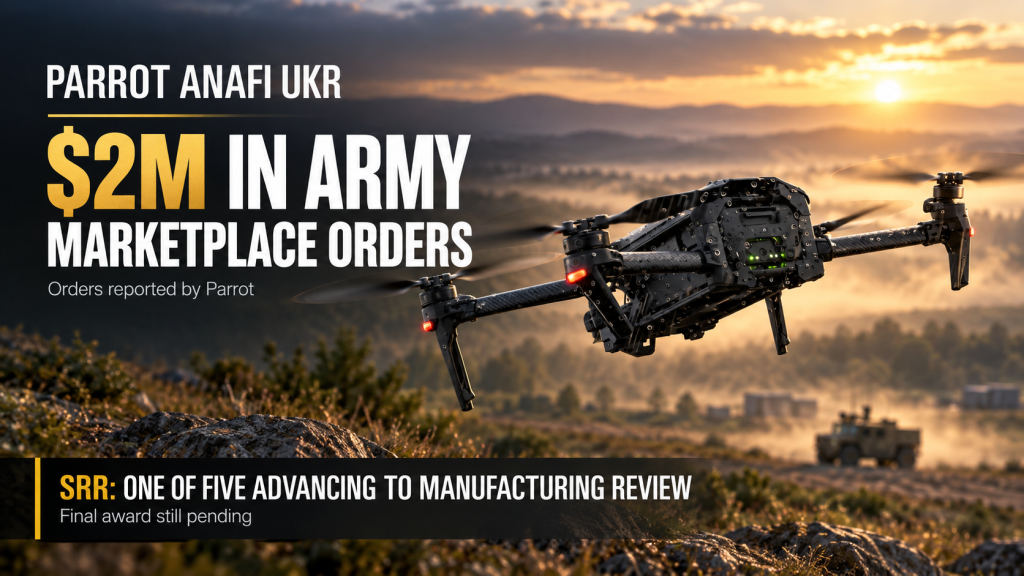
Parrot says U.S. Army buyers are already writing checks on the new UAS Marketplace—and that its ANAFI UKR has cleared another gate in the Army’s platoon-level Short Range Reconnaissance (SRR) competition. In an October 12, 2026 press release, the European micro-UAV maker reported roughly $2 million in ANAFI UKR orders since going live on the Marketplace in Q3 2026, and confirmed it is one of five manufacturers advancing to a manufacturing readiness assessment (MRA) after June 2026 fly-offs.
That is not a final SRR award. It is a procurement signal: non-Covered-List, NDAA-friendly small UAS keep gaining formal Army channels while FCC pressure on Chinese-origin systems continues.
The Army launched the UAS Marketplace in March 2026 as a qualified catalog where military units, government agencies, and allied partners can compare and purchase vetted systems against mission needs. Admission requires Army qualification and compliance checks, including technical and cybersecurity assessments. Unlike a single winner-take-all contract, the Marketplace lets end users pick from approved options.
Parrot went live in Q3 2026 and says initial ANAFI UKR orders already total about $2 million. The company is building toward approximately two-week delivery lead times to support that demand. For public-safety and enterprise buyers watching federal catalogs, Marketplace traction is a useful proxy for what clears U.S. government cybersecurity and supply-chain screens.
Separately, Parrot completed the flight-demonstration phase of the Army’s next-generation platoon-level SRR evaluation. After competitive trials in June 2026, five manufacturers advanced to the manufacturing readiness assessment phase. Parrot’s release describes the other four as U.S. companies without naming them; secondary reporting identifies Skydio, Skycutter, Teal Drones, and Vantage Robotics alongside Parrot. Treat those four names as secondary-sourced unless the Army publishes its own list.
SRR aims to put advanced small UAS in frontline units for real-time intelligence, surveillance, and reconnaissance. Advancing to MRA tests whether a vendor can perform and scale—not whether it has won the program of record.
ANAFI USA is already in use with multiple U.S. federal agencies and state public-safety organizations, per Parrot. ANAFI UKR is pitched for tactical reconnaissance with longer endurance, autonomous features, secure links, and GNSS-denied operations. Manufacturing is described as U.S. and South Korea based, with design work in Europe—relevant for buyers mapping Covered List and NDAA constraints.
None of that replaces Part 107 for civil operations. It does explain why police, fire, and critical-infrastructure fleets keep asking about non-DJI options as marketplace and authorization rules tighten.
Whether you fly enterprise inspection or public-safety support, the regulatory floor in U.S. civil airspace is still Part 107. Our Part 107 online course covers the rules every remote pilot needs while defense and FCC supply-chain stories play out in parallel.
Parrot’s October 12 update pairs early UAS Marketplace sales (~$2 million ANAFI UKR since Q3) with advancement—not award—in the Army’s SRR manufacturing readiness phase as one of five competitors. For readers tracking American-made and NDAA-compliant alternatives under continuing DJI/FCC pressure, it is a concrete data point. For everyone else: verify sources, do not invent a program win, and keep flying under the authorizations you actually hold.
Sources: Parrot press release PDF (Oct. 12, 2026); The Robotics Media (SRR vendor list—secondary)
 0
0
