
Remotely Piloted Caravan Flies in Albuquerque as Archer Tours San Francisco Bay
October 20, 2026
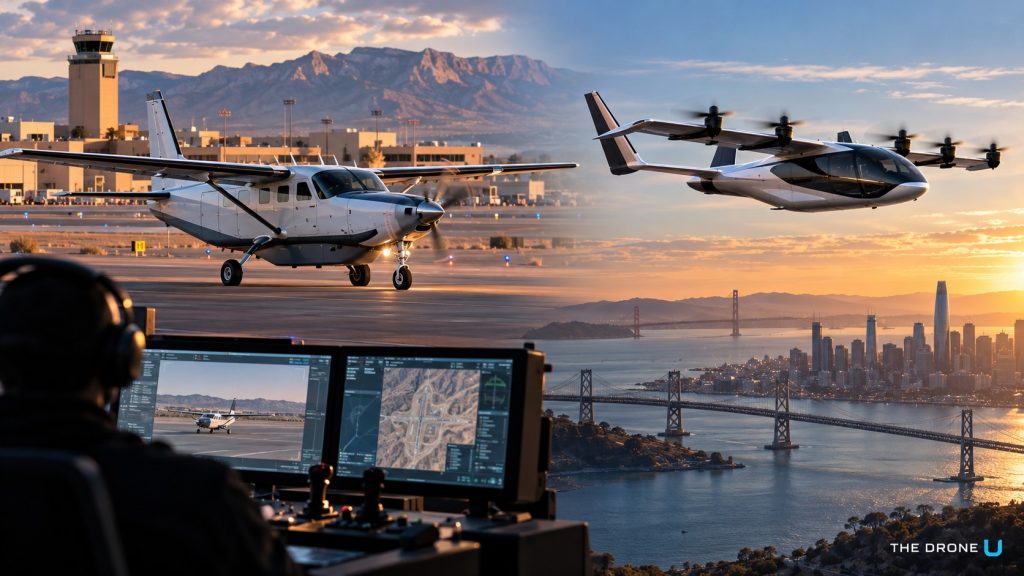
Two advanced air mobility stories surfaced on Monday, October 19. The FAA announced that New Mexico has become the sixth location to fly under the federal eVTOL Integration Pilot Program (eIPP), with a remotely piloted Cessna Caravan cargo demonstration in Albuquerque. Meanwhile, Archer Aviation published footage of its Midnight air taxi flying over San Francisco Bay. Neither flight was a vertical takeoff, and that detail is worth noticing.
According to the FAA’s October 19, 2026 release, the City of Albuquerque Aviation Department and Reliable Robotics flew a demonstration at Albuquerque International Sunport last week. It tested cargo deliveries with Reliable’s remotely piloted Cessna 208B Caravan. The FAA described the flight as a “hybrid-electric demonstration.” The release doesn’t explain what part of the operation that refers to, and it doesn’t say whether a safety pilot was on board.
New Mexico follows North Carolina, which launched in late September. Albuquerque’s aviation director, Manny Manriquez, said the city is one of eight designees in the program and is focused on autonomous aircraft operations. FAA Administrator Bryan Bedford said each test flight supplies data for building out the system. Reliable Robotics CEO Robert Rose described the work as a roadmap for bringing autonomy into high-density airspace. The city and other eIPP participants plan more test flights through the end of the year.
Keep the scope in mind. The announcement covers a demonstration, not a commercial approval. No route network, start date or certification decision came with it, a point The Aviation Diary also made in its coverage.
Archer flew its piloted Midnight prototype, registered N703AX, around San Francisco Bay out of Oakland International Airport last week. FLYING reported three flights of roughly 20 minutes each, based on FlightAware data. Archer says one leg showed a trip to San Francisco’s Marina District could take about 10 minutes, compared with more than an hour by car. The aircraft didn’t land in the Marina.
FLYING and DroneXL both note that the aircraft took off and landed on a runway, like a conventional airplane. Its rear lift propellers were stowed. Archer hasn’t yet announced a piloted flight that takes off vertically, transitions to wing-borne cruise and lands vertically. DroneXL reports that CEO Adam Goldstein told investors in August the company was on track for full transition later this year. It also reports that Archer said its first eIPP operations would start with conventional takeoff and landing. Archer says the Bay flights wrapped up a Northern California tour of more than 200 miles across seven cities.
The eIPP was created under the administration’s Unleashing American Drone Dominance executive order. The FAA says its eight projects span 28 states and include air taxis, regional passenger service, cargo, emergency medical response, offshore energy and autonomous flight. The agency says data from these projects may shape future regulations.
The Albuquerque flight is the closest of the two to the drone world. It puts a remote pilot and an autonomy stack into a busy airport environment, where questions about ATC communication, lost-link handling and ground movement have to be answered with real data.
If you want to build a career on remotely piloted aircraft, the first step is the remote pilot certificate. Our Part 107 course covers the airspace, weather and operating rules that every remote pilot needs.
Sources: FAA press release (Oct. 19, 2026); The Aviation Diary; Unmanned Airspace; FLYING; Archer
 0