
One Motor, One Propeller: How a Hinged Prop Lets a Drone Steer Without a Swashplate

October 23, 2026
Every drone pilot learns the basics early: a quadcopter steers by speeding up and slowing down four separate motors, and a traditional helicopter tilts its rotor with a swashplate and a set of servos. A new open-source build from YouTube creator and engineer Joshua Bird skips both. His prototype hovers and steers on one motor turning one propeller, with the steering done by the way that motor speeds up and slows down inside every single revolution.
Bird published the project on Oct. 17, 2026 in a video titled “I Built a Drone With Only One Motor,” and posted the CAD files and firmware on GitHub. It is a hobby research prototype, not a product, but the engineering is worth understanding because it shows where small-drone design could head.
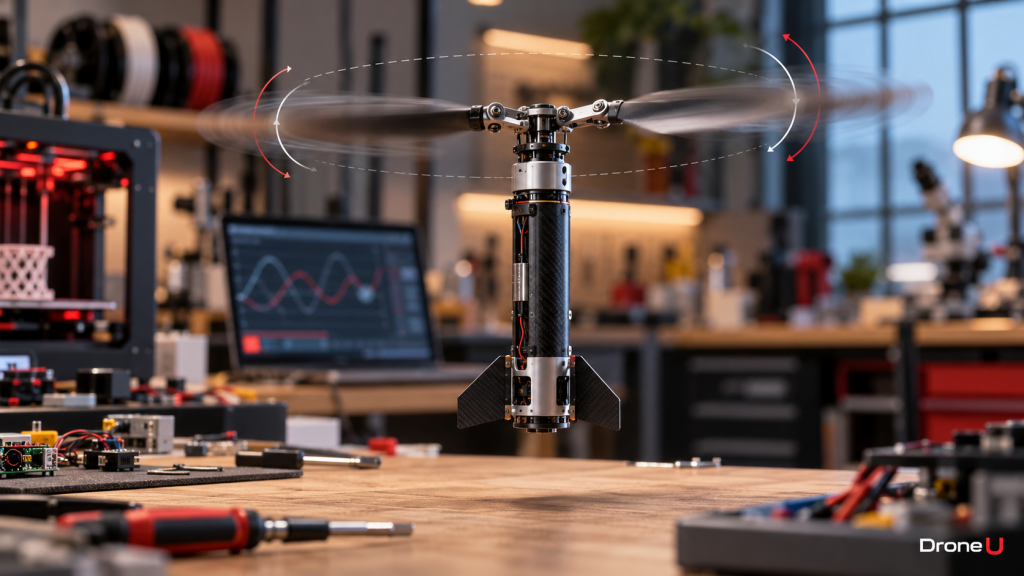
The trick lives in the propeller hub. Instead of being bolted rigidly in place, each blade sits on a hinge that is angled (Bird describes the hinges in his first hub as set at 45 degrees). When the motor accelerates, the blades lag slightly behind the hub. Because of the angled hinge, that lag twists one blade to a higher pitch and the other to a lower pitch, so one side of the disc makes more lift than the other.
Pulse that acceleration at the right point in each rotation and the extra lift always lands on the same side of the aircraft. That tilts the drone, which is exactly what a helicopter’s swashplate does with cyclic pitch, only here there is no swashplate and no servos. The average motor speed still sets overall thrust. Bird’s body has fins under the propeller to deal with the spin (yaw) that a single rotor would otherwise put into the airframe.
The underlying concept has a solid academic pedigree. University of Pennsylvania researchers James Paulos and Mark Yim described an “underactuated propeller” that gets cyclic blade pitch from a modulated motor torque in a 2013 IROS paper, flew a 227-gram swashplateless coaxial helicopter in 2015, and published the full model in the Journal of Guidance, Control, and Dynamics in 2018. Paulos’s dissertation reports rotors from 10 cm to 100 cm tested and aircraft from 29 g to 870 g flown.
What Bird adds is a push toward small, fast propellers using hobby-accessible parts. Earlier hinged-propeller drones tended to use large, slow-turning props. Bird reports running a 6-inch hinged propeller at nearly 20,000 RPM while the motor accelerated and decelerated about 300 times per second. He calls that, “to my knowledge,” the fastest and smallest hinged propeller demonstrated on a drone. That is his own claim and has not been independently tested.
The video opens by saying this drone “should not be possible” and that the design “could make drones smaller, cheaper, and far easier to manufacture.” Fair, but with caveats. The mechanism has been in the research literature for more than a decade. The current build depends on an external infrared beacon for heading, which rules out normal outdoor flying for now. And the repository shares CAD and firmware but, not a parts list or tuning guide. No flight time, payload, wind tolerance or reliability data has been published, and nothing suggests a commercial product is coming. Bird himself says the mechanical simplicity is paid for with “extremely complex” software.
For now, nothing changes in your kit bag. But the direction is interesting. Fewer motors means fewer parts to fail, buy and replace, and potentially smaller, lighter and cheaper aircraft. The tradeoff is redundancy: a quad that loses one motor is in trouble, and a single-motor aircraft that loses its one motor has no backup at all. Any design like this would have to prove reliability before it shows up in commercial work.
It is also a good reminder that the physics you study for your license is not academic trivia. Lift, blade pitch, torque and how rotorcraft are controlled all show up on the FAA knowledge test and in real flying decisions. If you are working toward your certificate, our Part 107 course walks through the aerodynamics and regulations you need to fly commercially, whatever the aircraft looks like. And whatever a future single-motor drone might look like, the rules still apply: under Part 107 it is an unmanned aircraft like any other.
Sources: Joshua Bird, “I Built a Drone With Only One Motor” (YouTube, Joshua Bird channel); jyjblrd/single-propeller-drone on GitHub; Hackaday; Paulos & Yim, “An Underactuated Propeller for Attitude Control in Micro Air Vehicles” (IROS 2013); “Flight performance of a swashplateless micro air vehicle” (ICRA 2015); “Cyclic Blade Pitch Control Without a Swashplate for Small Helicopters” (JGCD 2018); Paulos, “Rotorcraft Blade Pitch Control Through Torque Modulation” (UPenn dissertation).
 0