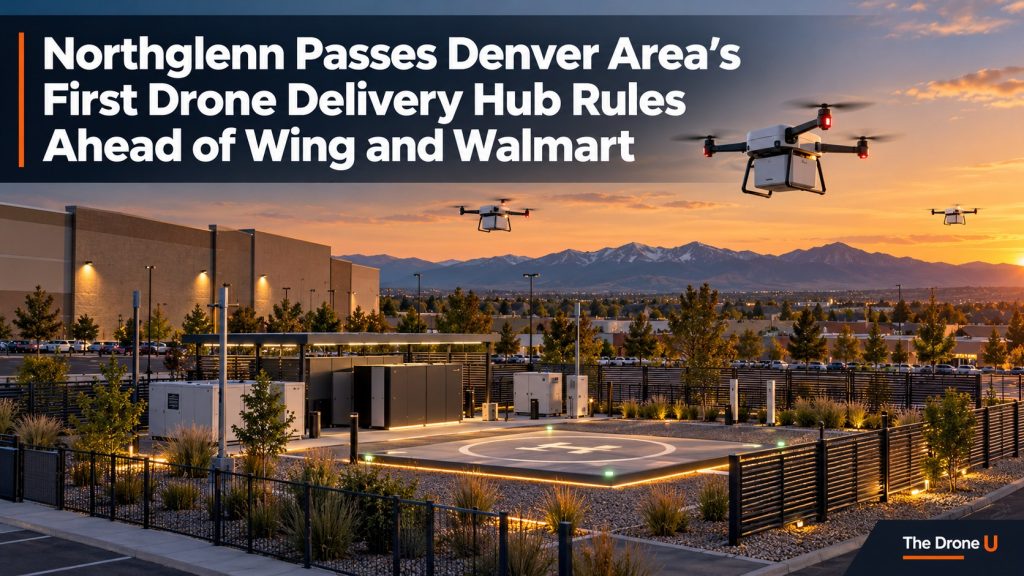
Northglenn, a suburb just north of Denver, now has rules for drone delivery hubs. On Monday night, October 26, the City Council voted 9–0 to pass CB-2043. The ordinance creates a new land-use category called a “Commercial Drone Delivery Hub” and sets out where those hubs can go, how they have to be screened and when they can operate. Albeit, they may be setting up an argument about what an aerial property line means. Time to revisit Causby v. United States. Drone U members should remember the document the FAA uses to define Airspace, private vs. thoroughfare.
The timing isn’t an accident. Wing and Walmart have said drone delivery is coming to the Denver metro in 2027, and Denver7 reported that Northglenn wanted rules on the books before that happens. City staff told the council that seven nearby cities met in August to compare approaches. So far, none of them has adopted an ordinance.
The ground, not the sky
The most useful part of the ordinance for pilots is the line it draws. The staff memo and the ordinance both say the FAA has exclusive authority over airspace: flight paths, altitude, flight schedules and aircraft certification. The city says it has no power to regulate where drones fly once they’re airborne. What it can regulate is the ground facility, including the pad, fencing, screening, lighting, parking, security and ground noise.
Here’s what CB-2043 requires:
- Zoning and permits. A hub attached to an existing business, such as a store, restaurant or warehouse, is allowed only in the Commercial General, Commercial Auto-Oriented and Industrial zones. A standalone hub is allowed only in Industrial zones. Every hub needs a Special Use Permit.
- 200-foot buffers. The drone staging area has to be at least 200 feet from residentially zoned lots, schools and childcare facilities, and critical facilities such as police, fire and utility sites.
- Size cap. The staging area can’t take up more than 10% of the lot or 10,000 square feet, whichever is smaller. It can’t block fire lanes, drive aisles, loading zones or required parking.
- Hours. Operations are limited to 7 a.m. to 10 p.m., and to the host business’s regular hours if those are shorter.
- Noise. Ground equipment and ground operations can’t exceed 65 decibels at the property line, matching the city’s existing noise standard.
- Fencing and rooftops. Ground-level hubs need ornamental fencing. Chain link is allowed only in limited cases. Rooftop hubs are allowed, with a single mast up to 10 feet for a windsock or antenna.
- Paperwork. Applicants must file an operating narrative with expected altitudes, the number of aircraft, and average and peak daily flights. They also need an incident and emergency response plan, at least $1 million in liability coverage naming the city, and copies of their federal approvals, including a Part 135 air carrier certificate.
- Incidents and privacy. Operators have to call 911 right away for any crash or unplanned landing that causes injury, damage or a hazard. They must notify the city within 24 hours of any incident they’re required to report to a federal or state agency. The ordinance also makes it unlawful to fly a drone to intentionally surveil someone in a private place.
The city’s Planning Commission recommended approval 4–0 after a September 15 public hearing.
Why this matters beyond Northglenn
Local reactions to drone delivery have been all over the map. Some towns have tried to keep hubs out entirely. Others, like Northglenn, are writing zoning rules that allow hubs and control the ground-side impacts. Northglenn’s approach follows the split the FAA itself describes: cities control land use, and the FAA controls the airspace. Other Front Range cities may end up using it as a model.
For Wing and Walmart, the rules mean a clear permitting path in Northglenn, with the costs spelled out up front. For residents, they mean a hub won’t open next to their backyard and drones won’t be launching at midnight.
What this means for drone pilots
- Know where local authority stops. If you fly under Part 107, Northglenn’s ordinance is a clear statement of the split between federal and local power. A city can regulate your takeoff site as a land use. It can’t set your altitude or your route.
- Expect more delivery traffic on the Front Range. As hubs get permits, expect delivery aircraft operating at low altitude around retail areas north of Denver. Keep your situational awareness up, and give way to other aircraft as Part 107 requires.
- The privacy clause covers everyone. The ban on intentional surveillance of people in private places is written broadly. It isn’t limited to delivery companies.
- Delivery companies hire certificated pilots. Hub operations like these are run by remote pilots and operations staff. If you want into that work, start with a solid foundation in our Part 107 course.
Sources: City of Northglenn, CB-2043 council packet and ordinance text; City of Northglenn vote record, Oct. 26, 2026; Denver7; Axios Denver; Wing.
 0