
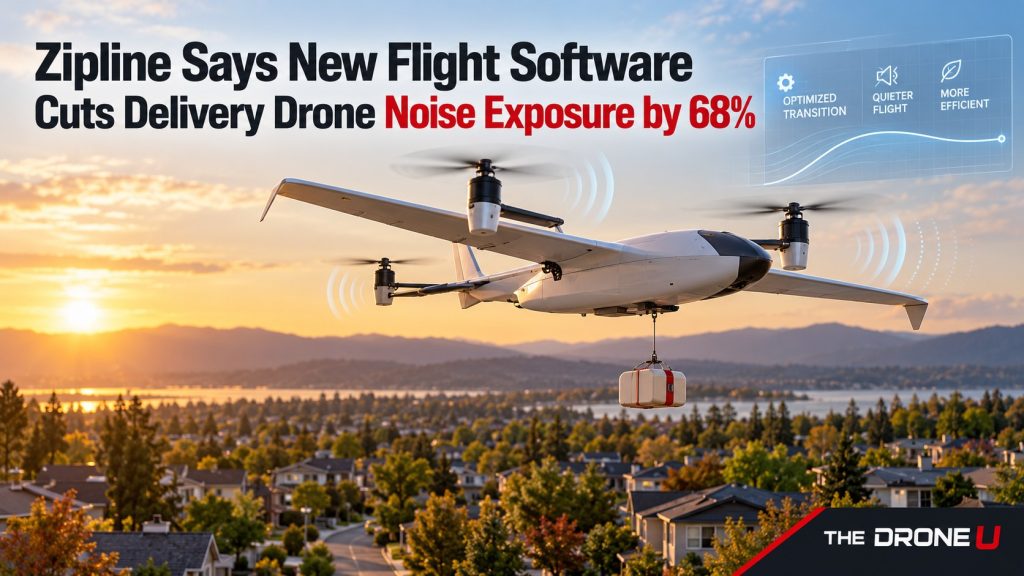
Zipline Says New Flight Software Cuts Delivery Drone Noise Exposure by 68%
October 28, 2026
Noise has become the main complaint about drone delivery. It comes up whenever a town debates a new hub, and it’s behind the decibel caps some cities are starting to write into law. On October 27, Zipline said a software change now running on its entire fleet makes its deliveries noticeably quieter. The update doesn’t involve new hardware or new propellers. It changes how the aircraft flies through the loudest part of each trip.
Zipline’s delivery aircraft is a hybrid. It takes off and lands vertically like a multirotor, then switches to wing-borne flight for cruise and shuts down all but one motor. The noisiest part of a flight is the transition, when the drone is still on its lift rotors and building enough airspeed for the wing to take over.
Zipline calls the new approach sound-optimized dynamic flying. Until now, the drone flew a fixed, pre-planned climb and descent. Now it measures the wind at takeoff with its onboard weather sensors and feeds that into a sound model. The model picks the quietest way to get onto the wing. Sometimes that means pitching the nose down to pick up speed quickly, like coasting downhill on a bike. At the end of a flight it can pull up to bleed off speed instead of slowing down on its rotors.
Zipline says the change works alongside earlier hardware and software improvements. The company’s figures, which it says are based on internal modeling and compared with its 2025 fleet, are:
The company also pointed to its delivery design. The main aircraft holds about 330 feet above the ground while a tethered “droid” lowers the package. Zipline contrasts that with an average of about 32 feet for other delivery services. CTO Keenan Wyrobek said the goal is for people to like having Zipline around, not just put up with it.
The figures come from Zipline’s own modeling, and the company hasn’t published independent field measurements. Still, the announcement shows where delivery competition is going. Local fights over drone hubs, from Massachusetts to Oregon, have centered on how loud the drones are near homes. Some cities now regulate the ground side directly. Northglenn, Colorado’s new hub ordinance, for example, limits noise from ground equipment and ground operations to 65 decibels at the property line. Reducing noise with software, without new aircraft, could become a common answer as companies like Zipline, Wing and Amazon expand into more suburbs.
The efficiency gains matter too. If a drone uses a fifth less energy per flight, it can spend more time flying between charges, and that supports more deliveries from each dock. That matters as Zipline adds sites, including the charging-tower location it is permitting in Charlotte.
Most Part 107 pilots fly multirotors, and those can’t glide on a wing. The lesson still carries over: how you fly affects how people feel about drones.
If you want to turn careful, neighbor-friendly flying into paid work, start with your certificate. Our Part 107 course walks you through the rules, the airspace and the test.
Sources: Zipline newsroom; DroneDJ; City of Northglenn CB-2043
 0