

BETA Technologies Posts Record Quarter: $17.7 Million in Revenue, a $4 Billion Backlog and 250,000 Miles Flown

November 4, 2026
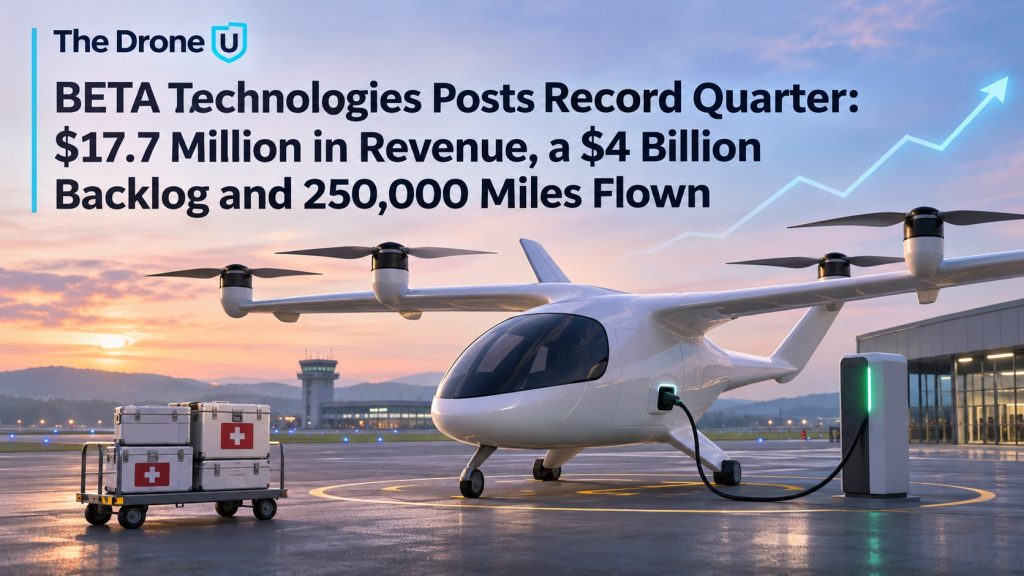
BETA Technologies just had its best quarter ever, and the numbers say a lot about where electric aviation is actually making money today. The Vermont company, which trades on the New York Stock Exchange as BETA, reported third-quarter 2026 revenue of $17.7 million on Tuesday, November 3. That is up 98% from $8.9 million a year earlier and above the company’s own guidance range.
BETA also raised its full-year 2026 revenue forecast to between $52 million and $57 million. It is still spending heavily, though, with a quarterly net loss of $119.1 million.
The operational stats may be more telling than the financials. BETA says its fleet has now flown more than 250,000 nautical miles, passing its year-end target early, across both its conventional takeoff CX300 and its vertical takeoff A250. Its open charging network has grown to 168 sites across the U.S.
The company also says it has launched six of its seven projects in the FAA’s eVTOL Integration Pilot Program (eIPP). Examples it highlighted include moving medical supplies in North Carolina, delivering emergency response equipment in Texas and carrying time-sensitive cancer medicines in Utah.
The quarter’s headline regulatory item came in October: the A250 became the first electric VTOL aircraft to receive an FAA Special Airworthiness Certificate for market surveys, which lets BETA fly prospective customers aboard before the aircraft has a type certificate.
“This was our strongest quarter of revenue since inception, and we’re exceeding the targets we set at the beginning of 2026,” founder and CEO Kyle Clark said in the release. He credited what he called a “stepwise” approach: fly real missions, learn from them and feed that back into the aircraft as the company moves toward production and certification.
Trend coverage of the earnings has described this as a pivot from passenger air taxis to cargo and medical work. BETA’s own release does not use that word. It describes the company as an aerospace and defense business that sells aircraft, electric motors, components and chargers to cargo, logistics, defense, passenger and medical customers. In practice, though, almost every mission it highlighted this quarter carried cargo, medicine or equipment, not paying passengers. That fits a pattern across the industry: missions with no passengers on board are simply easier to get approved and flying first.
The other takeaway is in the revenue mix. Services brought in more than twice as much as product sales this quarter, so BETA is not yet living on aircraft deliveries. The release does not break the service figure down further.
Electric aviation and the drone world are converging. The same middle-mile medical and logistics routes that BETA is flying with crewed electric aircraft are where large cargo drones are also competing, and the FAA’s work on BVLOS and eIPP operations will shape the shared low-altitude airspace that every drone pilot flies in. Expect more electric aircraft around regional airports and hospitals, and more reasons to check NOTAMs and stay sharp on right-of-way rules.
The jobs are coming too: operations, data and flight roles at companies like BETA increasingly favor people who already understand airspace, weather and aeronautical decision-making. A Part 107 certificate is a smart first credential. Drone U’s Part 107 course covers all of it, and students have been known to finish the online course in three days and pass the test.
Sources: BETA Technologies; BETA Technologies earnings release (SEC filing); HoverNews
 0