

Oshkosh, the Military Truck Maker, Will Build Grid Aero’s Lifter Autonomous Cargo Drones

November 4, 2026
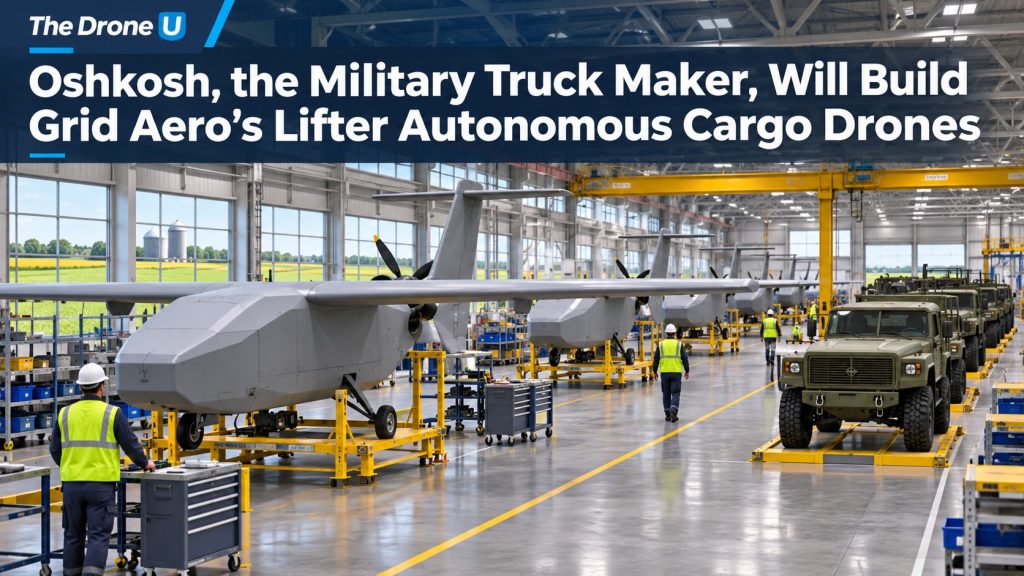
Oshkosh Defense is best known for building military trucks, MRAPs and airport fire rescue vehicles. Now it plans to build drones, and big ones. On Monday, November 2, the Wisconsin manufacturer announced a strategic partnership with Silicon Valley startup Grid Aero to industrialize and eventually mass-produce Grid Aero’s Lifter, an autonomous cargo aircraft with modular payloads.
Defense Daily reported that the deal pairs Oshkosh’s manufacturing experience with a low-cost autonomous aircraft that can carry thousands of pounds of cargo over long ranges. Defense News reported that the Lifter would be the first aircraft Oshkosh has ever produced.
According to the Oshkosh release, Oshkosh will work with Grid Aero on design for manufacturability, production planning and supply chain optimization, and ultimately on building Lifter aircraft at scale using its Wisconsin factories and workforce. Early work focuses on production engineering and customer engagement, with the goal of showing defense customers a production-ready autonomous logistics aircraft.
It is a manufacturing partnership, not a government purchase. No contract value or order was announced. Grid Aero will keep developing the aircraft and handle low-rate production at first, while Oshkosh sets up a pilot production line. Grid Aero CEO Arthur Dubois told Breaking Defense he expects another six to 12 months of prototype testing and a pilot line at Oshkosh in roughly a year, with a goal of producing hundreds or even thousands of aircraft by the early 2030s.
Grid Aero, founded in 2024, calls the Lifter a “pickup truck of the skies.” Dubois said in the release that it is “simple, rugged, piston-powered, and built from ubiquitous materials, borrowing as much from military trucks as from traditional aircraft.” Defense News reported that Oshkosh liked the Lifter partly because it uses metal construction rather than composites, which matches the kind of fabrication Oshkosh already does.
Dubois told Breaking Defense the aircraft is designed to carry a “few” thousand pounds for a “few” thousand miles, with modular payload bays for cargo, intelligence, surveillance and reconnaissance, or other missions. That puts the Lifter in the military’s Group 4 or Group 5 categories, which cover unmanned aircraft heavier than 1,320 pounds.
“This partnership represents a new model for defense innovation, bringing Silicon Valley’s transformative technology development together with the Midwest’s unmatched manufacturing capability,” said Logan Jones, Oshkosh Defense’s chief growth officer. Jones told Defense News the companies plan to shift production to Oshkosh in stages as customer demand grows.
The Pentagon has been asking for “affordable mass,” meaning large numbers of low-cost Group 4 and 5 drones it can buy in quantity, adapt to new payloads and replace quickly. That mostly isn’t happening with exquisite, hand-built aircraft. Bringing in a company that already builds thousands of vehicles a year on lines that switch between variants is one answer, and it follows a run of recent deals aimed at building more of the U.S. drone supply chain at home.
The Navy and Marine Corps are also shopping. DroneLife reported Monday that a new Navy program office is planning a Marine Corps cargo drone demonstration in Huntsville, Alabama, early next year, the kind of event a Lifter could be built for.
Large autonomous cargo aircraft are a long way from the 55-pound limit of Part 107, but the trend lines connect. Defense money is building a U.S. drone manufacturing base, and companies like Grid Aero say they are also targeting commercial customers. Middle-mile cargo, disaster logistics and remote resupply are civilian missions that need the same kind of aircraft, and they will need trained operators, visual observers, maintainers and mission planners who understand airspace.
If you want to be part of that workforce, start with the basics. An FAA Part 107 certificate is the entry ticket for commercial drone work in the U.S. Drone U’s Part 107 course gets you ready for the knowledge test, and students have been known to complete the online course in three days and pass.
Sources: Defense Daily; Oshkosh Defense; Defense News; Breaking Defense; DroneLife (Navy cargo drone demo)
 0
