

Shield AI Finishes First X-BAT Prototype and Rolls It Toward Flight Test in Kansas

November 5, 2026
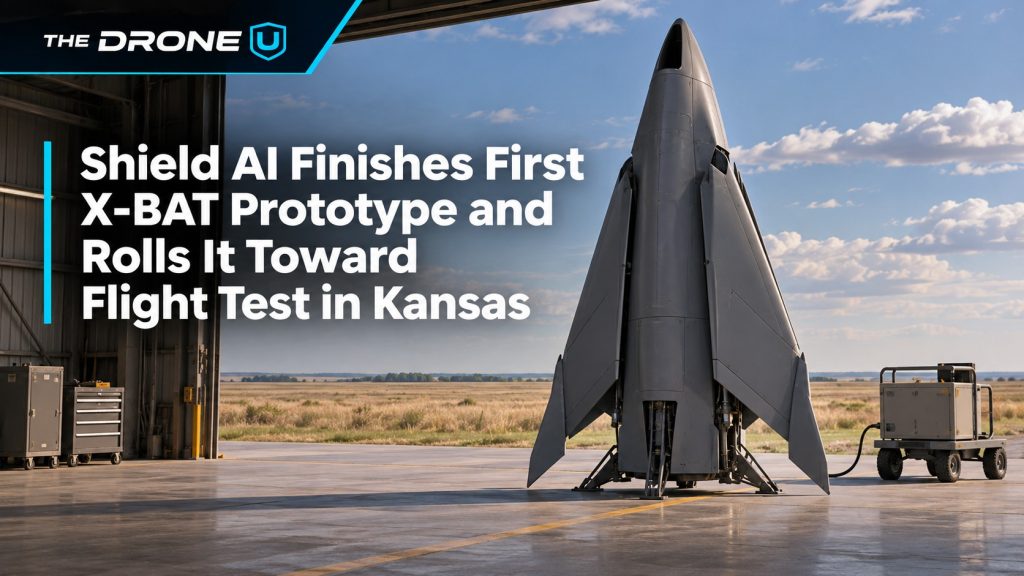
Shield AI says it has finished building the first full-scale prototype of X-BAT, its autonomous vertical-takeoff strike aircraft, and is moving the jet from Frisco, Texas, to the company’s flight-test site in Newton, Kansas. Defense Daily flagged the milestone on November 4; Shield’s own engineering post the same day walks through what comes next on the test stand.
Armor Harris, Shield’s senior vice president of aircraft engineering, wrote that the company shared the X-BAT design a year ago and has now completed the first full-scale prototype. The aircraft is a tail-sitting VTOL combat drone meant to take off and land vertically from short paved pads or ship decks, then transition to conventional flight. Aviation Week, covering a Munich display of the prototype, reported Shield plans a first flight before the end of 2026. Defense Daily’s lede likewise said the Kansas campaign is expected to produce a first flight this year.
Harris’s post is careful about the near-term sequence. Testing starts with the aircraft horizontal on its launch-and-recovery vehicle for engine runs, then vertical engine runs, then crane-suspended flights as a safety tether before untethered work. The crane is only a test aid, he wrote, so an engine stall does not put the prototype into the ground.
Shield is pitching X-BAT as a multi-role aircraft, not a small air-to-air wingman. Harris said it is sized to carry serious strike weapons inside and outside the airframe, plus air-to-air, electronic warfare and other mission sets. That puts it in a different class from Air Force Increment 1 collaborative combat aircraft, which he described as much smaller and focused on air-to-air. X-BAT is roughly twice that size, carries more sensors, and uses a General Electric F110 engine with thrust vectoring for a more fighter-like envelope, according to Shield and Aviation Week’s technical description of vertical lift on afterburner.
The strategic argument is basing. Long-range missiles make fixed airfields vulnerable; a VTOL fighter that can hide on a ship or an island forces an adversary to hunt for it, Shield says, while other U.S. forces maneuver.
Harris said Shield is focused now on widening the launch-and-recovery envelope, then aims to fly a missionized aircraft in 2028 and move into production in 2029. Aviation Week separately reported the company talking about accelerating flight test ahead of low-rate production in 2028 and initial operational capability in 2029 — the same years, with slightly different milestones depending on the speaker.
X-BAT is not a Part 107 quadcopter, but the industrial story matters. Defense primes and startups are hiring people who already understand airspace, risk management and uncrewed operations language. The same fundamentals that keep a construction pilot legal under Part 107 are the ones defense programs expect when they pull civilian talent into test ranges and contractor flight ops.
If you want that door open, start with the certificate. Drone U’s Part 107 test prep course gets you ready for the FAA knowledge test, and students have been known to finish the online course in three days and pass.
Sources: Defense Daily; Shield AI; Aviation Week
 0
