
AutoFlight Flies Five Mixed eVTOLs in Formation for 47 Minutes Over Kunshan

November 6, 2026
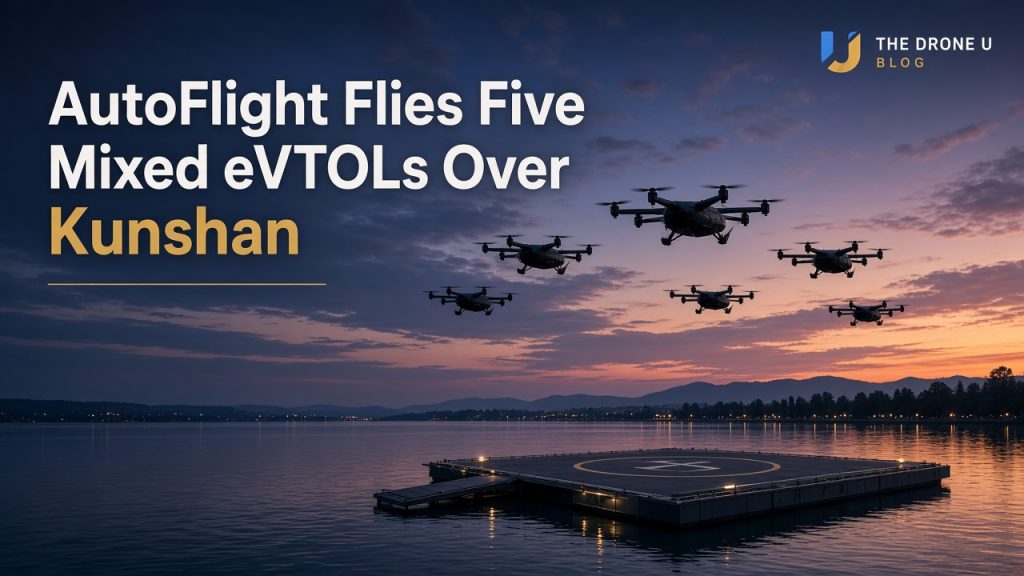
Five electric vertical-takeoff aircraft just flew as a coordinated pack over eastern China — and according to the company that built them, none of the pilots had their hands on the controls. AutoFlight says it completed a mixed-fleet formation on October 31 and November 1 at its Bailian Lake Flight Test Base in Kunshan, pairing one 5-ton V5000 Matrix with four 2-ton machines across cargo and firefighting variants.
HoverNews surfaced the milestone for eVTOL readers; the primary account is AutoFlight’s own newsroom post, with corroborating coverage from Xinhua.
The formation mixed three models: the V5000 Matrix lead ship, the V2000CG CarryAll cargo eVTOL and the V2000CGF CarryAll firefighting eVTOL. AutoFlight says the five-aircraft flight lasted 47 minutes and that the lead V5000 covered more than 133 kilometers. The entire sortie was autonomous, with no manual intervention. On November 1 the company says the pack held horizontal and vertical separation even in strong winds — a non-trivial claim when the aircraft do not share the same mass or mission profile.
Guests included alumni from the Stanford Executive Program, international eVTOL professionals, customers and partners. After touring Sunship, AutoFlight’s water-based vertiport on Dianshan Lake, they watched the formation from the shoreline. The company positions the demo as a step beyond its three-aircraft formation in May 2026 and as groundwork for low-altitude networks that stitch long-haul, regional and last-mile legs together.
Most early eVTOL publicity films show a single sleek air taxi on a perfect day. Operators who want cargo, emergency response and passenger hops in the same metro will eventually need different airframes to share corridors, vertiports and traffic-management services. A five-ship mixed formation does not equal a certified U.S. airline operation, but it is a concrete data point that multi-model autonomy is leaving the slide deck.
Coordinating different weight classes also stresses communication links, contingency logic and collision-avoidance assumptions that single-type demos never touch. AutoFlight’s own framing — connecting air and sea mobility through eVTOLs and platforms like Sunship — is aimed at that denser future, even if today’s flight was still a controlled test-base show for invited guests.
Xinhua’s brief matched the core numbers — five aircraft, 47 minutes, more than 133 kilometers — without adding independent telemetry. Treat the “world’s first†label as AutoFlight’s framing until other manufacturers publish comparable mixed-fleet sorties with third-party verification.
Part 107 remote pilots will not be flying five-ton eVTOLs next week, but the airspace those aircraft want is the same low-altitude band delivery drones, public-safety UAS and eventually air taxis will share. Understanding how formation autonomy, vertiports and UTM concepts fit beside today’s NOTAMs and LAANC authorizations is becoming part of professional literacy.
That literacy still starts with a certificate. Drone U’s Part 107 test prep course covers the airspace and operations foundation advanced air mobility employers expect from UAS talent, and students have been known to complete it in three days and pass the test.
Sources: AutoFlight newsroom; Xinhua; HoverNews
 0