

Axon Bets $1.2 Billion on Skydio and Becomes Its Exclusive Public Safety Seller in the U.S. and Canada

November 9, 2026
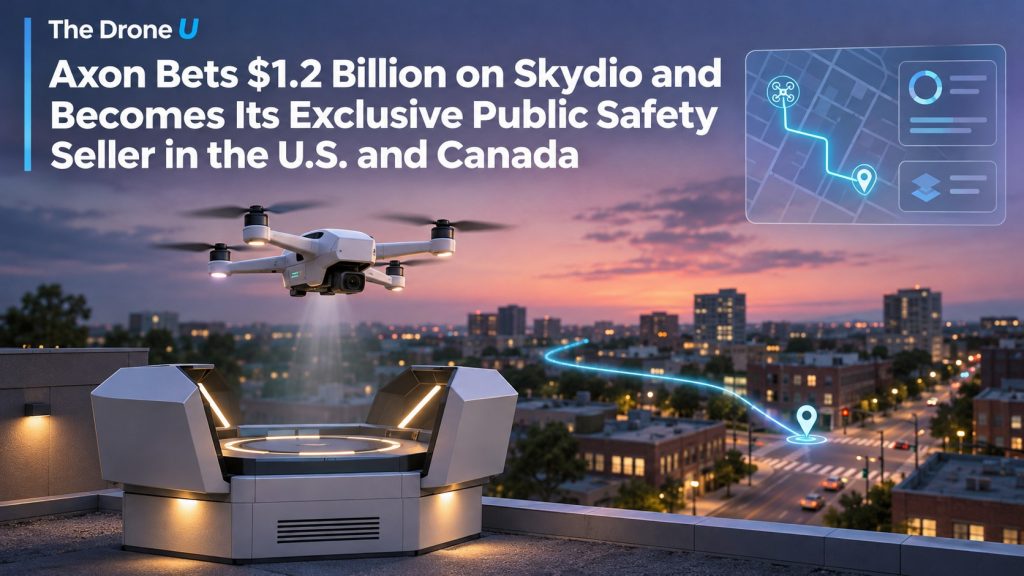
The biggest public-safety drone deal of the year has been signed. Axon is putting about $1.2 billion more into Skydio. Axon is the company behind TASER, police body cameras and the Evidence.com software stack. Under the deal it also becomes Skydio’s exclusive distributor to public-safety agencies in the United States and Canada.
Both companies announced the agreement on November 5, the same day Axon reported its third-quarter results. Axon calls it the largest single investment in its history.
Skydio says it expects roughly $1 billion in total bookings this fiscal year. Axon puts the market for drone as first responder (DFR) programs at about $13 billion in the U.S. and Canada alone.
The investment gets the headlines, but the channel deal will matter more to most agencies. U.S. and Canadian police, fire and other public-safety buyers will now get Skydio through Axon. Skydio still sells on its own in defense, enterprise and other commercial markets.
The two companies already work closely together. Skydio docks and drones stream into Axon’s Fusus real-time crime center software. Officers wearing Axon’s Body 4 camera can request a drone, and that request is routed to Skydio’s DFR Command dispatch tool. Drone footage can also go into the same digital evidence system agencies use for body-camera video. Axon’s shareholder letter also mentions Dedrone, the airspace security company it already owns, as part of what it calls an integrated platform for detecting, understanding and responding to incidents.
The companies say Skydio serves more than 1,500 public-safety customers and that more than 28 million Americans now live within two miles of a Skydio DFR dock. They also say agencies using Skydio DFR have cut priority response times by as much as 65%, with the drone arriving before officers on about 80% of calls where it is sent. Those are company-reported results from Skydio deployments, not independent averages for DFR programs in general.
Neither the press release nor the SEC filing explains how existing direct contracts between agencies and Skydio, or Skydio’s current resellers and integrators, will move to the Axon channel. Agencies with active Skydio programs or pending purchases should ask their reps about pricing, support and renewal terms before budgets are finalized.
The deal also concentrates the U.S. public-safety drone market. With DJI hardware shut out of new FCC authorizations, many departments have already moved toward American-made platforms. The biggest of those platforms is now tied to the dominant police technology vendor, which will raise competition questions from other U.S. drone makers and from procurement officers.
If you fly for a police or fire department, or want to, DFR is quickly becoming the main way public-safety agencies use drones. DFR programs usually run beyond visual line of sight from docks on rooftops. They depend on FAA waivers or Part 108-style approvals, trained remote pilots in the loop and strict data-handling rules. That creates jobs for remote pilots, program managers and drone dispatchers who understand both airspace and agency procedure.
Almost every one of those roles starts with an FAA Part 107 remote pilot certificate. If you don’t have yours yet, Drone U’s Part 107 course is a quick place to start, and students have been known to complete the online course in 3 days and pass the test.
Sources: DroneLife; Axon press release; Axon Form 8-K; Axon Q3 2026 shareholder letter.
 0
