

ASICS Says Corvus Warehouse Drones Help It Recover Lost Stock 60% Faster in Mississippi

November 12, 2026
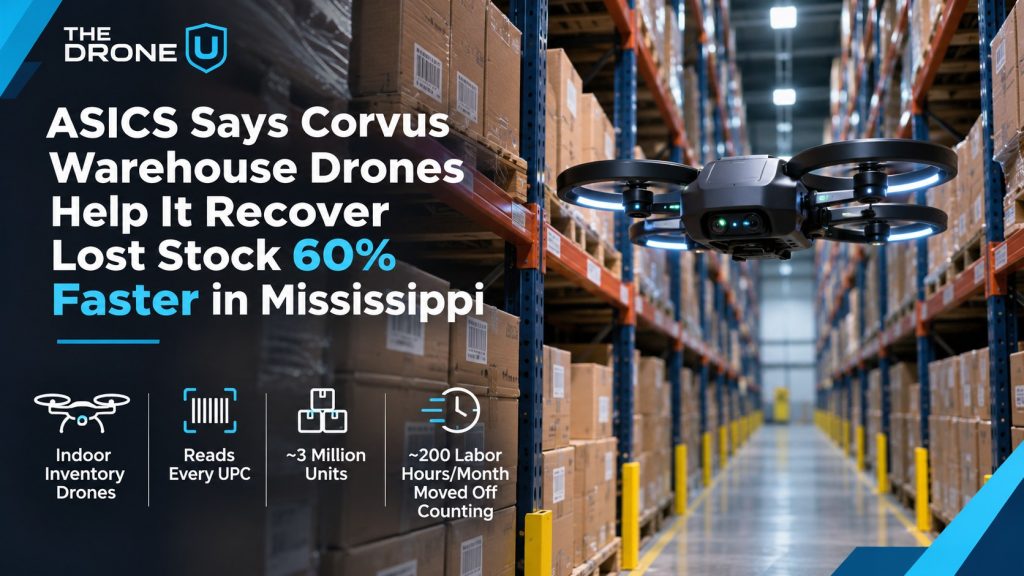
ASICS America is flying autonomous inventory drones inside its distribution center in Byhalia, Mississippi, and the company says the results are already showing up in how fast it finds lost product. In a Nov. 10 press release, Corvus Robotics said ASICS is running its Corvus One drones in the 855,000-square-foot warehouse and reports recovering misplaced inventory about 60% faster since the system went in. Those figures come from the two companies. They have not been independently audited.
Corvus, which is based in Mountain View, California, describes Corvus One as an autonomous inventory system that flies inside active buildings with no added localization infrastructure such as stickers, beacons or markers. At Byhalia, ASICS schedules seven flights a night, starting around 7 p.m., in very narrow aisles less than 6 feet wide. The drones use onboard computer vision, the company says, and no extra infrastructure was installed in the building.
The aircraft are covering two storage areas Corvus calls the facility’s highest-risk zones: the singles area, where returned and single-pair product is stored and picked, and case reserve. Both had been counted twice a year under ASICS’s cycle-count policy. They are now counted monthly, which Corvus describes as a sixfold increase. The next morning, an inventory associate reviews each flight and works through most discrepancies from a desk, using video and stills the drones capture at every location. On the same pass, Corvus says, the drone reads every UPC and counts the boxes in a location so the two totals can be checked against each other.
The Byhalia campus holds close to 3 million units, including 2.3 million pairs of footwear and 700,000 pieces of apparel and accessories, across roughly 44,000 SKUs, all managed in a Manhattan Associates warehouse management system. It ships e-commerce orders, wholesale accounts and ASICS retail stores.
Kyle Koestler, ASICS America’s senior director of distribution and transportation, said a missing unit could once go unnoticed for six months, long enough to cancel an order for the last pair in the building. “With Corvus One, we’re cycle counting on a monthly basis so we can surface any errors sooner and ensure customer orders are delivered on time,” he said in the release. ASICS says about 200 labor hours a month have moved off manual counting and into inventory research, exception work and other projects. In one three-month stretch, according to the release, the drones turned up 26 misplaced cases holding more than 200 pairs of shoes.
The companies also tie the counts to online marketplace listings. Before the deployment, ASICS says it held back 12 to 15 units out of every 100 from availability feeds because the tail of the inventory chain carried fulfillment risk. It now says it publishes the full feed and can sell that product at full price. Mohammed Kabir, Corvus’s CEO and co-founder, called a footwear distribution center with tens of thousands of SKUs “one of the more complex inventory environments in the industry.” Corvus says it designs the system in the United States and manufactures each unit at its Mountain View headquarters. A longer writeup is on the company’s ASICS case study page.
This is indoor warehouse work, not a typical outdoor Part 107 job, and the system is built to fly itself down an aisle. Even so, it is a useful look at where inventory and logistics companies are putting autonomous aircraft, and at how much of the value sits in the software that reads a location and flags a mismatch. Professional drone work still starts with knowing the rules when a mission leaves the warehouse and enters the national airspace system. Drone U’s Part 107 test prep course covers that exam, and students have been known to take the online course in 3 days and pass the test. For the automation side of jobs like this, Drone U also offers AI automation classes.
Sources: Corvus Robotics press release, Nov. 10, 2026; Corvus Robotics ASICS case study. Performance figures are company-reported.
 0
