

Pentagon’s Drone Dominance Program Sends Eight Reusable Bomber Drones to the Final Gauntlet at Camp Grayling

November 13, 2026
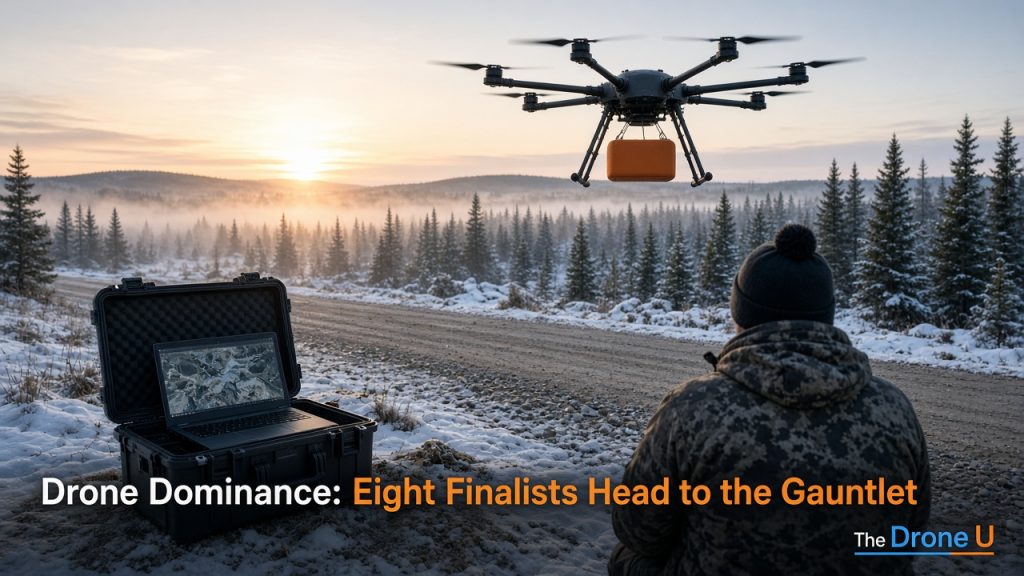
The Pentagon’s Drone Dominance Program has narrowed its reusable bomber drone competition to eight companies, and the final round starts today. Gauntlet 2.5 opens Friday, Nov. 13, at Camp Grayling in northern Michigan. There, military operators, not company pilots, will fly each finalist’s aircraft through long-range strike scenarios. The program says results will be posted after the event wraps up.
According to the program’s announcement, listed alphabetically, the eight finalists are:
The program first invited 17 companies to the bomber qualifier in September. That event slipped from October to early November and began Nov. 7. Twelve companies ended up flying in it. Four of them, The Airo Group, KRUSH Tech, UDD Tech and W.S. Darley & Co., took part but did not advance, and five invitees did not show. Several finalists have Ukrainian roots. Defense Daily, which reported the selections on Nov. 12, identified Grim Tech as a Ukrainian company. Swarm Defense was already a top performer in the program’s earlier deep strike round.
Earlier Drone Dominance rounds focused on one-way attack drones that are expended on the mission. Phase 2.5, which the program’s request for solutions calls Mission C, asks for something different: a drone that can carry multiple munitions to a target 15 to 30 kilometers away, release them, and come home to fly again. The requirements include:
Only inert payloads are allowed at the event; live explosives are excluded from Mission C testing. Each finalist had to bring at least six working aircraft, two sets of ground control equipment and 120 inert payloads. As part of advancing, the government is buying six aircraft, two control sets and 300 inert payloads from each finalist for $150,000.
The request for solutions says roughly three vendors are expected to come out of the Gauntlet with prototype delivery orders for at least 200 sets each, along with 40 inert payloads per set. The program plans about $32 million in initial prototype orders for this phase. That is a small slice of the broader effort, which the Defense Department describes as a roughly $1 billion, multi-phase push to buy more than 200,000 low-cost drones by 2027 and grow the domestic drone industrial base. The Test Resource Management Center runs the events, the Defense Innovation Unit handles industry engagement, and Naval Surface Warfare Center Crane issues the orders.
The program has also been recruiting the operators who will fly these systems. In October it put out a call for service members with FPV experience to volunteer as pilots for future Gauntlets.
Most of our readers will never fly a bomber drone, but this competition tracks closely with the skills commercial pilots already use. Every system is being judged on whether ordinary operators can get it working fast, fly it beyond line of sight, and keep control when GPS and radio links get messy. The same competencies, plus solid airspace knowledge and disciplined preflight habits, are what defense contractors, test ranges and public safety agencies look for when hiring. The big money flowing into U.S. drone manufacturing is also creating civilian jobs in test flying, training and field support. If you want to be ready for that work, start with your FAA certificate. Drone U’s Part 107 test prep course covers airspace, weather, regulations and operations, and students have been known to take the online course in 3 days and pass the test.
Sources: Defense Daily; Drone Dominance Program announcements; Drone Dominance Program (including the Phase 2.5 Mission C request for solutions); Inside Defense.
 0