

Pentagon Picks Seven Laser Weapons for a Counter-Drone Shoot-Off at Dugway

November 18, 2026
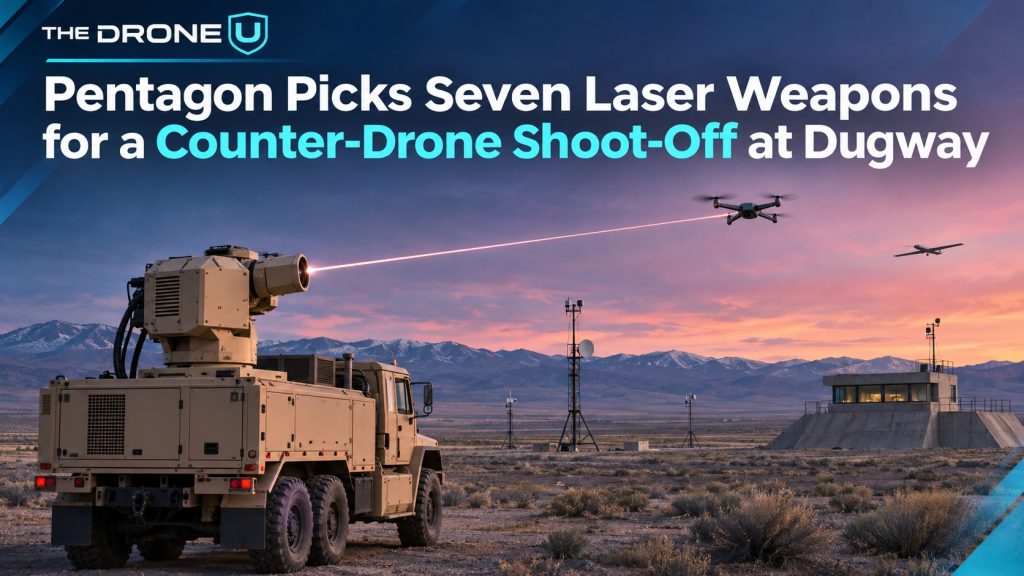
The Pentagon has picked seven companies to bring high-energy laser weapons to a live-fire counter-drone “shoot-off” at Dugway Proving Ground in Utah next month. The Department of War’s Office of Research and Engineering (R&E) and Joint Interagency Task Force 401 (JIATF 401) announced the selections on Nov. 16, saying the reviewers chose seven systems out of 13 technical white papers. Defense Daily reported the picks the same day.
According to the department’s release, these teams and systems are moving to Phase II of the directed energy counter-UAS evaluation:
The list mixes large defense primes with much smaller firms. Yrikka’s entry is the one to watch, because it puts the laser on a drone instead of a truck, pallet or fixed mount. The department did not name the six companies that weren’t selected.
Through the rest of November, the vendors have to finish laser safety certifications and connect their systems to the test’s command-and-control architecture. Each system then has to arrive at Dugway for a week of safety reviews, communications checks and range-readiness testing before it can fire.
Live-fire “target vignettes” are scheduled to start by mid-December. The lasers will engage representative unmanned aerial targets in planned scenarios, and evaluators will grade how well each system tracks and defeats drones both above and below the horizon. Below the horizon generally means drones flying low against terrain or buildings, which are harder to spot and harder to engage safely.
The bigger story is speed. “We’re trying to structure the shoot-off in such a way that systems that perform effectively or successfully can immediately result in a purchase order that allows us to start building the production lines to get these systems into the field,” said Army Brig. Gen. Matthew Ross, JIATF 401’s director. In other words, the test is meant to lead directly to orders, not to another round of studies.
Cheap drones have upended air defense. Shooting down a small quadcopter or a one-way attack drone with an interceptor missile can cost far more than the drone itself, and a magazine runs out. Lasers promise a very low cost per shot and, as long as there’s power and cooling, a much deeper magazine. They also come with real limits: weather, dust and smoke can weaken the beam, the laser has to stay on target long enough to cause damage, and there are strict safety rules about where a beam can go.
JIATF 401 was set up to speed up how the military and its government partners buy counter-drone technology, both at home and overseas. This shoot-off fits that job. It is one of several fast-track efforts this year, along with the Drone Dominance program and the Army’s new small-drone Manufacturing Rodeo.
Most commercial and hobby pilots will never get near a high-energy laser. Still, the direction is clear: counter-drone systems are spreading fast, and they are designed to detect and stop aircraft that show up where they aren’t expected. Military installations, critical infrastructure and many large events already use detection tools, and many security TFRs now warn that federal agencies may disable or seize drones they see as a threat. Stay well clear of military bases and restricted areas, check NOTAMs before every flight, and keep Remote ID broadcasting so you can be identified as a legitimate operator. Understanding special use airspace and TFRs is core material in Drone U’s Part 107 course.
The shoot-off is also a reminder that drone and counter-drone work is a growing career field. The companies building, testing and running these systems need people who understand how small UAS actually fly.
Sources: U.S. Department of War release (Nov. 16, 2026); Defense Daily (Matthew Beinart, Nov. 16, 2026); DefenseScoop.
 0