

AIR Ships Its 550-Pound-Payload Autonomous Cargo eVTOL to Florida for U.S. Demos

November 18, 2026
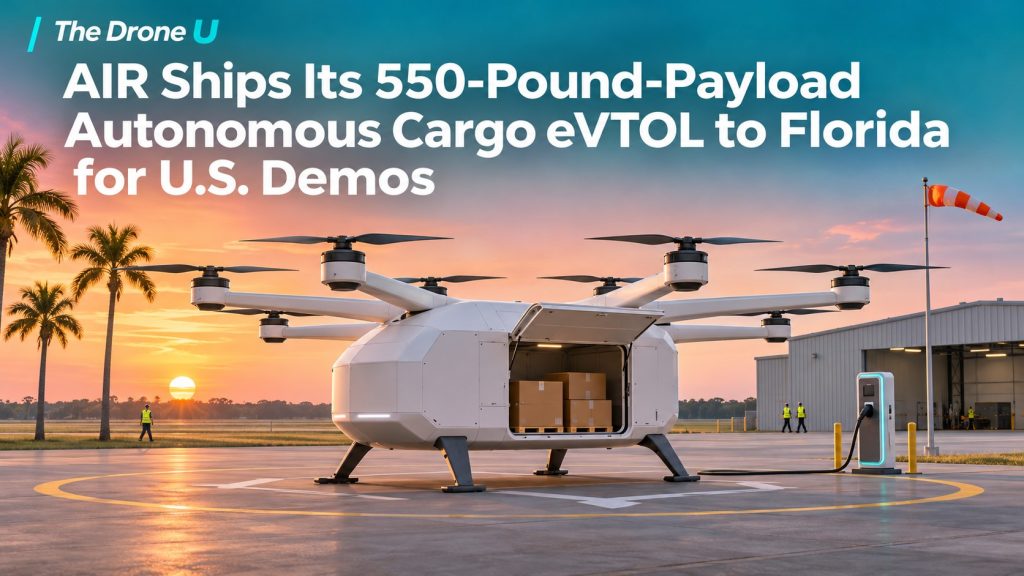
A large autonomous cargo eVTOL is coming to Florida. AIR VEV, the Israeli company also known for its AIR ONE personal eVTOL, said on Nov. 16 that it has shipped its first AIR 120D autonomous cargo aircraft to its U.S. headquarters in Auburndale, Florida. The aircraft will fly demonstrations there, at the state’s SunTrax advanced air mobility test site. FLYING Magazine and AVweb both covered the shipment.
According to AIR’s announcement, the 120D carries cargo with no pilot on board. It can haul about 550 pounds (250 kg) in a 70-cubic-foot cargo bay and takes off and lands vertically, so it doesn’t need a runway. FLYING puts its endurance at about one hour. AIR lists missions such as remote resupply, maritime logistics, commercial mid-mile delivery and humanitarian aid, and says the aircraft falls in the U.S. military’s Group 4 UAS category.
The company says the cargo platform is backed by customer deliveries and hundreds of development flights. AVweb notes that AIR flew its production cargo configuration for the first time in April and reported at the time that more than 25 aircraft had been ordered and paid for.
AIR announced in August that it would put its U.S. headquarters at SunTrax under an agreement with the Florida Department of Transportation, and bring flight programs for both the AIR ONE and its cargo aircraft there. SunTrax, in Polk County, is the state’s dedicated test environment for advanced air mobility. FLYING describes it as the home of the nation’s first AAM aerial test track, with dedicated airspace, vertiports, charging stations and maintenance hangars.
AIR says bringing the 120D to Florida moves forward its plans for U.S. aircraft production and flight operations. Florida keeps adding to its eVTOL activity: AVweb points out that the FAA said on Oct. 30 that the state had finished demonstration flights over Tampa Bay with Joby Aviation and BETA Technologies aircraft.
A few things are still unknown. AIR has not given a date for the 120D’s first U.S. flight, and it has not said which FAA authorizations will cover the demonstrations. The FAA experimental airworthiness certificate AIR received earlier covers the two-seat AIR ONE, not the cargo aircraft.
At roughly 550 pounds of payload, the 120D is in a different class from the drones most Part 107 pilots fly. Part 107 covers unmanned aircraft under 55 pounds, so an aircraft like this needs a separate path, such as experimental certificates, exemptions or, eventually, type certification. That is a good reminder of how the drone industry is splitting. Small drones handle inspection, mapping, media and last-mile delivery. Larger autonomous aircraft are going after the middle-mile and military logistics market that helicopters and small cargo planes serve today.
The skills carry over, though. Autonomous cargo operations still need people who understand airspace, weather, preflight planning, maintenance, and the remote-pilot and supervision roles regulators expect. A Part 107 certificate and hands-on small-drone experience are a practical way into that world. If you want to grow with this side of the industry, Drone U’s Part 107 course is the first step. Students have been known to finish the online course in 3 days and pass the test.
Keep an eye on SunTrax. Once demonstrations begin, Florida could become one of the first places in the U.S. where the public sees heavy autonomous cargo eVTOLs flying regularly, and the approvals behind those flights will show how the FAA plans to handle aircraft of this size.
Sources: AIR VEV announcement via PR Newswire (Nov. 16, 2026); FLYING Magazine (Nov. 17, 2026); AVweb.
 0
