

FCC Approves a Nationwide Drone Control Network and Drone-Detection Radar

November 19, 2026
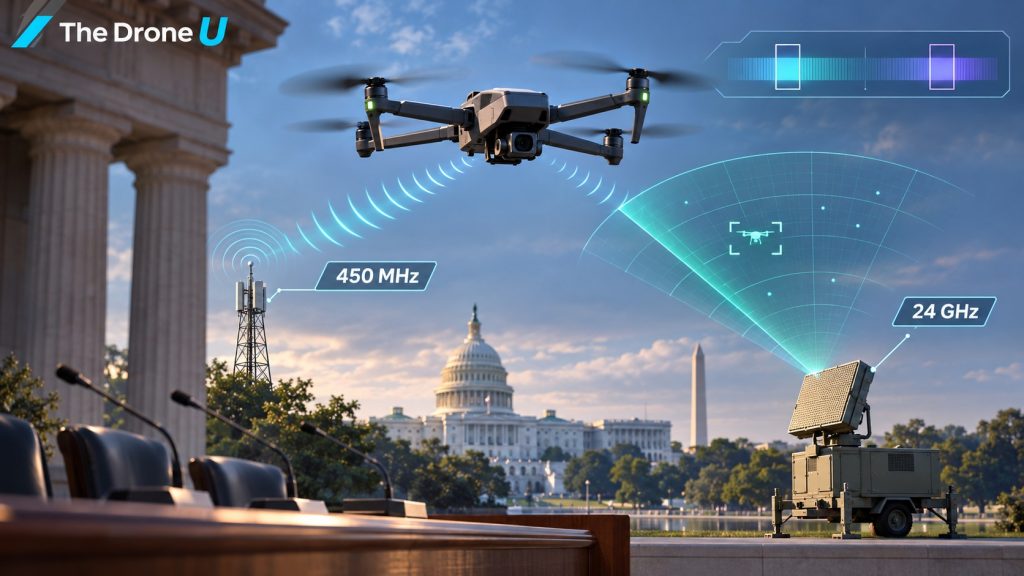
The FCC voted Thursday, Nov. 19, to adopt a package of final rules that opens a sliver of the 450 MHz band to drone command-and-control links under a nationwide license, lets ground-based radars use the 24.45–24.65 GHz band to detect drones, and updates in-flight broadband rules in the 800 MHz air-ground band. In a news release issued after the open meeting, the Commission said Chairman Brendan Carr and Commissioners Gomez and Trusty approved the Report and Order (FCC 26-81). Carr and Trusty issued separate statements that had not been posted when this story was updated. The adopted order itself also had not been posted yet, so the licensing and build-out details below are from the 97-page public draft the FCC released on Oct. 29, the text the Commission had before it at the vote.
The new rules will open the 450 MHz band for safety-related data links between the ground and both crewed and uncrewed aircraft, and replace site-by-site rules with a more flexible nationwide licensing system meant to support drones and advanced air mobility. The band is small: 650 kilohertz split between 454.6625–454.9875 MHz and 459.6625–459.9875 MHz. Until now, the rules limited it to air-ground voice service for general aviation aircraft at high altitude, which effectively ruled out data and low-altitude use. The draft adds a primary allocation for aeronautical safety communications and allows control-and-non-payload communications, the link that lets a pilot command a drone, plus other flight-safety data.
One company holds every license in the band. In the draft, AURA Network Systems, which operates 54 sites, may voluntarily convert them into a single nationwide license covering the lower 48 states, Alaska, Hawaii and the U.S. territories. There’s no auction, and the draft declines to charge a windfall payment, pointing to the more than $100 million AURA says it has invested under an earlier waiver. The license term would be 15 years, and the draft lifts an application freeze that has been in place since January 2025.
The build-out rules are where drone pilots should look closely. The draft gives the licensee two options:
In other words, coverage at 400 feet, the Part 107 altitude limit, is one path to compliance, not a requirement. If the licensee misses its eight-year benchmark, the license ends automatically. We’ll confirm those benchmarks if they change when FCC 26-81 is posted.
The FCC said the new rules will allow ground-based radars to use 24.45–24.65 GHz to detect and track unauthorized or dangerous drones near airports, borders, prisons, stadiums and critical infrastructure. Radar maker Echodyne petitioned for the change in 2018, and so far Echodyne and MatrixSpace have run such radars only under waivers.
In the draft, radars would be licensed site by site under Part 90. Only fixed stations are allowed, though temporary-location licenses cover trailer- and vehicle-mounted setups. Airborne radars are turned down for now. The draft is explicit that a spectrum license “does not confer, expand, restrict, or otherwise alter” any legal authority needed to detect, track, mitigate or disable drones. A stadium can license a radar, but that radar doesn’t give anyone new power to take a drone down.
The Commission also said the decision will update rules for the 849–851/894–896 MHz commercial air-ground band so providers can deliver modern broadband more efficiently to commercial and other aircraft. The draft moves that band from peak to average power measurements.
If you fly a typical camera drone, nothing changes today. Those aircraft talk to their controllers on unlicensed 2.4 and 5.8 GHz radio. The 450 MHz network is aimed at long-range, beyond-visual-line-of-sight operations, the kind the FAA’s proposed Part 108 rule would make routine, and at future air taxis that need a protected, licensed control link. Whether it helps low-altitude commercial work will depend on which coverage option the licensee picks. The 24 GHz radars, meanwhile, mean more sites may be able to see your drone coming, which is another reason to keep Remote ID on and respect stadium and security TFRs.
Spectrum rules, airspace and BVLOS are all moving at once. A solid Part 107 foundation, like Drone U’s Part 107 course, makes it easier to keep up, and students have been known to take the online course in 3 days and pass the test. We’ll update this story when the adopted order and the Carr and Trusty statements are posted.
Sources: FCC news release, “FCC Votes to Release More Spectrum for the Skies,” Nov. 19, 2026 (DOC-427319A1); FCC public draft and fact sheet, “Unleashing American Drone Dominance; Facilitating Opportunities for Advanced Air Mobility,” GN Docket No. 26-74, WT Docket No. 24-629 (Oct. 29, 2026).
 0
