
Dubai Certifies Its Marina Vertiport, Completing Joby’s First Air Taxi Route

November 19, 2026
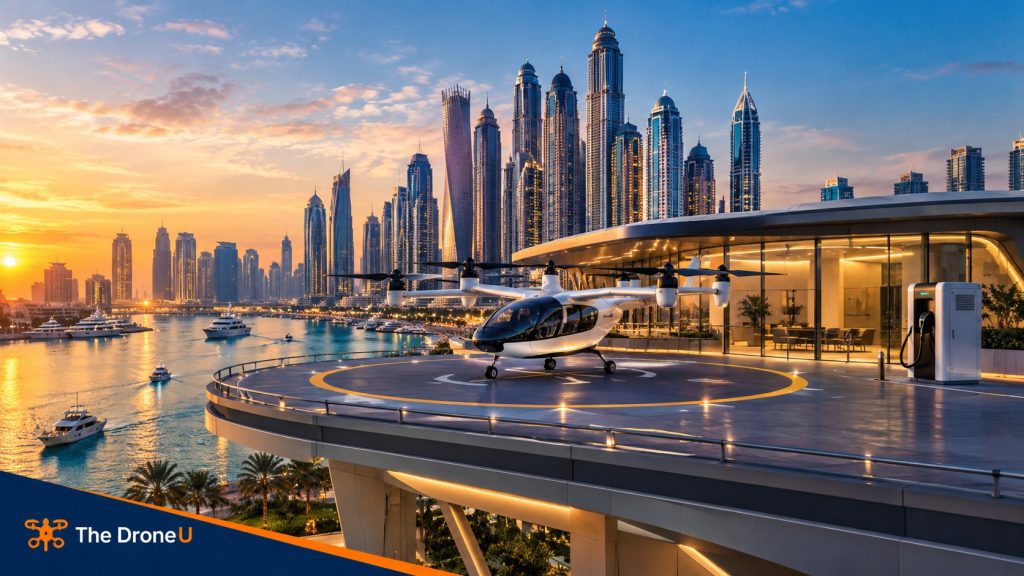
Dubai now has both ends of its first air taxi route built and certified. Vertiport developer Skyports Infrastructure and Dubai’s Roads and Transport Authority (RTA) announced Nov. 18 that the Dubai Marina Vertiport is complete and has been certified for commercial eVTOL operations by the UAE’s General Civil Aviation Authority (GCAA). The site now carries the aviation call sign “VMR.”
VMR pairs with “VDX,” the network’s main vertiport near Dubai International Airport, which was certified earlier. Together they form what the partners call the world’s first permanent vertiport-to-vertiport electric air taxi route. Joby Aviation, which is set to run the Dubai Air Taxi service, will fly it.
The facility sits next to the American University of Dubai and a short walk from a Dubai Metro station, linking the Marina’s residential and entertainment district with the business hubs of Dubai Internet City. It’s a compact setup: a single elevated touchdown and liftoff (TLOF) pad, a charger and a passenger terminal. Skyports says it can handle up to 21,000 landings and 84,000 passengers a year.
Several design choices borrow from offshore helideck practice. The most practical is a dedicated “push-in” parking spot, where an aircraft can sit without blocking the pad, so a second aircraft can keep landing and taking off. VMR is the second vertiport, after VDX, certified under the GCAA’s new CAR AGA Part VFI regulation for vertiport infrastructure. Skyports says an official certification ceremony took place at the site on Nov. 3. Two more vertiports, in Downtown Dubai and on Palm Jumeirah, are under development.
Not yet. Both the RTA and Skyports say commercial service “remains subject to relevant operational approvals and readiness,” and neither has announced a launch date or fares. Joby has been flying piloted test flights in Dubai since June 2025 and completed the UAE’s first point-to-point air taxi flight in November 2025, from its Margham test site to Al Maktoum International Airport. According to the announcement, Joby’s four-passenger aircraft can reach 200 mph, which would cut the airport-to-Marina trip to under 10 minutes, compared with about 35 minutes by road.
Back home, Joby’s aircraft is still working through FAA type certification. Gulf News reports that Joby’s Nov. 4 update pointed to FAA pilot training and more company flight testing in the first half of 2027 ahead of formal type inspection authorization (TIA) testing. Commercial operations in Dubai, however, fall under the UAE’s own approval process, which is why Dubai could see paying passengers before U.S. cities do.
Vertiports are one of the least glamorous pieces of advanced air mobility, and one of the hardest. An aircraft is only useful if it has certified places to land, charge and board passengers in the middle of a city. Dubai’s approach of a government transport agency, a dedicated vertiport operator, a single airline-style operator and a purpose-built regulation is a template U.S. cities are watching. The FAA released a draft advisory circular on heliport and vertiport design in October, with comments due Jan. 11, 2027.
Air taxis and drones will share low-altitude airspace, and vertiports will become new places where you shouldn’t fly. Expect them to be treated much like heliports today: busy, low-altitude traffic that crewed aircraft have the right of way over, and possible TFRs or local restrictions during operations. Knowing how to read a sectional chart, spot heliport symbols and stay clear of manned traffic is core Part 107 knowledge. Drone U’s Part 107 course covers it. The eVTOL industry is also hiring people with drone experience for flight test, operations and inspection work, so the certificate can open more doors than it used to.
Sources: Skyports Infrastructure and Dubai RTA announcements (Nov. 18, 2026); Gulf News (Nov. 18, 2026).
 0