

Ascendance Rolls Out Its ATEA Hybrid-Electric VTOL, Targets First Flight in Early 2027

November 20, 2026
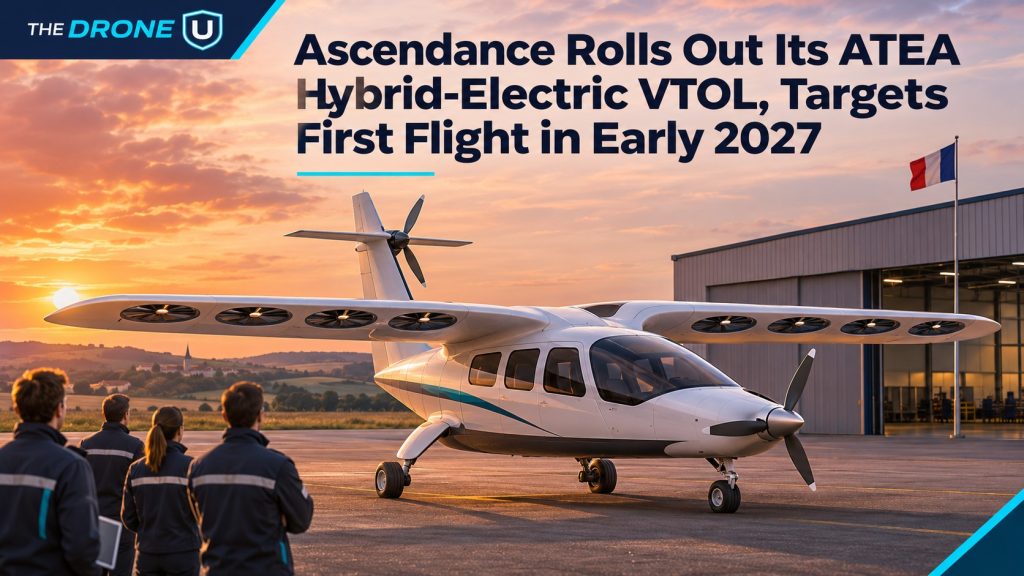
Europe’s hybrid-electric answer to the helicopter is out of the hangar. French startup Ascendance rolled out the first full-scale prototype of its ATEA vertical takeoff and landing aircraft on Nov. 19 at Muret-Lherm airfield near Toulouse, and says it has started ground testing ahead of a first flight it now expects in early 2027.
Most of the air taxis making U.S. headlines, from Joby to Archer, are all-electric. ATEA isn’t. It runs on Ascendance’s in-house STERNA propulsion system, which pairs batteries for the power-hungry takeoff and landing phases with fuel-burning generators for cruise. According to AeroTime, the system can run on conventional Jet A-1 or sustainable aviation fuel.
The layout is also distinctive. Eight electric lift rotors are built into the wings for vertical flight, and two propellers, one in the nose and one at the rear of the vertical tail, push the aircraft forward in cruise. Ascendance chose Safran’s ENGINeUS electric motor for the flying prototype in 2025, and the airframe was built by Duqueine Group in Lyon.
Key details reported from the rollout:
Ascendance has raised more than €60 million (about $66 million) since its 2018 founding, employs over 100 people and holds more than 140 patents, according to AIN. The company told AIN that potential customers have signed letters of intent for more than 630 aircraft. Letters of intent are not firm orders.
Co-founder and CEO Jean-Christophe Lambert acknowledged at the event that €60 million is small next to what some U.S. and Chinese eVTOL developers have raised, AeroTime reported, and he framed ATEA as a European aircraft built largely with European parts and technology. “With Sterna, we want to make hybrid-electric propulsion a new standard for aviation performance,” he said in comments reported by AIN.
The timeline has slipped before. When Ascendance unveiled the ATEA design in December 2021, it said a full-scale prototype would begin testing in 2023. Flight testing now depends on a permit to fly from EASA, and AeroTime noted the company’s website still listed a 2026 first crewed flight and certification targeted for 2029.
Ascendance is also selling STERNA as a powertrain for other platforms, including fixed-wing aircraft and drones. AIN reports it’s going into Delair’s DT46 drone, which is being developed with backing from France’s DGA defense procurement agency. This year, the company signed a letter of intent with ATR on hybrid-electric regional aircraft and a memorandum of understanding with Naval Group on power systems for autonomous naval platforms.
Hybrid-electric propulsion addresses the problem every drone pilot knows best: battery endurance. The same architecture Ascendance is putting in a passenger aircraft is heading into long-range drones, which could mean longer mapping, inspection and public-safety missions than batteries alone allow. Those missions will need beyond-visual-line-of-sight approvals and pilots who understand airspace.
The rollout is also a reminder that advanced air mobility is coming from many directions, alongside projects like the SKYLA V30 tiltrotor and the vertiport network taking shape in Dubai. As these aircraft start sharing low-altitude airspace with drones, knowing how to read charts and NOTAMs matters more. Drone U’s Part 107 course is a solid foundation for flying commercially today and for the more crowded skies ahead.
Sources: AeroTime (Miquel Ros, Nov. 19, 2026); Aviation International News (Charles Alcock, Nov. 20, 2026).
 0
