
Stockholm Air Ambulance Pilots Can Now See Everdrone’s Defibrillator Drone on Their Own Cockpit Display

November 27, 2026
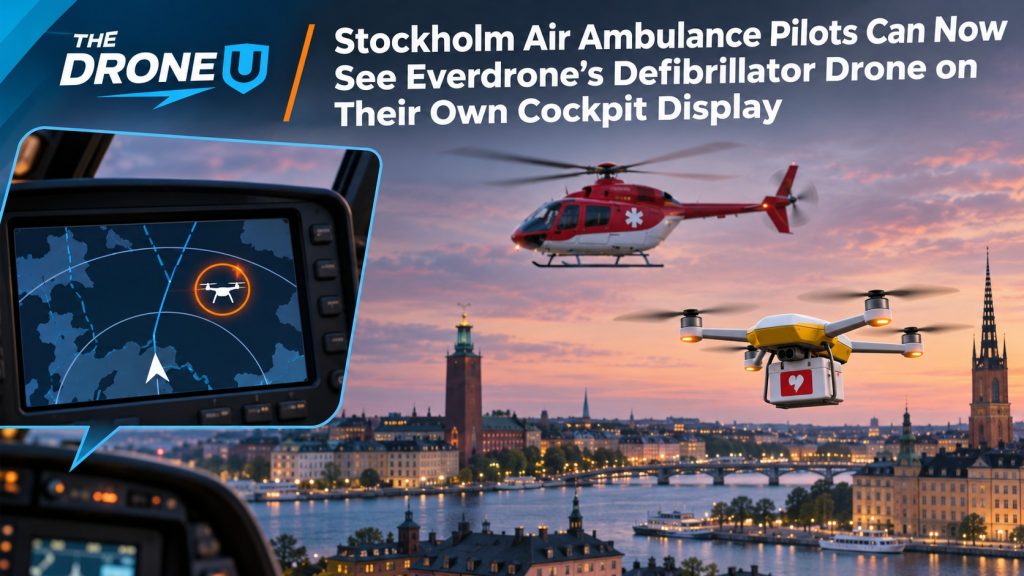
One of the hardest problems in emergency drone work is simple: the helicopter crew flying to the same scene often has no idea the drone is there. A test in Sweden just showed one way to fix that. Everdrone, which flies drones carrying automated external defibrillators (AEDs) to cardiac arrest calls, announced on Nov. 26 that its drone appeared on an air ambulance pilot’s regular navigation display during a trial in Stockholm.
The flight took place on Sept. 11 with Avincis, which runs air ambulance helicopters for regional health authorities and hospitals. Everdrone’s E3 drone broadcast its position using FLARM, an electronic conspicuity system widely used in European general aviation, especially by gliders. A new feature on the Avincis helicopter received that signal and placed the drone on a display the pilot already uses in routine flying.
The key difference is where the information shows up. Everdrone said crewed aircraft could already see its drones through separate digital tools. This time the drone appeared inside a primary cockpit system, so the pilot didn’t need another screen or app.
“It is essential to us that drones are not developed as a separate system operating alongside manned aviation,” Everdrone CEO Mats Sällström said. Rickard Gillberg, head of flight operations at Avincis, put it in terms any helicopter crew would recognize: “If we cannot ensure the safety of the air ambulance helicopter, we cannot help the patients who need us.”
The announcement is short. It doesn’t say how many flights were flown, at what distances the helicopter picked up the drone, or whether the feature will be rolled out across the Avincis fleet. Treat this as a demonstration that the integration works, not as proof of how much warning it gives in real operations.
Medical helicopters and emergency drones tend to work in the same low, busy airspace near hospitals, highways and accident scenes, often with little notice. In the U.S., drone-as-first-responder programs are spreading quickly, and police drones regularly share airspace with news, medical and law enforcement helicopters. We looked at that same tension in our recent piece on how the FAA expects helicopters, eVTOLs and delivery drones to share low-altitude airspace.
The technical path would look different here. FLARM is far less common in U.S. cockpits than ADS-B, and Part 107 does not allow small drones to transmit ADS-B Out unless the FAA authorizes it (14 CFR 107.53). The FAA adopted it over concerns that large numbers of drone signals could crowd ADS-B frequencies. Remote ID, meanwhile, was designed so people on the ground can identify drones, not as a collision-avoidance feed for pilots. The FAA’s proposed Part 108 rules for beyond-visual-line-of-sight flights lean heavily on electronic conspicuity, so the question of how drones and crewed aircraft “see” each other is going to keep coming up.
Under Part 107, the job of avoiding crewed aircraft is still yours, every flight. You must yield right of way to all crewed aircraft, and in practice a helicopter crew probably can’t see you. Until systems like Everdrone’s become standard, here’s what that looks like in the field:
Right-of-way rules, see-and-avoid and airspace around heliports are all on the FAA knowledge test. Drone U’s Part 107 course walks through each one, and if you’re building a public safety program, our coverage of Knoxville’s new DFR program shows how other agencies are handling it.
Sources: Everdrone AB press release via Cision (Nov. 26, 2026); 14 CFR 107.53 (eCFR).
 0