

Amazon Drones Go Live in Nampa, Idaho, While Westborough Gets a Pause

November 3, 2026
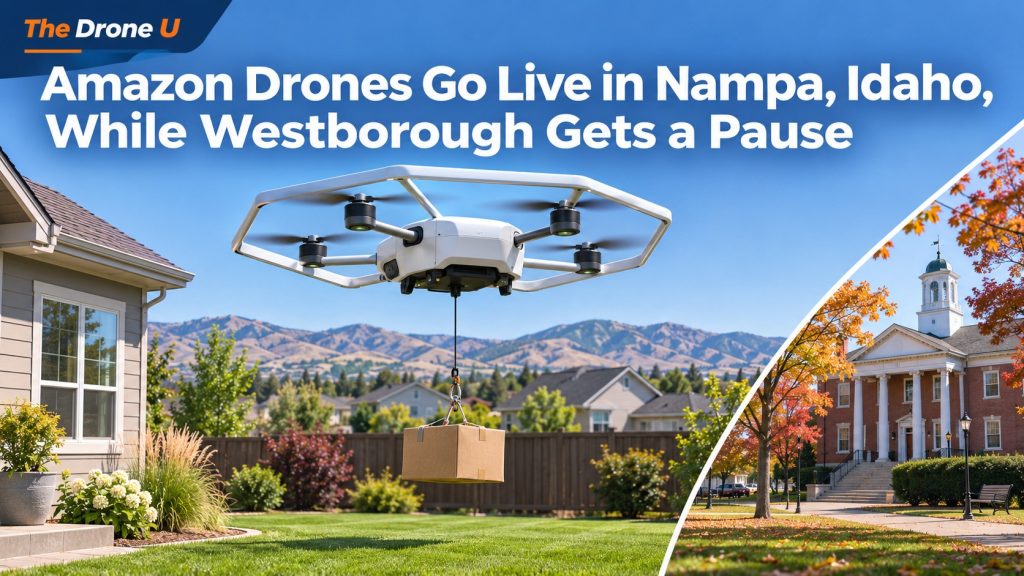
Amazon’s Prime Air program had a split-screen weekend. In Idaho, drones started dropping packages on doorsteps in Nampa, the state’s first drone delivery site. In Massachusetts, the company quietly pulled the application for its Westborough launch pad after weeks of local pushback. Both stories show that the hardest part of drone delivery today is often getting the ground site approved, not flying the route.
Amazon told KTVB that Prime Air went live in Nampa on Friday, October 30. Flights launch from the company’s fulfillment center on East Franklin Road using the MK30, Amazon’s current delivery drone. It carries packages of 5 pounds or less out to about 7.5 miles from the site. That radius covers roughly 170 to 175 square miles, depending on who is doing the math, and reaches into a small part of Boise.
Idaho News 6 reported that Prime members pay nothing for drone delivery on orders of $50 or more and $2.99 on smaller orders. Customers without Prime pay $4.99. Flights run in daylight only, starting 30 minutes after sunrise and ending 30 minutes before sunset. Amazon says it aims to land orders within 30 minutes of checkout.
Living inside the circle does not guarantee service. Amazon told KTVB a home needs enough open ground for the drone to lower a package safely. Customers can check their ZIP code on Amazon’s drone delivery page. KTVB also noted that Prime Air operates under an FAA Part 135 air carrier certificate and that federal regulators reviewed noise, visual and wildlife effects before launch under the National Environmental Policy Act.
The local approval path was comparatively smooth. Nampa’s Planning and Zoning Commission approved a conditional use permit for the drone hub by a 6-1 vote on May 26, the Idaho Statesman reported.
The Massachusetts story went the other way. In an October 30 letter, Amazon asked the Westborough Planning Board for permission to withdraw its site plan application for a drone launch area at its 64 Otis Street fulfillment center, the Boston Globe and Patch reported. The company asked for the withdrawal “without prejudice,” which leaves it free to file again.
Amazon spokesperson Lindsay Hamilton told CBS Boston that the company plans to resubmit a revised project soon, after more conversations with local stakeholders. The original plan called for up to 1,000 deliveries a day across Westborough and roughly 15 nearby communities.
The withdrawal follows a string of setbacks. On October 19, Town Meeting voters approved a bylaw restricting commercial drone launch pads and delivery zones by a 510-13 vote. That bylaw still needs sign-off from the state Attorney General and MassDOT’s Aeronautics Division. MassDOT has also told Amazon it needs a state Certificate of Approval, with at least one public hearing, before Prime Air can operate from the site. The local opposition group Mass Blue Skies warned supporters that “it is not over.”
The Planning Board is expected to act on the withdrawal request at its November 10 meeting. A separate residents’ appeal over whether a drone pad counts as an accessory use of the warehouse was on the Zoning Board of Appeals agenda for Monday night.
Drone delivery companies like Amazon fly under Part 135 air carrier rules, a different and much heavier framework than the Part 107 rules most commercial pilots use. But the Westborough fight shows where local power really sits. Towns generally can’t regulate the airspace, which belongs to the FAA. They can regulate where aircraft take off and land through zoning, site plans and state aeronautics approvals. Expect more communities to test that line, and expect delivery operators to pick friendlier sites first.
For pilots, the growth in delivery hubs also means more low-altitude traffic in suburban areas. If you fly near a hub, check for posted notices and keep your head on a swivel during daylight delivery windows. Delivery networks also hire people with aviation knowledge for operations, safety and support roles, and an FAA Part 107 certificate is a strong first credential. Drone U’s Part 107 course walks you through airspace, weather and regulations, and students have been known to finish the online course in three days and pass the test.
Sources: KTVB; Idaho News 6; KIVI; Idaho Statesman; Boston Globe; Westborough Patch; CBS Boston; Boston.com; Town of Westborough
 0
