

The Army Wants Non-Chinese Magnets for Small Drone Motors, and FPV Pilots Will Recognize the Sizes

November 2, 2026
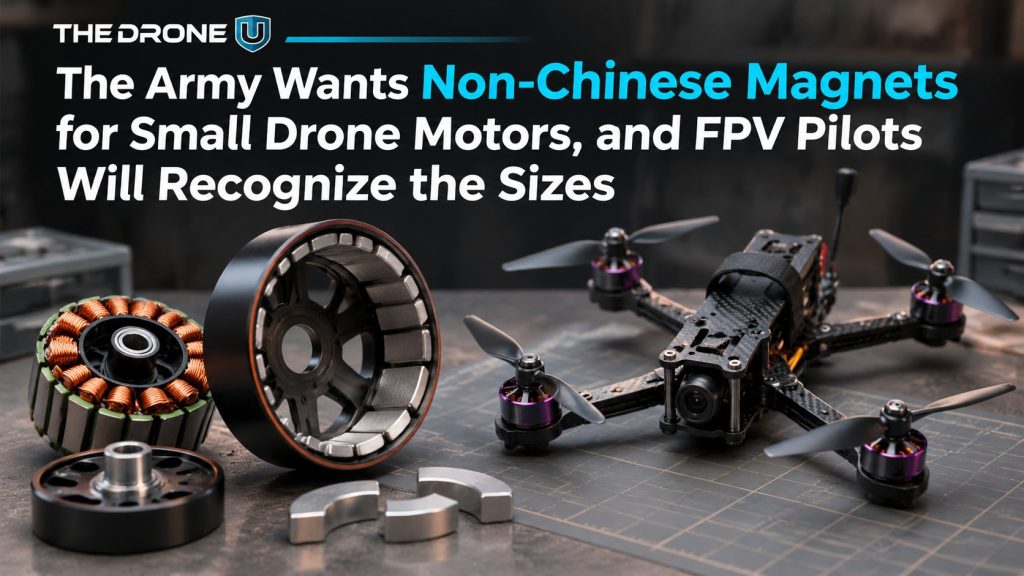
Every brushless motor on a quadcopter has a ring of small curved magnets inside its bell, and most of those magnets come from China. The U.S. Army is now trying to find out who else can make them. As Defense Daily noted in its Defense Watch column on Friday, Army Contracting Command has been surveying industry for rare earth magnets built specifically for the motors in small drones. At least one company has publicly said it responded.
The sources sought notice on SAM.gov was posted September 28 by the Tobyhanna Division of Army Contracting Command at Aberdeen Proving Ground, and responses were due October 28. The attached request for information spells out exactly what the Army wants:
FPV builders will recognize those numbers right away. A 2807 motor has a 28 mm stator that is 7 mm tall. That is the kind of hardware behind 7-inch long-range FPV quads, not toy drones.
This is market research only. The notice says it is not a request for proposals and does not commit the government to buy anything.
Miami-based Evolution Metals & Technologies (Nasdaq: EMAT) said in an October 28 press release that it submitted a capability statement. The company says it already makes N42SH magnets commercially at a plant in Pohang, South Korea. It plans to grow that plant from about 1,000 to about 10,000 metric tons a year. EM&T proposed a step-by-step path to qualify its magnets to the Army’s spec. It also offered a “mine-to-magnet” traceability record for each production lot, tied to Pentagon sourcing rules (DFARS 252.225-7052) that the company says expand on January 1, 2027.
“Every one of their motors depends on high-performance rare earth magnets that today come overwhelmingly from China,” EM&T president Andrew Knaggs said in the release. Being one respondent doesn’t mean the Army has picked EM&T, and other companies may have answered quietly.
The motor supply chain is getting squeezed from both sides. Beijing’s new export-license requirements for larger drone motors, speed controllers and propellers take effect November 18. In Washington, FCC Covered List actions are pushing U.S. buyers away from Chinese drones and parts. A drone that’s “American-made” on the outside can still depend on Chinese magnets inside every motor. The Army’s survey is a small, early attempt to see if that dependency can be broken for the motors its small drones actually use.
Sources: Defense Daily; SAM.gov sources sought notice; Evolution Metals & Technologies
 0