

BVLOS Drone Operations: From Waivers to FAA Part 108
March 19, 2026
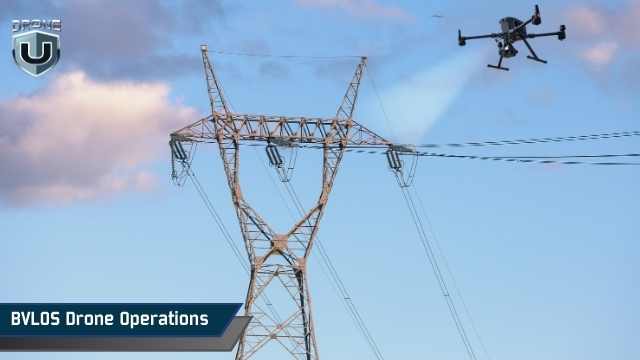
Beyond Visual Line of Sight (BVLOS) drone operations represent the shift from isolated pilot flights to scalable aerial infrastructure. Instead of flying within visual range, drones can operate across long distances, multiple sites, and complex environments.
This capability allows organizations to inspect infrastructure, deliver goods, support emergency response, and monitor sites continuously.
Until now, BVLOS operations have largely depended on waivers, which makes it difficult for organizations to scale operations consistently. The proposed FAA Part 108 framework is designed to address this limitation. It moves BVLOS from exception-based approvals to a standardized operational model.
This guide outlines how BVLOS operates today, what FAA Part 108 changes, and how you can prepare for scalable drone operations.
Understanding BVLOS today, and how Part 108 reshapes it, is essential for any organization planning long-term drone programs.
BVLOS refers to drone operations where the aircraft flies beyond the pilot’s direct visual observation. Instead of relying on eyesight, these operations depend on technology, procedures, and structured workflows to maintain safe control.
This capability allows organizations to operate across longer distances, cover larger areas, and run more complex missions. As a result, BVLOS becomes the foundation for scalable commercial drone operations.
BVLOS allows drones to fly beyond the pilot’s visual line of sight while maintaining safety through technology, procedures, and operational oversight. This shifts your drone work from individual missions to repeatable operations across larger areas.
As a result, drones can deliver value across a wider range of industries:
Today, most BVLOS operations still depend on waivers. Approvals take time, and requirements vary by project. This makes scaling difficult.
For a deeper explanation of BVLOS drone operations, read our complete BVLOS guide.
Next, let’s explore how BVLOS operates under current rules.
Today, most BVLOS operations run through waivers.
Under FAA Part 107, you must request approval before flying beyond the visual line of sight. Each waiver application documents how the operation manages safety, airspace awareness, communication reliability, and contingency procedures.
Approvals often take time, and requirements can vary between applications. Even similar missions may require new submissions.
As a result, BVLOS operates as an approved exception rather than a standardized operational model.
This limitation is what led regulators to develop a dedicated BVLOS framework through FAA Part 108.
FAA Part 108 is a proposed rule created to establish a dedicated regulatory framework for BVLOS drone operations in the United States. Following the recent public comment period that concluded in February 2026, the industry is now eagerly awaiting the final rule.
Today, most BVLOS flights require waivers under FAA Part 107. This approach evaluates operations one mission at a time. Part 108 is designed to support safe and repeatable operations beyond the pilot’s visual line of sight.
The goal of Part 108 is to establish clear expectations for BVLOS operations.
Regulators evaluate whether the operational model manages safety consistently rather than approving individual flights. The rule focuses on operational architecture. This includes command-and-control reliability, airspace integration, detect-and-avoid capability, defined operational roles, and structured risk management processes.
The emphasis moves from approving a flight to assessing the operation.
BVLOS enables long-range inspection, public safety missions, mapping, and logistics. However, the waiver process creates approval timelines, variations between applications, and operational constraints.
Part 108 introduces a predictable framework so organizations can design repeatable BVLOS programs rather than justify each mission separately.
Part 107 established baseline rules for small UAS operations. It assumes the pilot maintains a visual line of sight.
Part 108 builds on that foundation and addresses operations where visual observation is no longer the primary safety method. The rule introduces operational design, system requirements, and structured safety controls designed specifically for BVLOS.
At a high level:
This distinction positions Part 108 as the authority framework for scalable BVLOS.
Next, let’s look at the framework designed specifically for these operations and what Part 108 changes for operators.
Part 108 changes how you plan, approve, and run BVLOS operations.
Today, you design missions around waiver approval. Under FAA Part 108, you can design an operational system that meets defined regulatory expectations. Once you establish that system, you can repeat operations within the same framework.
This changes how organizations design and manage drone operations at scale.
The biggest change is the level at which approval happens.
The approval focuses on demonstrating that the operational model consistently manages risk across flights. This includes defining procedures, assigning operational roles, ensuring communication reliability, and implementing contingency planning.
The focus moves from “Can this flight be approved?” to “Is your operation designed correctly?”
Part 108 introduces clearer expectations around who does what during BVLOS operations.
Responsibility expands beyond the remote pilot. The Notice of Proposed Rulemaking (NPRM) introduces clearer role definitions for BVLOS operations.
The UAS Operator is the organization responsible for the overall operation. The Remote Pilot controls the aircraft during flight. The Flight Coordinator supports airspace awareness and operational oversight.
Together, these roles create a structured framework for managing BVLOS operations safely.
Safety becomes structured rather than descriptive.
Operators must show how they maintain situational awareness without direct visual observation. This includes airspace awareness, detect-and-avoid strategies, command-and-control reliability, and documented procedures.
The emphasis is consistency.
For operators, the change is strategic.
You stop designing one-off BVLOS missions and start designing repeatable workflows. Planning becomes more predictable, technology decisions become clearer, and scaling across locations becomes realistic.
This naturally leads to the next question: what requirements operators must meet under Part 108?
Part 108 shifts the focus from requesting permission to meeting defined operational requirements.
Instead of explaining why a single BVLOS mission is safe, you demonstrate that your operation is designed to manage risk consistently. These requirements center on how your system functions, not just how a pilot flies.
You must maintain a reliable command-and-control link throughout the operation.
This includes link performance, redundancy where appropriate, and procedures for degraded or lost connection scenarios. The operation must define how you detect issues, respond quickly, and maintain safe aircraft behavior.
The regulator evaluates whether loss-of-link scenarios are predictable and controlled.
Without visual observation, you must show how the operation maintains awareness of other aircraft.
This does not point to a single technology. Instead, it focuses on a strategy. Operators define how they identify airspace conflicts, what tools support that awareness, and what actions occur when risk thresholds are reached.
The emphasis is on documented decision logic.
BVLOS operations require continuous awareness of the surrounding airspace environment.
This requires understanding airspace constraints, dynamic traffic, and coordination procedures where needed. Operators must define how information flows to decision makers during the mission.
The requirement is operational visibility, even without direct visual contact.
Part 108 expects structured procedures.
Organizations document workflows, escalation paths, contingency handling, and role responsibilities. This ensures operations remain consistent across missions and teams.
The regulator evaluates whether the operation can run predictably, not just successfully once.
You must implement a structured risk management process.
This process includes identifying hazards, defining mitigations, documenting procedures, and establishing escalation paths. It also includes reviewing incidents, updating procedures, and maintaining operational consistency over time.
Regulators expect a repeatable safety methodology, not one-time documentation.
You must demonstrate that personnel are trained for BVLOS-specific responsibilities.
This includes operational procedures, abnormal scenario response, technology use, communication workflows, and role-based training. You show how competency is evaluated and maintained.
Training shifts from pilot qualification alone to operational readiness across the team.
You must maintain documentation that proves your operation runs as designed.
This includes procedures, system descriptions, training records, safety processes, and operational logs. Documentation allows regulators to evaluate your model and verify consistency.
Recordkeeping supports scalability because your operation becomes auditable and repeatable.
Meeting Part 108 requirements means designing your BVLOS program intentionally.
You design procedures, responsibilities, and safety processes first, then execute flights within that structure. Technology, procedures, and oversight must align.
This shifts BVLOS from experimentation to infrastructure.
Next, let’s examine the technology and safety system that supports consistent BVLOS operations.
Part 108 evaluates whether your technology stack enables safe, repeatable BVLOS operations.
The focus is on capability, not specific tools.
Technology maintains awareness, supports decision-making, and ensures consistent behavior when pilots cannot rely on direct visual observation.
Many BVLOS operations rely on third-party service providers that deliver airspace, weather, and traffic information. These systems often function as part of the broader Uncrewed Traffic Management (UTM) ecosystem.
By aggregating airspace intelligence and operational data, these services help operators maintain situational awareness across larger operational areas.
When you fly BVLOS, you must demonstrate that your aircraft can detect conflicting traffic and avoid it.
Detect-and-Avoid systems provide this capability.
These systems typically combine onboard sensors (ADS-B receivers, radar, optical cameras) with ground-based surveillance and network data. Together, they create a real-time picture of the surrounding airspace.
Regulators are not looking for one specific sensor. They are looking for a reliable method that allows you to maintain separation from crewed aircraft.
This is why redundancy matters. A single sensor can fail. A layered DAA architecture shows operational maturity.
Part 108 introduces the concept of shielded operations. These occur when drones fly close to structures, terrain, or obstacles that naturally separate them from crewed aircraft.
In the proposed rule, shielded operations usually occur within 50 feet of a structure or obstacle. Crewed aircraft are not expected to fly this close to buildings, towers, bridges, or infrastructure.
Because of this separation, some shielded operations may not require complex detect-and-avoid systems. Instead, safety can rely on proximity to structures and clearly defined flight paths.
Your command and control link becomes your lifeline in BVLOS operations.
You must show that communication between the pilot and aircraft is reliable, secure, and resilient to interruptions.
Operators typically use:
Part 108 focuses heavily on how you handle degraded connectivity. It is not about proving the link never fails. It is about proving the operation remains safe when it does.
This is where predefined contingency logic becomes critical.
BVLOS operations require continuous awareness of airspace conditions.
This includes:
This awareness increasingly relies on UTM platforms that aggregate airspace data and coordinate multiple operators.
Systems that integrate planning, authorization, tracking, and monitoring reduce operational risk and support scalable BVLOS deployments.
For regulators, this demonstrates that your operation fits into a shared airspace environment rather than operating in isolation.
Technology alone is not enough. Regulators evaluate how technology integrates into procedures.
Your safety architecture typically includes:
This layer translates raw technology into predictable behavior.
It shows that safety is designed into the operation, not dependent on pilot improvisation.
The proposal also raises an important discussion about right-of-way in shielded environments. Traditional aviation follows the “see-and-avoid” principle, where pilots visually detect and avoid other aircraft.
Under the Part 108 proposal, drones flying in shielded areas may effectively have operational priority. This is because crewed aircraft are not expected to operate so close to obstacles.
This concept has generated discussion across the aviation community. Regulators and industry groups examine how drones and crewed aircraft should safely share low-altitude airspace.
Part 108 shifts approvals from one-off waivers to repeatable operational models. This means regulators evaluate whether your technology stack supports consistency.
They want evidence that:
Operators who invest early in infrastructure move faster through approvals because they can demonstrate operational reliability instead of describing intent.
And this is the underlying theme of BVLOS regulation: approval follows evidence.
Part 108 changes BVLOS from a waiver-driven activity into a defined operational model. Here’s how it compares to the current rules and why that matters for commercial drone programs.
Aspect |
BVLOS Today |
BVLOS Under Part 108 |
| Approval Model | Individual mission approvals through waivers | Defined operational framework for repeatable BVLOS |
| Pilot Responsibility | Heavy reliance on the remote pilot and mission justification | Shared responsibility across operational roles and system design |
| Scalability | Limited — approvals tied to specific missions and locations | Built for replication across regions and recurring operations |
| Safety Framework | Operators describe the safety case in each application | Regulators define baseline safety expectations |
| Documentation | Repeated application documentation for similar operations | Standardized operational documentation reused across missions |
Understanding the shift is only the first step. The next question is how operators can prepare their programs before the new framework is finalized.
You can start preparing for BVLOS before new regulations take effect. The focus is not on flying farther today, but on designing operations that can scale when BVLOS becomes standardized.
Shift From Missions to Operations
Start thinking beyond individual flights.
Instead of treating BVLOS as a special project, define repeatable workflows. Identify where BVLOS will operate continuously, what coverage areas will look like, and how missions will connect to ongoing services.
This shift lays the foundation for scalable BVLOS programs.
BVLOS programs require more than a pilot.
Clarify who is responsible for operational oversight, safety monitoring, escalation decisions, and airspace awareness. Even if one person holds multiple roles today, defining them early creates structure that scales later.
Do not treat documentation as something created only for approvals.
Document procedures, decision logic, contingency handling, and workflows as part of normal execution. Over time, this becomes reusable operational evidence rather than one-off application material.
This approach mirrors the direction regulators are moving toward.
Avoid choosing tools only for features.
Focus on reliability, visibility, and integration. Ask whether your systems support situational awareness, consistent decision making, and predictable behavior during degraded scenarios.
Part 108 evaluates operational capability, not individual products.
You do not need a large BVLOS program immediately.
Start with constrained environments, recurring routes, or clearly defined use cases where outcomes are measurable. The goal is to refine procedures, validate decision logic, and build operational confidence before expanding.
Preparation is about building operational discipline early. This positions you to adopt Part 108 more quickly once the framework becomes final.
BVLOS is moving toward clearer expectations for how drone programs are designed and managed. Instead of navigating approvals one mission at a time, you can operate within defined frameworks that establish consistent requirements.
For commercial teams, the opportunity lies in building operational discipline early. When workflows are clear, responsibilities are defined, and execution is documented, adapting to new BVLOS frameworks becomes significantly easier.
Treat BVLOS as a long-term capability rather than a special project. Designing at the program level creates the foundation for expanding coverage and supporting recurring services. It also enables drones to integrate more consistently into ongoing business operations.
Join DroneU to accelerate this transition. Explore training and operational guidance designed to help you build scalable BVLOS programs
 0
0