

China Adds Big Drone Motors, ESCs and Props to Its Export License List Starting Nov. 18

October 20, 2026
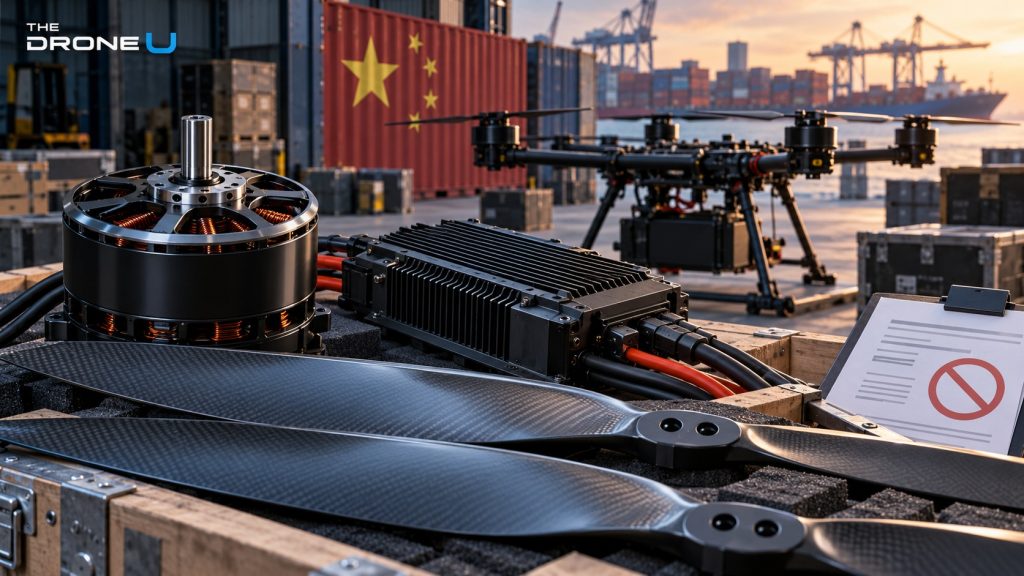
China is tightening export licensing on the heavy-lift drone hardware many builders rely on. Think drones similar in size to the Jetson 1. On Monday, October 19, 2026, China’s Ministry of Commerce, the General Administration of Customs and the Central Military Commission’s Equipment Development Department jointly issued Announcement No. 49 of 2026. It rewrites which drones, parts and technologies need an export license, and it takes effect November 18, 2026.
The ministry calls it an “optimization” and says some once-advanced drones have become everyday consumer products. For components, though, the list is now very specific: big motors, speed controllers and carbon-fiber propellers each have their own license triggers.
We read the announcement’s Chinese text on the ministry’s website. Headline items include:
Exporters also have to declare item specs to customs. A part that comes close to a threshold without crossing it must be declared and marked “not subject to export control.” Customs can hold shipments while it questions a declaration.
The announcement offers relief for some exporters. Drones in the lower 9A012.a tier can ship on a register-before-export basis, and companies with solid compliance records can apply for general licenses. American buyers probably won’t see those benefits. In August, the same ministry issued Announcement No. 34 of 2026. It says listed drones, key components and related technology headed to the United States get strict case-by-case review, and license facilitation measures don’t apply.
Read together, the two notices suggest that motors, ESCs and props crossing the new lines will face case-by-case review for U.S. shipments starting November 18. That’s our interpretation, and DroneXL reached the same conclusion. The ministry hasn’t spelled out how the two notices interact.
China’s commerce ministry said applications that meet the requirements will be approved. It also said it briefed its export-control dialogue partners before publishing. DroneXL quoted a Shenzhen drone industry association official who said common spraying, inspection, delivery and filmmaking models generally fall below the new lines, with about a month for exporters to adjust paperwork. DroneXL also pointed out that DJI’s published 100-liter spray tank for the Agras T100 is over the 80-liter spray line.
Supply chains will shift, but the rules for flying commercially won’t. If you’re building a drone business, start with the fundamentals in our Part 107 course.
Sources: MOFCOM/GAC/CMC EDD Announcement No. 49 of 2026 (Chinese); MOFCOM spokesperson Q&A (Chinese); MOFCOM Announcement No. 34 of 2026 (Chinese); Xinhua; DRONELIFE
 0