

Czech KBP Unveils GRYF, a Drone Carrier Built to Hunt Other Drones

October 23, 2026
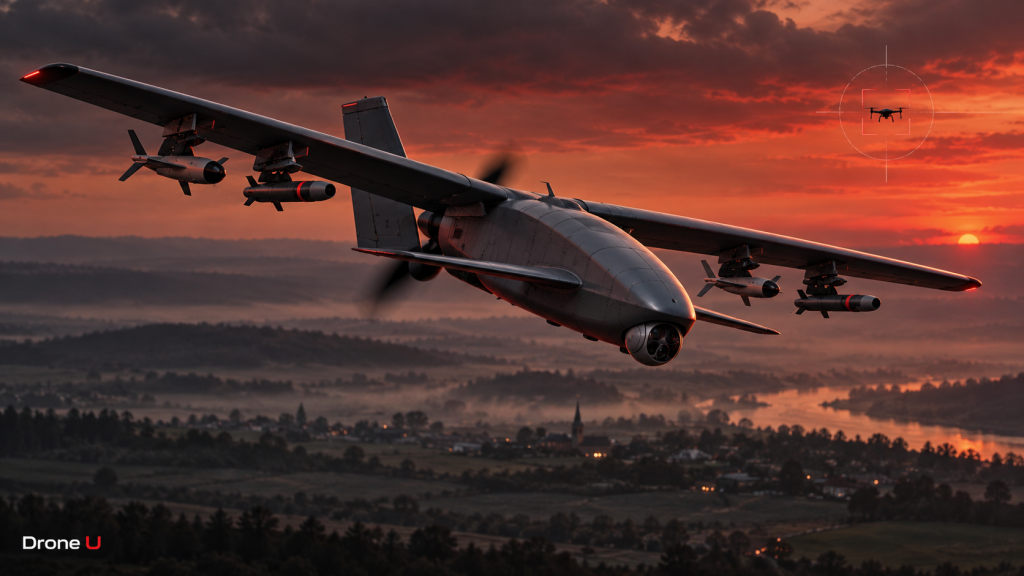
Czech defense group KBP has pulled the cover off GRYF, a fixed-wing drone built to carry weapons that hunt other drones. KBP International showed it at the opening of the Future Forces Forum at PVA EXPO in Prague on Wednesday, Oct. 21, 2026, and Czech President Petr Pavel was there for the first public showing.
The idea behind it is cost. Air defenses are firing expensive missiles at cheap drones, and GRYF is meant to be a cheaper layer that patrols, finds a drone threat and handles it with its own small interceptors, saving the costly missiles for bigger targets.
GRYF is a carrier, or “mothership,” not a single-shot interceptor. According to the Czech defense outlet SECURITY magazín, its main job is to launch the munitions or interceptor drones it carries at a target. KBP presented two setups: one carrying interceptor drones and one carrying small missiles. The Ukrainian outlet Militarnyi, which had a reporter at the unveiling, confirms both setups were on display.
The numbers reported so far:
The two outlets don’t agree on speed. Militarnyi reports a 150 km/h cruise speed, while SECURITY magazín says KBP hadn’t yet given a flight speed. Treat 150 km/h as unconfirmed for now.
KBP International already sells ODIN, a counter-drone interceptor. SECURITY magazín reports that ODIN’s spec sheet lists a top speed of 290 km/h, a range of 35 km, up to 22 minutes of flight and a ceiling of about 22,000 feet. It guides itself to the intercept area automatically, but a human operator always gives the final OK to strike. The outlet says GRYF’s layout suggests it could carry ODIN, but KBP has not officially confirmed that pairing.
KBP pitches GRYF as one layer in a multi-layer air defense network, able to work at different altitudes with different weapons. What was shown in Prague was a display model. KBP hasn’t announced flight-test results, a customer or a delivery date.
GRYF is a military system, and you won’t see one over a U.S. job site. The trend behind it matters, though. Counter-drone technology is moving fast, from jammers and detection networks to drones built to physically intercept other drones. Many of these systems were designed for war in Ukraine, and civilian versions of the detection side are already showing up around airports, stadiums and critical infrastructure.
For commercial pilots, the takeaway is simple: the sky is getting watched more closely. Flying legally, with Remote ID broadcasting, within the right airspace authorizations and outside TFRs, is what keeps you on the “known and cooperative” side of the systems built to track drones. If you’re flying for work and want to master airspace, NOTAMs and the rules that keep you compliant, start with our Part 107 course.
Sources: SECURITY magazín (Czech-language report, translated by Drone U); Militarnyi; Future Forces Forum programme; Future Forces exhibitor listing for KBP International.
 0