

Defense Daily Op-Ed: Iran Builds Hundreds of Drones a Week, but the U.S. Gap Is Training

November 25, 2026
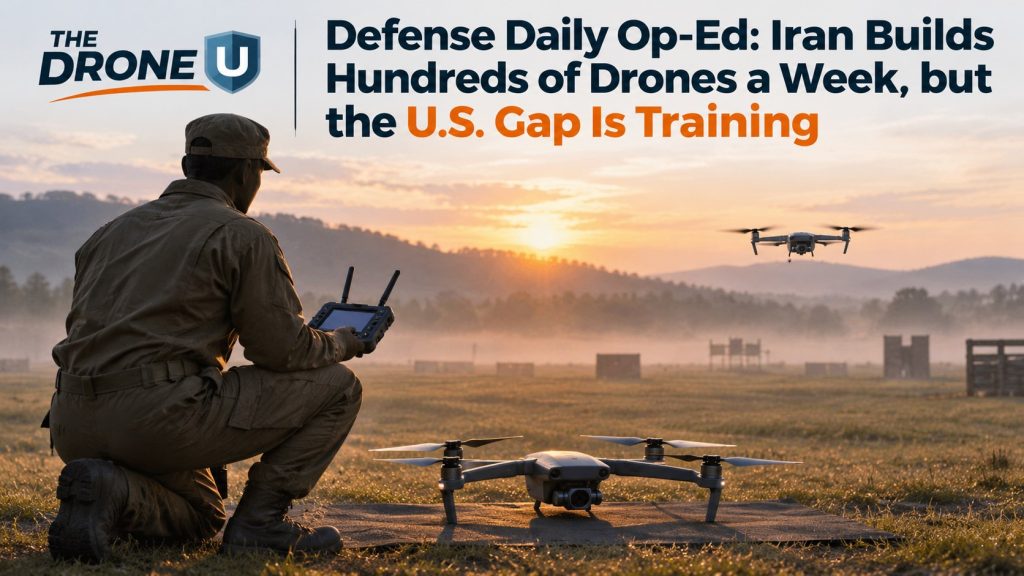
Pentagon drone debates usually focus on buying more aircraft, faster. A commentary published this week by Defense Daily makes a different case: the U.S. military isn’t getting full value from the drones and gear it already has, because troops aren’t trained enough to use them. The piece, by Navy veteran and defense technology executive Calin Brierley, builds on his podcast conversation with Rep. Ryan Zinke (R-Mont.), a former Navy SEAL.
The opinion piece argues that people, not equipment, drive most military problems. Brierley puts the human share at 50 to 70 percent in his experience. When a capability gap shows up, he writes, the reflex is to buy something new, even when the system already in hand can do more than troops are getting out of it. He suggests that before spending more, the services should have to explain what their current equipment can’t do.
Zinke supplied the line that sums it up. “I can buy the best shotgun in the world,” he said, “but I’m not gonna be very effective unless I train with it.” He also noted that new technology takes far longer to field than a skills gap takes to close, and the commentary argues that training should reach every service member, National Guard included, not just elite units.
The headline number is Iran’s drone output. Zinke said Iran builds roughly 500 to 600 Shahed one-way attack drones a week, and the commentary warns that a month of that production could add up to a stockpile no warship could stop if it were used in a coordinated swarm. That figure is Zinke’s estimate as quoted in the piece, and we haven’t independently verified it.
The piece also compares costs. Skydio announced in March that the U.S. Army ordered more than 2,500 X10D reconnaissance drones for over $52 million. Skydio called it the largest single-vendor tactical small drone order in Army history. Brierley works that out to roughly $20,800 per aircraft and contrasts it with Ukrainian scout and attack drones that cost a few thousand dollars or less. He acknowledges that U.S. drones have to meet strict cybersecurity and supply-chain rules, which add cost. His larger point is scale: citing Just Security, he notes Ukraine went from a few thousand small drones a year in 2022 to roughly 3 million in 2025 by letting many private companies compete and iterate.
The other theme is risk tolerance. Zinke said the Pentagon’s five-year budget plan is built for a peacetime force, and that the services are “very risk averse because no one wants to be hung with a mistake.” His fix is to put operators and manufacturers in the same room so the people who write requirements understand what’s needed in the field. The commentary notes that drone technology in Ukraine can become obsolete in one to three months, so long programs often deliver outdated hardware.
The Pentagon is already testing faster approaches. We’ve covered its Drone Dominance program and the Army training artillery soldiers on interceptor drones.
This is an opinion piece about the military, but its core argument applies to every civilian operator: an expensive aircraft flown by an undertrained pilot is a liability. With DJI cut off from new FCC approvals, many pilots are moving to unfamiliar platforms with different flight modes, failsafes and sensors. Learning your aircraft, practicing lost-link and low-battery procedures, and rehearsing emergency avoidance matter more than ever. A new drone won’t make up for skills you haven’t built.
That starts with the fundamentals. Students have been known to take Drone U’s online Part 107 course in 3 days and pass the test, and they come out knowing the airspace, weather and decision-making that hands-on practice builds on.
Sources: Defense Daily commentary by Calin Brierley (Nov. 24); Skydio (Army X10D order); Just Security.
 0