

DJI Teases Battery-Swapping Dock for October 14 — Not Available in the US

October 9, 2026
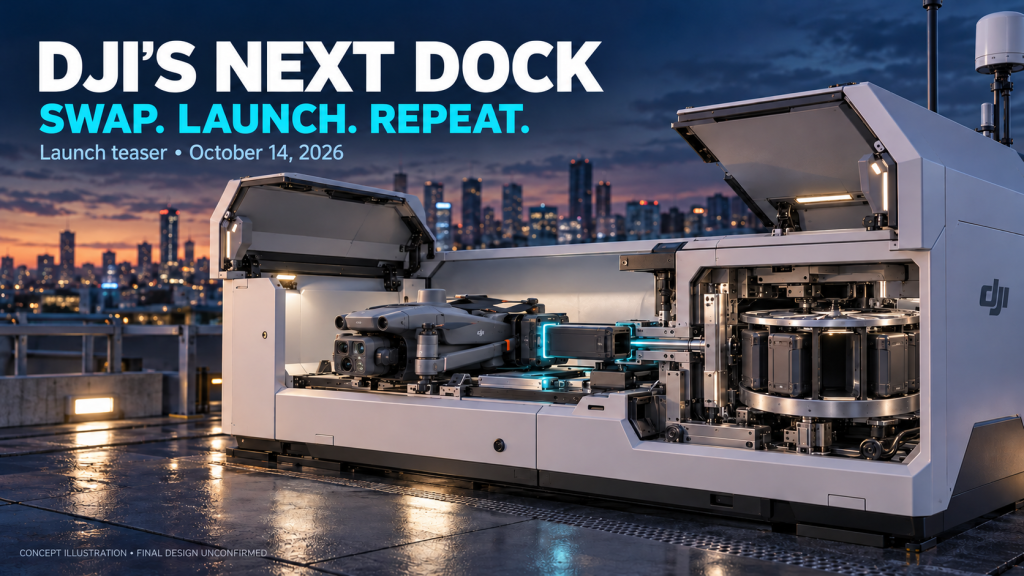
DJI Enterprise dropped a teaser on October 8 for a launch on October 14, 2026, at 8 a.m. Eastern / 12 p.m. GMT. The clip shows a battery carousel swapping a pack into the rear bay of a folded-arm dock drone—charging by exchange, not by waiting on the pad.
Leaked names point to Dock 4 and a Matrice 5TD. DJI has not confirmed those labels. Either way, U.S. buyers should set expectations early: new DJI hardware is blocked from fresh FCC authorizations, so watching the stream is not the same as placing an order.
Today’s Dock 3 charges a battery in place. DJI has published a 27-minute charge from 15% to 95% at 77°F for that system. The paired Matrice 4TD is rated around 54 minutes of forward flight and about 47 minutes of hover. In Dock as First Responder mode, the aircraft can be airborne in under 15 seconds and put eyes on a scene 0.6 miles away in under 100 seconds.
Those numbers are strong for rapid response. The gap has always been recharge time. A battery-swapping dock attacks that gap directly: land, exchange the pack, launch again without sitting through a full charge cycle.
Industry coverage describes the October 14 product as the successor line to Dock 3 and the Matrice 4TD, which arrived in February 2025. Heliguy has also flagged a new DJI Enterprise product for October 14. Treat model names as unverified until DJI says them on stage.
A China UOM filing for a Matrice 5TD lists about 2.6 kg empty and 3.05 kg maximum takeoff weight. That is filing data, not a U.S. spec sheet, but it suggests a compact dock aircraft in the same general class as current enterprise quadcopters rather than a heavy-lift platform.
On December 22, 2025, DJI was placed on the FCC Covered List in a way that blocks new equipment authorizations for DJI hardware. Dock 3 and the Matrice 4TD were authorized before that change, so existing units already in the field are a different story from brand-new 2026 launches.
DJI has told the Ninth Circuit that the action voided 14 authorizations and blocks 25 planned 2026 product launches. The practical result for U.S. buyers is blunt: you can watch the October 14 stream, but you should not expect to order a new dock or aircraft that still needs FCC authorization.
This sits alongside the separate October 13 component-parts Order that restricts new authorizations for devices using Covered List logic-bearing components. Together, the Covered List status and the parts rule make new DJI enterprise hardware a non-starter for the U.S. market until the legal and regulatory picture changes.
Automated docks change the workflow, not the need for a certificated remote pilot who understands airspace and risk. If you are building that foundation, our Part 107 prep course is still the right starting point.
DJI is teasing a battery-swapping enterprise dock for October 14. The tech pitch is faster turnaround than charging in place. For U.S. operators, the Covered List blocks new FCC authorizations for DJI hardware, so this launch is a watch-only event until the authorization picture changes.
 0
0
