

DJI Ends Support for the Inspire 2 and 10 Other Products on Dec. 1, and the Phantom 4 RTK Follows Dec. 31

November 26, 2026
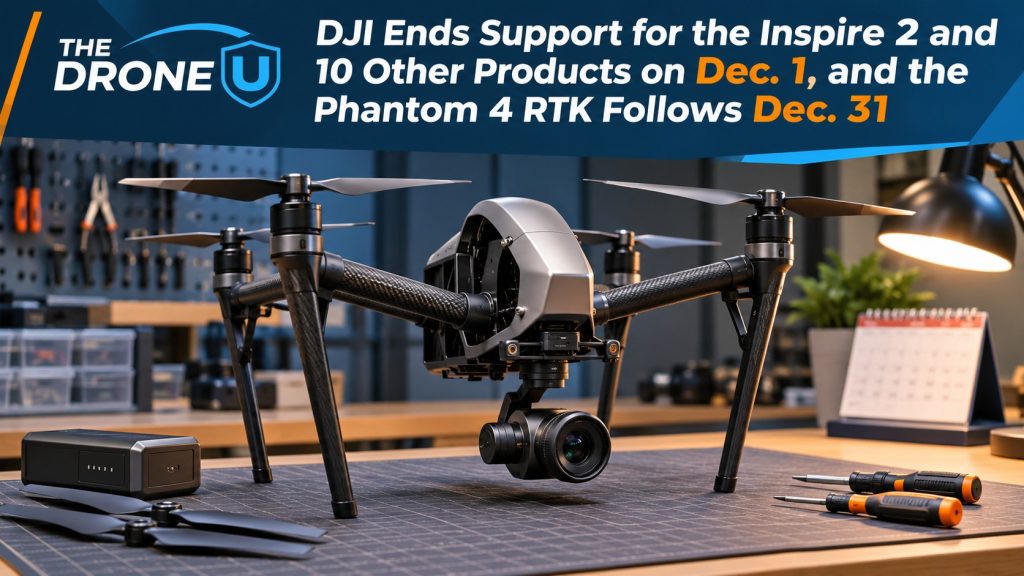
If you still fly an Inspire 2 or use one of DJI’s first-generation FPV kits, your time to get help from DJI runs out next Tuesday, Dec. 1. Under the company’s updated end-of-service notice, DJI stops supporting the Inspire 2 and 10 related products on Dec. 1, 2026. A second group follows on Dec. 31, including the Phantom 4 RTK survey drone and the Mavic 2 Enterprise Advanced. After those dates, DJI says it will no longer answer product inquiries, provide technical support or repair the products.
DJI’s list shows when each product went out of production and when service ends. The Dec. 1 group is mostly the Inspire 2 platform and early FPV gear:
The same notice sets Dec. 31, 2026 as the end of service for the Phantom 4 RTK and Phantom 4 RTK SE (both out of production since January 2023), the Phantom 4 Multispectral (September 2022), the Mavic 2 Enterprise Advanced (December 2022), and the RoboMaster S1, EP and EP Core educational robots.
These cutoffs come after several others this fall. Support for the Phantom 4 Pro V2.0 ended Oct. 31, the Mavic 2 Pro lost support Aug. 31, and older Agras T16 and T20 spray drones and the original Osmo Action dropped off on Nov. 2. DJI’s notice says every product generation has a fixed life cycle. It recommends that owners of listed products upgrade to a newer model.
Your drone doesn’t stop flying on Dec. 1. Nothing in DJI’s notice says the aircraft will be disabled. What goes away is factory repair, official troubleshooting and DJI’s help with product questions. Over time, genuine spare parts usually get harder to find too, and third-party shops become the only option for repairs. App and firmware support for older aircraft also tends to fade as DJI moves on to newer models.
Plenty of Inspire 2 rigs are still earning money on film sets, and many Phantom 4 RTKs still fly survey jobs. If one of these aircraft is part of your business, here is what to do:
Good habits matter more as an aircraft ages: thorough preflight inspections, battery health tracking and maintenance logs. Those habits are part of the professional mindset we teach in Drone U’s Part 107 course, alongside everything you need to pass the FAA knowledge test.
Sources: DJI Support, Notice of Suspension of Service and Support for Old Product Series; DroneDJ (Ishveena Singh, Nov. 25, 2026).
 0