

DJI Matrice 5 Leaks: 4× the Thermal Resolution, 176× Zoom, and Another Wake-Up Call for American Drone Manufacturers

October 14, 2026
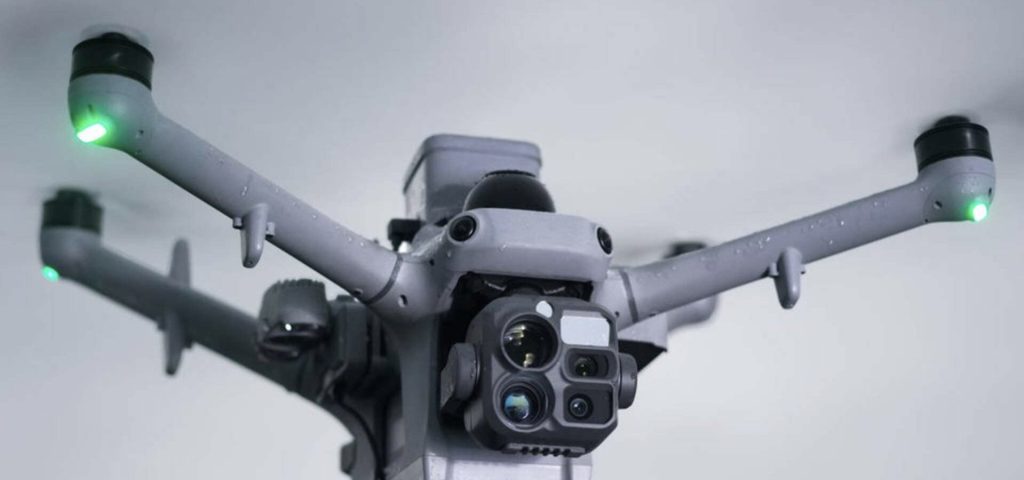
DJI is reportedly preparing to release the Matrice 5 Enterprise this week, and if the leaked specifications are accurate, this drone could represent one of the biggest leaps in enterprise drone technology in years.
With a dramatically improved thermal sensor, powerful optical zoom, 4K color night vision, and AI-powered target recognition, the Matrice 5 appears designed to push the boundaries of what a compact enterprise drone can accomplish.
But the real story isn’t just the specifications. It’s what these capabilities could mean for public safety, utilities, infrastructure inspections, and the rapidly evolving American drone market.
Perhaps the most significant improvement is the reported 1280 × 1024 thermal camera, representing a fourfold increase in native thermal pixel count compared with the 640 × 512 sensor found in the Matrice 4TD.
DJI is also reportedly introducing thermal super-resolution up to 2560 × 2048, potentially providing significantly greater detail for thermal inspections.
For enterprise operators, that could translate into better identification of electrical anomalies, improved search-and-rescue capabilities, and more detailed thermal inspections of critical infrastructure.
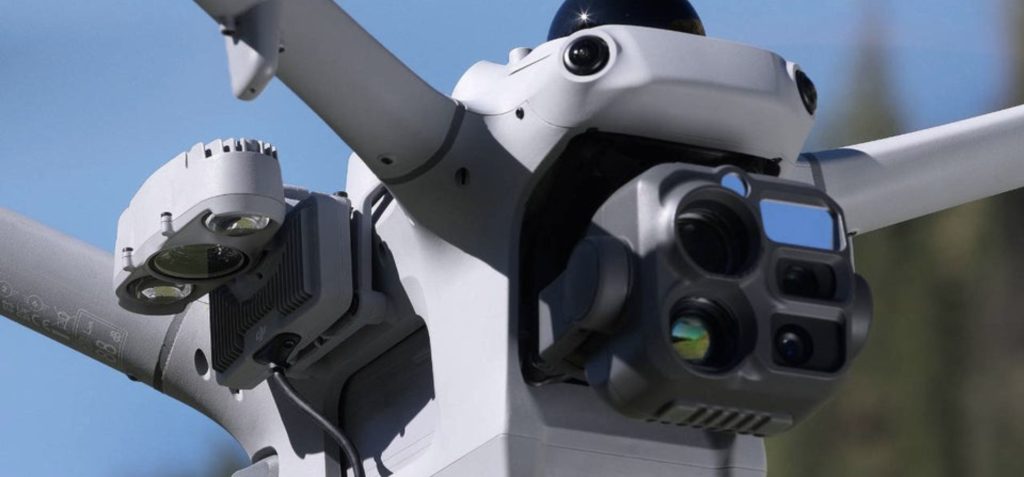
However, resolution alone doesn’t determine thermal performance. Sensor sensitivity, lens quality, calibration, and measurement accuracy will ultimately determine how much of an improvement operators experience in the field.
The reported camera configuration includes:
For utility inspectors, this could mean capturing detailed images of transmission equipment, insulators, and other elevated infrastructure while maintaining greater separation from potential hazards.
For public safety agencies, the combination of multiple focal lengths and powerful zoom could improve situational awareness during complex operations.
The important distinction is that 176× hybrid zoom doesn’t mean 176× optical zoom. Actual image quality at extreme magnifications will depend heavily on digital processing, stabilization, and environmental conditions.
One of the most intriguing reported features is 4K color night vision video.
Traditional nighttime drone operations frequently rely on thermal imaging or low-light cameras that struggle to reproduce usable color information.
Improved nighttime color imaging could provide valuable context for identifying vehicles, infrastructure, terrain, and other objects that are difficult to distinguish through thermal imagery alone.
For emergency responders and infrastructure operators working around the clock, the ability to combine high-resolution thermal imagery with usable color video could be a meaningful operational advantage.
The Matrice 5 is also rumored to feature a laser rangefinder capable of measuring distances up to 3 kilometers.
That capability could help operators identify the location of distant objects, estimate distances to infrastructure, and improve coordination during search-and-rescue missions.
Of course, maximum ranging distance is only part of the equation. Real-world performance depends on target reflectivity, atmospheric conditions, measurement accuracy, and how effectively ranging data integrates with mapping and mission-planning software.
DJI is reportedly expanding onboard AI recognition to identify 17 different target types.
This is potentially one of the most important developments.
Enterprise drones are rapidly evolving from platforms that simply capture data into systems that help operators interpret what they’re seeing.
AI-assisted recognition could reduce the workload associated with identifying objects, tracking subjects, and reviewing imagery.
But there are important unanswered questions.
What are the 17 supported target categories? How accurately can the system distinguish them? Does recognition operate entirely onboard? And how well does it perform in challenging conditions?
Those answers will determine whether the technology becomes a meaningful operational tool or simply another impressive specification.
Here’s where things get interesting.
While American manufacturers continue developing increasingly capable enterprise platforms, DJI appears determined to maintain its advantage in sensor integration, imaging technology, and overall product capability.
The Matrice 5’s reported specifications raise an important question:
Can American drone manufacturers match DJI’s pace of innovation while remaining commercially competitive?
For public safety agencies and utility operators, procurement decisions increasingly involve more than performance.
Cybersecurity, supply-chain restrictions, regulatory compliance, data protection, and domestic manufacturing requirements all influence which platforms organizations can purchase and operate.
The Matrice 5 could further widen the performance gap in certain imaging applications, but its specifications alone won’t determine its suitability for regulated U.S. operations.
What makes the rumored Matrice 5 interesting isn’t any single feature.
It’s the combination of high-resolution thermal imaging, multiple optical cameras, powerful zoom, long-distance ranging, and AI-assisted recognition in one aircraft.
That combination represents a broader industry transition.
Drones are no longer simply flying cameras. They’re becoming increasingly sophisticated tools for collecting, analyzing, and interpreting operational data.
And as sensor capabilities improve, pilot training must evolve alongside them.
Knowing how to fly is only the beginning.
Understanding how to configure sensors, interpret thermal imagery, select appropriate focal lengths, maintain safe inspection distances, and deliver actionable intelligence is what separates a competent drone operator from a truly effective enterprise pilot.
If these specifications are confirmed, the DJI Matrice 5 Enterprise could establish a new benchmark for integrated imaging capabilities in the enterprise drone market.
A fourfold increase in native thermal resolution, 176× hybrid zoom, 4K color night vision, a 3-kilometer laser rangefinder, and expanded AI recognition would make this a compelling platform for numerous commercial and public-sector applications.
But impressive specifications are only the beginning.
Real-world testing will determine whether the Matrice 5 delivers meaningful improvements in inspection accuracy, operational efficiency, and mission performance.
And perhaps the biggest question isn’t what DJI will release next. It’s whether the rest of the enterprise drone industry can keep up.
Editor’s note: The specifications discussed in this article are preliminary and have not been independently verified against an official DJI product announcement. Availability, pricing, performance, and U.S. regulatory eligibility remain unconfirmed.
 0
0
