Most people waste time jumping between random videos, apps, and FAA documents. A clear path makes this much easier.
Thank you!
Thank you. You will now be redirected to your requested resources.
What Is This Page and How Should You Use It?
This page gives you 70 free FAA-style practice questions. The real exam has 60 questions. The extra 10 questions cover topics candidates most often miss.
Questions are grouped by the five FAA subject areas. Every answer includes the FAA ACS code. Use that code to find exactly what to study next.
Score yourself honestly before booking your $175 exam. Drone U students who hit 90%+ here pass their real exam on the first attempt.See the full Part 107 prep course ?
Are you feeling stressed about preparing for the FAA Part 107 certification exam?
You’ve just arrived at the right place, at the right time.
For over a decade, Drone U has helped more than 20,000 pilots successfully pass the Part 107 certification exam. Whether you’re a complete beginner or just need a refresher, this guide has everything you need to succeed.
The FAA Part 107 Knowledge Test: Structure and Passing Expectations
Here is exactly what the real exam looks like. Know the format before you start practicing.
Exam Detail
Specification
Questions
60 multiple choice (this practice test has 70 — 10 extra to cover commonly missed topics)
Time limit
120 minutes (2 hours)
Passing score
70% — at least 42/60 correct
Test location
FAA-approved PSI testing center (800+ nationwide)
Exam fee
$175 per attempt
Results
Immediate pass/fail notification on screen
FAA reference
14 CFR Part 107 / FAA Airman Certification Standards (ACS)
Renewal
Every 24 calendar months via FAA recurrent online training
The exam is at an FAA-approved PSI testing center. There are 800+ locations nationwide. To book, visit psiexams.com and select “Unmanned Aircraft General – Small (UAG)”. For a full breakdown of every cost involved, see the Part 107 cost guide.
The Five Subject Areas: What the FAA Actually Tests
CRM, radio comms, emergency procedures, maintenance, fatigue
~8
Weather and Airspace trip up most candidates with no aviation background. If either area feels unfamiliar, read our complete Part 107 license guide before you start.
FAA References Relevant to This Test
These are the documents the real exam draws from. Keep them open while you study.
Once you’re comfortable with the structure, move on to the full 70-question practice test below.
The answer key is provided below after the last question.
Let’s begin by understanding the Part 107 Knowledge test.
What is the Part 107 Knowledge Test?
If you are looking to fly drones commercially in the US, you need to pass the Federal Aviation Administration’s (FAA) Part 107 Knowledge Test. This exam confirms that you understand the rules, airspace system, weather factors, and operational requirements needed to fly safely and legally.
Commercial drone work covers a wide range of activities, including:
If you plan to earn money from drone work or operate on behalf of a business, this certification is required.
This is the first requirement for obtaining your FAA drone license and becoming a certified remote pilot.
Ready for the practice questions?
Here’s the complete set of exam-style questions, grouped by topic, so you can evaluate your knowledge before the test day.
These questions follow the same structure and logic you’ll see on the official exam, making them a helpful way to measure your readiness.
FAA Part 107 Practice Test Sample Questions
We’ve included 70 questions in this practice test (10 more than the standard 60) to give you access to all the most important and relevant questions in one place.
This page is regularly updated as we find new, high-quality questions, so you don’t miss anything important during your Part 107 prep.
These questions are specifically curated to measure your performance and bolster your confidence.
The answer key appears immediately after each question. For timed practice, cover the answers and work through all 70 first.
Note: Each answer includes two reference codes. The ACS code (e.g., UA.I.B.K2) is the FAA Airman Certification Standards reference. UA = Unmanned Aircraft, I = Area of Operation, B = Task, K2 = Knowledge item 2. The Ref line cites the exact regulation or Advisory Circular(AC) the question draws from. AC 107-2 is the FAA’s Advisory Circular for small UAS operations and the primary study document for this exam.
If you get a question wrong, use both codes to find exactly what to study next.
Section A. Part 107 Practice Test Questions Related to Regulations (Questions 1–13)
1. A professional wildlife photographer operates a sUAS from a moving truck to capture aerial images of migrating birds in remote wetlands. The driver of the truck does not serve any crew member role in the operation. Is this sUAS operation in compliance with 14 CFR Part 107?
A. Compliant with Part 107
B. Not compliant with Part 107
C. Not compliant with state and local traffic laws
Answer: A. You may operate from a moving vehicle over sparsely populated areas. The driver must not serve as Remote PIC, person manipulating the controls, or visual observer. ACS: UA.I.B.K2 | Ref: 14 CFR §107.25, AC 107-2
2. When is a Remote ID broadcast module required for a Part 107 operation?
A. Only when flying in controlled airspace
B. For all Part 107 operations unless operating in a FRIA
C. Only for drones weighing more than 250 grams
D. Only during night operations
Answer: C. You may not operate directly over a person unless they are directly involved in the operation or within safe cover, such as inside a stationary vehicle or a protective structure. ACS: UA.I.B.K2 | Ref: 14 CFR §107.39, AC 107-2
3. Personnel at an outdoor concert venue use a sUAS to drop promotional t-shirts and CDs over the audience. Is this sUAS operation in compliance with 14 CFR 107?
A. No, unless authorized by the venue
B. Yes, compliant with Part 10
C. Not compliant with Part 107
Answer: C. Not compliant. Dropping objects is only allowed under §107.23 if precautions protect people and property below. Flying over an audience also violates §107.39 unless Category requirements are met. ACS: UA.I.B.K2 | Ref: 14 CFR §107.23, §107.39, AC 107-2
4. Which of the following crew members must be used during Part 107 sUAS operations?
A. Remote PIC
B. Remote PIC, Visual Observer
C. Remote PIC, Visual Observer, Person manipulating the controls
Answer: A. A Remote PIC must be used during Part 107 operations. A visual observer is optional. The person manipulating the controls may be the Remote PIC or must operate under the Remote PIC’s direct supervision. Reference: ACS: UA.I.B.K2 | Ref: 14 CFR §107.19, AC 107-2
5. How many sUAS may the remote PIC operate at a time?
A. 5
B. 1
C. No more than 2
Answer: B. A person may not operate or act as a Remote PIC or a visual observer in the operation of more than one unmanned aircraft at the same time. ACS: UA.I.B.K2 | Ref: 14 CFR §107.35, AC 107-2
6. Which of the following is an acceptable way to comply with Remote ID requirements?
A. Flying only below 100 feet AGL
B. Using a standard Remote ID drone
C. Requesting authorization from ATC
D. Operating only during daylight hours
Answer: B. A standard Remote ID drone broadcasts identification and location data as required. An unmanned aircraft is one operated without direct human intervention from within the aircraft. ACS: UA.I.B.K7 | Ref: 14 CFR §107.1, §107.3, AC 107-2
7. Under what conditions may objects be dropped from the sUAS?
A. Only with prior permission is received from the FAA
B. in an emergency
C. If precautions are taken to avoid injury or damage to persons or property on the surface
Answer: C. No items may be dropped from an sUAS in a manner that creates undue hazard to persons or property on the surface. ACS: UA.I.B.K2 | Ref: 14 CFR §107.23, AC 107-2
8. Unless otherwise authorized, what is the maximum airspeed at which a person may operate an sUAS below 400 feet?
A. 80 mph
B. 100 mph
C. 200 knots
Answer: B. The sUAS cannot exceed a ground speed of 87 knots (100 mph). It must also be operated below 400 feet AGL. ACS: UA.I.B.K2 | Ref: 14 CFR §107.51, AC 107-2
9. When an ATC clearance has been obtained, no remote PIC may deviate from that clearance, unless that pilot obtains an amended clearance. The one exception to this regulation is
A. an emergency
B. When the clearance states “at pilot’s discretion.”
C. If the clearance contains a restriction
Answer: A. Except in an emergency, no person may operate contrary to an ATC clearance or instruction. ACS: UA.I.B.K2 | Ref: 14 CFR §107.21, AC 107-2
10. Under what conditions would a small unmanned aircraft not have to be registered before it is operated in the United States?
A. When the aircraft has a takeoff weight that is more than .55 pounds but less than 55 pounds, not including fuel and necessary attachments
B. When the aircraft weighs less than .55 pounds on take-off, including everything onboard or attached to the aircraft
C. All small unmanned aircraft need to be registered regardless of the weight of the aircraft before, during, or after the flight
Answer: B. Owners must register the sUAS if it weighs more than 0.55 lbs and less than 55 lbs when operated under Part 107. Under 0.55 lbs at takeoff, including everything onboard, means no registration is required. ACS: UA.I.B.K1 | Ref: 14 CFR §107.13, AC 107-2
11. What is the minimum visibility requirement for anti-collision lighting during Part 107 night operations?
A. Visible from 1 statute mile
B. Visible from 2 statute miles
C. Visible from 3 statute miles
D. No visibility requirement exists
Answer: C. Three statute miles. This applies during both night and civil twilight operations. See §107.29. ACS: UA.I.B.K2 | Ref: 14 CFR §107.29, AC 107-2
12. What must a remote pilot do before conducting Part 107 night operations?
A. Obtain a night waiver
B. Notify local law enforcement
C. Complete updated recurrent training or testing
D. Fly only with a visual observer
Answer: C. The 2021 rule change removed the night waiver requirement. Night flying is now allowed without a waiver. But the Remote PIC must have completed recurrent training that includes night operations. ACS: UA.I.B.K2 | Ref: 14 CFR §107.29, AC 107-2
13. You’re asked a question about operations over people, and one of the answer options mentions an airworthiness certificate. Which category does that apply to?
A. Category 1
B. Category 2
C. Category 3
D. Category 4
Answer: D. Airworthiness certificates are a requirement for Category 4 operations only. You can eliminate that option if asked about Categories 1, 2, or 3. ACS: UA.I.B.K2 | Ref: 14 CFR §107.145, AC 107-2
Section B. Part 107 Practice Test Questions Related to Airspace Classification (Questions 14-24)
14. During an aerial survey of a Class D airport, ATC instructs you to remain clear of all runways. How do you confirm you are safely clear?
A. You are on the side of the hold short line with two solid yellow lines
B. You are following the yellow taxiway line
C. You are on the dashed side of the hold short marking
D. You are parallel to the runway edge markings
Answer: A. A useful mnemonic: solid is safe, dashed is dangerous. You must be on the solid side of the hold short markings to be considered clear of the runway. ACS: UA.II.B.K1 | Ref: AIM Chapter 2, AC 107-2
15. Which publication contains an explanation of airport signs and markings?
A. Aeronautical Information Manual (AIM)
B. Advisory Circulars (AC)
C. Chart Supplements US
Answer: A. The AIM. It is the primary FAA reference for airport signs, markings, and procedures. ACS: UA.II.B.K1 | Ref: AIM Chapter 2, AC 107-2
16. Responsibility for collision avoidance in an alert area rests with
A. the controlling agency
B. all pilots
C. Air Traffic Control
Answer: B. All activity within an Alert Area must be conducted per FAA regulations. Pilots of participating aircraft and pilots transiting the area are equally responsible for collision avoidance. ACS: UA.II.B.K2 | Ref: AIM 3-4-6, AC 107-2
17. According to 14 CFR Part 107, how may a Remote Pilot in Command (Remote PIC) operate an unmanned aircraft in Class C airspace?
A. The remote PIC must contact the ATC facility after launching the unmanned aircraft
B. The remote PIC must monitor the ATC frequency from launch to recovery
C. The remote PIC must have prior authorization from the Air Traffic Control (ATC) facility having jurisdiction over that airspace.
Answer: C. Prior authorization is required. §107.41 covers Class B, C, D, and surface E airspace. You must have approval before you launch. ACS: UA.II.B.K3 | Ref: 14 CFR §107.41, AC 107-2
18. When approaching holding lines from the side with the continuous lines, the pilot
A. should not cross the lines without ATC clearance
B. may continue taxiing
C. should continue taxiing until all parts of the aircraft have crossed the lines
Answer: A. All activity within an Alert Area must be conducted per FAA regulations. Pilots of participating aircraft and pilots transiting the area are equally responsible for collision avoidance. ACS: UA.II.B.K2 | Ref: AIM 3-4-6, AC 107-2
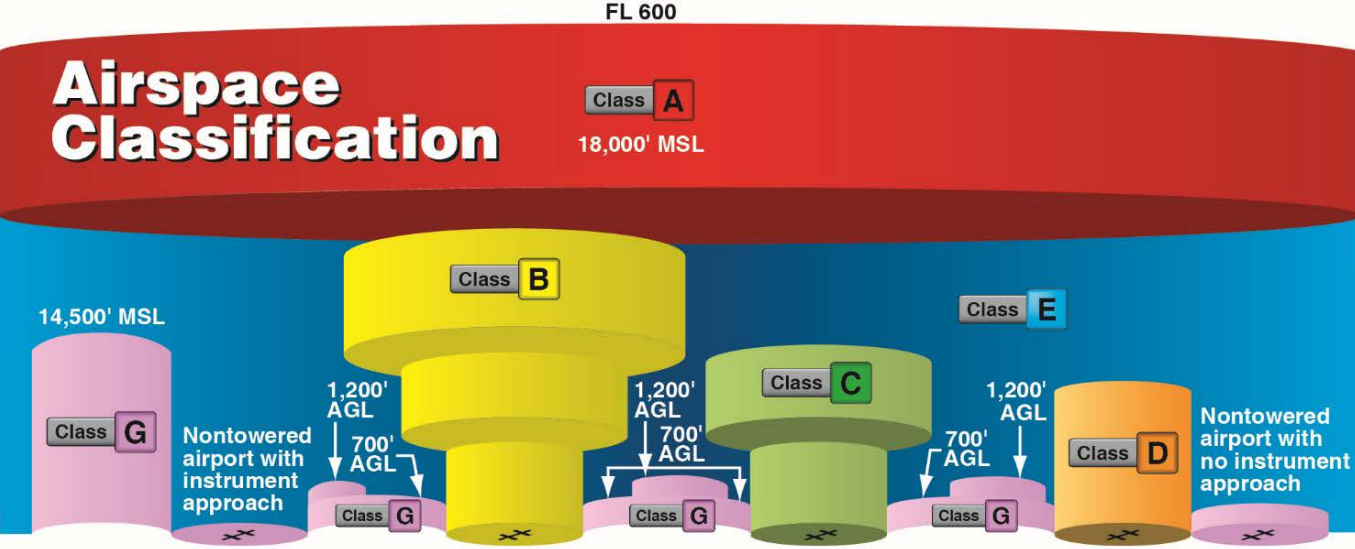
19. The lateral dimensions of class D airspace are based on
A. The instrument procedures for which the controlled airspace is established
B. the number of airports that lie within Class D airspace
C. 5 statute miles from the geographical center of the primary airport
Answer: A. The instrument approach procedures. Class D is shaped around them, not around a fixed radius. ACS: UA.II.B.K2 | Ref: AIM 3-2-5, AC 107-2
20. You have received authorization to operate an sUAS at an airport. When flying the sUAS, the ATC tower instructs you to stay clear of all runways. Which situation would indicate that you are complying with this request?
A. You are on the double solid yellow line side of markings near the runway
B. You are on the double-dashed yellow line side of markings near the runway
C. You are over the dashed white lines in the center of the pavement
Answer: A. Runway hold markings have two double-dashed and two solid yellow lines. You are on the taxiway side of the solid yellow lines. The dashed side means you are in the runway environment. ACS: UA.II.B.K1 | Ref: AIM Chapter 2, AC 107-2
21. When is LAANC authorization required for a Part 107 flight?
A. When flying above 200 feet AGL
B. When operating in uncontrolled (Class G) airspace
C. When operating in controlled airspace near airports
D. Only for night operations
Answer: C. LAANC applies to Class B, C, D, and designated surface E airspace. Class G needs no authorization. ACS: UA.II.B.K3 | Ref: 14 CFR §107.41, AC 107-2
22. Which category of operations over people allows flight without a waiver?
A. Any drone under 5 pounds
B. Category 1 operations meeting injury thresholds
C. Only drones with parachutes
D. Only government-operated drones
Answer: B. Category 1. These are drones under 0.55 lbs. No waiver is needed under the 2021 Operations Over People rule. ACS: UA.I.B.K2 | Ref: 14 CFR §107.120, AC 107-2
23. Under what conditions, if any, may remote pilots fly through a restricted area?
A. With the controlling agency’s authorization
B. When flying on airways with an ATC clearance
C. Regulations do not allow this
Answer: A. The controlling agency can authorize it. That is usually the military. Without their approval, entry is not permitted. ACS: UA.II.B.K2 | Ref: AIM 3-4-3, AC 107-2
24. Which technique should a remote pilot use to scan for traffic?
A. Continuously scan the sky from right to left
B. Systematically focus on different segments of the sky for short intervals
C. Concentrate on the relative movement detected in the peripheral vision area
Answer: B. Effective scanning uses short, regularly spaced eye movements. Each movement should not exceed 10 degrees. Each area should be observed for at least one second to enable detection. ACS: UA.II.B.K4 | Ref: AIM 8-1-6, AC 107-2
Section C. Part 107 Practice Test Questions Related to Weather (Questions 25-36)
25. You’re flying a fixed-wing SUAS on a high mountain plateau on a hot summer day. What must you consider?
A. Wings will generate more lift, and the propeller will be more efficient
B. Wings generate more lift, but a propeller is less efficient
C. Wings and propellers will both be less efficient
D. The propeller is more efficient due to thinner air
Answer: C. High, hot, and humid conditions — known as the Three Hs or High Density Altitude — reduce air density. Both wings and propellers are less effective. ACS: UA.III.B.K1 | Ref: AC 107-2, FAA-H-8083-25
26. Which of the following best describes “High Density Altitude”?
A. Air is thicker, and performance is increased
B. Air is thinner, and aircraft performance decreases
C. The aircraft is flying at sea level
D. The drone has high-density batteries
Answer: B. High-density altitude means thin air. Thin air reduces lift, thrust, and overall performance. ACS: UA.III.B.K1 | Ref: AC 107-2, FAA-H-8083-25
27. The presence of ice pellets at the surface is evidence that there
A. are thunderstorms in the area
B. is a temperature inversion with freezing rain at a higher altitude
C. has been a cold frontal passage
Answer: B. Ice pellets always indicate freezing rain at a higher altitude. ACS: UA.III.B.K2 | Ref: AC 107-2, FAA-H-8083-28
28. The minimum distance from clouds required for sUAS part 107 operations is
A. 500 feet below, 2,000 feet horizontally
B. clear of clouds
C. 500 feet above, 1,000 feet horizontally
Answer: A. Ice pellets always indicate freezing rain at a higher altitude. ACS: UA.III.B.K2 | Ref: 14 CFR §107.51, AC 107-2
29. What is the best way for a remote pilot to determine the likelihood of local fog formation?
A. Monitor the wind conditions to ensure the wind speed is not increasing
B. Monitor the barometric pressure to ensure that it is not decreasing
C. Monitor the temperature/dew point spread
Answer: C. Watch the temperature/dew point spread. When it narrows to 2 to 3 degrees Fahrenheit, fog is likely forming. ACS: UA.III.B.K2 | Ref: AC 107-2, FAA-H-8083-28
30. Which weather phenomenon is always associated with a thunderstorm?
A. Heavy rain
B. Hail
C. Lightning
Answer: C. Lightning. By definition, a storm without lightning is not a thunderstorm. ACS: UA.III.B.K2 | Ref: AC 107-2, FAA-H-8083-28
31. What effect does high-density altitude have on the efficiency of a UA propeller?
A. Density altitude does not affect propeller efficiency
B. Propeller efficiency is increased
C. Propeller efficiency is decreased
Answer: C. Thinner air means the propeller has less to bite into. Thrust output drops. ACS: UA.III.B.K1 | Ref: AC 107-2, FAA-H-8083-25
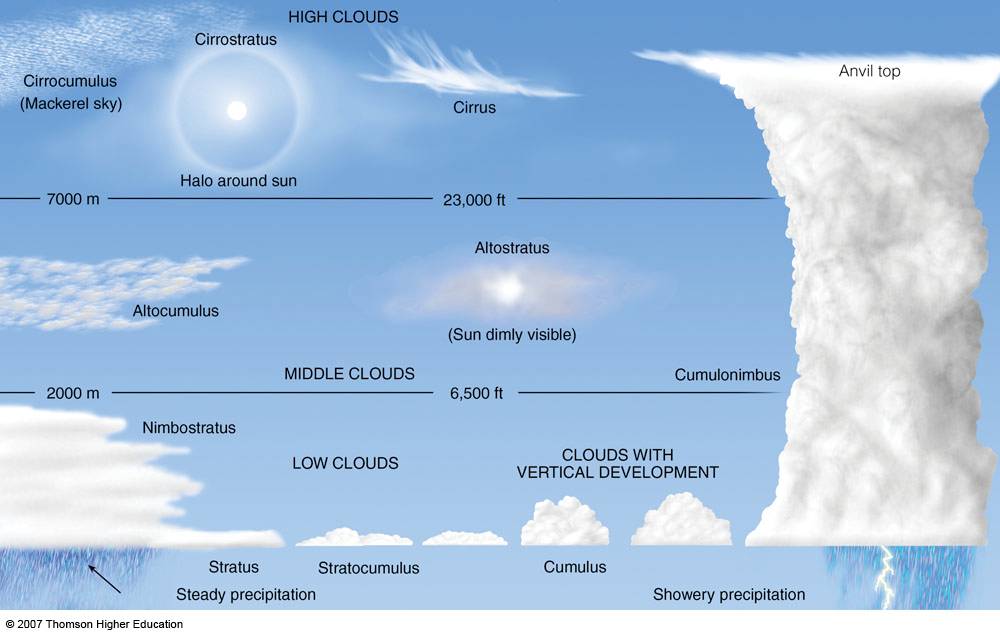
32. What are the characteristics of a moist, unstable air mass?
A. Turbulence and showery precipitation
B. Poor visibility and smooth air
C. Haze and smoke
Answer: A. A moist unstable air mass produces cumuliform clouds, showery precipitation, turbulence, and good visibility except in blowing obstructions ACS: UA.III.B.K2 | Ref: AC 107-2, FAA-H-8083-28
33. In which environment is aircraft structural ice most likely to have the accumulation rate?
A. Cumulus clouds with below-freezing temperatures
B. Freezing rain
C. Freezing drizzle
Answer: B. Freezing rain below a frontal surface is the condition most favorable for rapid accumulation of clear structural ice. ACS: UA.III.B.K2 | Ref: AC 107-2, FAA-H-8083-28
34. One weather phenomenon that will always occur when flying across a front is a change in
A. wind direction
B. type of precipitation
C. stability of the air mass
Answer: A. Wind direction always shifts when you cross a front. That is one of the most reliable indicators that a front has passed. ACS: UA.III.B.K2 | Ref: AC 107-2, FAA-H-8083-28
35. Which characteristic is a stable air mass most likely to have?
A. Showery precipitation
B. Poor surface visibility
C. Turbulent air
Answer: B. A stable air mass produces stratiform clouds, fog, continuous precipitation, smooth air, and fair to poor visibility in haze and smoke. ACS: UA.III.B.K2 | Ref: AC 107-2, FAA-H-8083-28
36. What is the expected duration of an individual microburst?
A. Two minutes with maximum winds lasting approximately 1 minute
B. One microburst may continue for as long as 2 to 4 hours
C. Seldom longer than 15 minutes from the time the burst strikes the ground until dissipation
Answer: C. An individual microburst seldom lasts longer than 15 minutes from the time it strikes the ground until dissipation. However, multiple microbursts may exist in the same area. ACS: UA.III.B.K2 | Ref: AC 107-2, FAA-H-8083-28
Section D. Part 107 Practice Test Questions Related to Loading & Performance (Questions 37–46)
37. When loading cameras or other equipment on an sUAS, mount the items in a manner that:
A. Does not adversely affect the center of gravity
B. Is visible to the visual observer or other crew members
C. Can be easily removed without the use of tools
Answer: A. Any mounted equipment must be balanced in a manner that does not adversely affect the center of gravity or result in unsafe performance ACS: UA.IV.B.K1 | Ref: 14 CFR §107.49, AC 107-2
38. Which of the following is true regarding the weight and balance of small unmanned aircraft?
A. Operations outside weight and balance limitations may result in loss of control
B. CG cannot change during the flight
C. Lateral CG is not important to small unmanned aircraft operations.
Answer: A. Loading outside of weight and balance limitations may produce moments that exceed the capabilities of flight controls or engines — leading to loss of control or performance anomalies.. ACS: UA.IV.B.K1 | Ref: 14 CFR §107.49, AC 107-2
39. A stall occurs when the smooth airflow over the unmanned aircraft’s wing/ propeller(s) is disrupted, and the lift reduces rapidly. This is caused when the wing/ propeller (s)
A. exceeds the maximum allowable operating weight
B. exceeds the critical angle of attack
C. exceeds the maximum speed
Answer: B. Exceeding the critical angle of attack breaks smooth airflow. When that happens, lift drops sharply. ACS: UA.IV.B.K2 | Ref: AC 107-2, FAA-H-8083-25
40. Maximum endurance is obtained at the point of minimum power to maintain the aircraft
A. in a long-range descent
B. in steady, level flight
C. at its slowest possible indicated airspeed
Answer: B. Maximum endurance is obtained at the point of minimum power required. That is the lowest fuel flow or battery draw needed to maintain steady, level flight. ACS: UA.IV.B.K2 | Ref: AC 107-2, FAA-H-8083-25
41. When range and economy of operation are the principal goals, the remote pilot must ensure that the sUAS will be operated at the recommended
A. long-range cruise performance
B. specific endurance
C. equivalent airspeed
Answer: B. The total range depends on the fuel available and the specific range. Long-range cruise gives the maximum design-operating radius or allows lesser distances with maximum fuel reserve at the destination. ACS: UA.IV.B.K2 | Ref: FAA-H-8083-25, AC 107-2
42. What is the best source for sUAS performance data and information?
A. Pilot report
B. Estimates based upon similar systems
C. Manufacturer publications
Answer: C. The manufacturer is the best source of performance data and information, when available ACS: UA.IV.B.K1 | Ref: 14 CFR §107.49, AC 107-2
43. What effect does an uphill terrain slope have on launch performance?
A. Increases launch distance
B. increase launch speed
C. decreases launch distances
Answer: C. Launching uphill creates a headwind component. That reduces the ground run needed to get airborne. ACS: UA.IV.B.K2 | Ref: AC 107-2, FAA-H-8083-25
44. When operating an unmanned aircraft, the remote pilot-in-command should consider that the load factor on the wings or rotors may be increased at any time:
A. The CG is shifted rearward to the aft CG limit
B. The gross weight is reduced
C. The aircraft is subjected to maneuvers other than straight and level flight
Answer: C. Unmanned aircraft performance decreases when load factor increases. Load factor increases whenever the aircraft is operated in maneuvers other than straight and level flight. ACS: UA.IV.B.K2 | Ref: AC 107-2, FAA-H-8083-25
45. The most critical conditions of launch performance are the result of some combination of high gross weight, altitude, temperature, and
A. obstacles surrounding the launch site
B. power plant systems
C. unfavorable wind
Answer: C. The most critical launch conditions come from some combination of high gross weight, altitude, temperature, and unfavorable wind. The Remote PIC must accurately predict takeoff distance regardless of the runway available. ACS: UA.IV.B.K2 | Ref: FAA-H-8083-25, AC 107-2
46. Before each flight, the remote PIC must ensure that:
A. objects carried on the sUAS are secure
B. ATC has granted clearance
C. The site supervisor has approved the flight
Answer: A. Before each flight, the Remote PIC must ensure any object attached to or carried by the sUAS is secure and does not adversely affect flight characteristics or controllability. ACS: UA.I.B.K2 | Ref: AC 107-2
Walk Into the Exam Feeling Prepared
Confidence doesn’t come from studying more; it comes from knowing you studied the right things.
You’ll be able to:
Know where to start (and what to ignore)
Spot weak areas before test day
Review quickly without second-guessing yourself
Thank you!
Thank you. You will now be redirected to your requested resources.
Section E. FAA Part 107 Practice Test Questions Related to Operations (Questions 47–70)
47. A travel blogger is filming from a drone while riding in a truck across a remote desert. The driver is operating the vehicle, and the passenger is the PIC of the drone. Does this comply with Part 107?
A. Yes
B. No
C. Only if the drone is carrying property
D. It depends on state driving laws
Answer: A. Yes, this is legal. §107.25 allows it over sparsely populated areas when no property is being carried for hire. ACS: UA.I.B.K2 | Ref: 14 CFR §107.25, AC 107-2
48. When is it legal to operate a drone from a moving vehicle under Part 107?
A. Over any area, as long as the driver is not the remote PIC
B. When over a sparsely populated area and not carrying property for compensation
C. Only if authorized by local traffic authorities
D. Only when the vehicle is stationary
Answer: B. §107.25 allows operation from a moving vehicle only over sparsely populated areas and only when not carrying property for compensation. ACS: UA.I.B.K2 | Ref: 14 CFR §107.25, AC 107-2
49. Which of the following is a requirement for Category 2 operations over people?
A. The drone must weigh less than 0.55 lbs
B. The drone must have an airworthiness certificate
C. The drone must not transfer more than 11 foot-pounds of kinetic energy on impact
D. The drone must be operated indoors only
Answer: C. Category 2 operations prohibit exposed rotating parts capable of laceration and limit kinetic energy transfer to under 11 foot-pounds on impact. ACS: UA.I.B.K2 | Ref: 14 CFR §107.130, AC 107-2
50. What is the weight requirement for Category 1 operations over people under Part 107?
A. Less than 0.55 lbs
B. Less than 1.55 lbs
C. Between 0.55 and 4.4 lbs
D. No weight restriction
Answer: A. Category 1 drones must weigh under 0.55 lbs and must not have exposed rotating parts that could lacerate skin. ACS: UA.I.B.K2 | Ref: 14 CFR §107.120, AC 107-2
51. Which of the following events is considered a flyaway?
A. Unmanned aircraft does not respond to control inputs and does not execute known lost link maneuvers
B. Loss of the link between the Remote PIC and the unmanned aircraft
C. Loss of communication link between the Remote PIC and ATC
Answer: A. A flyaway is when the aircraft ignores control inputs and does not follow its lost-link programming. It is fully uncontrolled. ACS: UA.V.B.K1 | Ref: 14 CFR §107.19, AC 107-2
52. Fatigue can be either
A. physiological or psychological
B. physical or mental
C. acute or chronic
Answer: C. Acute fatigue is a normal occurrence from long periods of physical or mental strain, including lack of sleep. Chronic fatigue occurs when there is not enough time to recover from repeated episodes of acute fatigue. ACS: UA.V.B.K2 | Ref: AC 107-2, FAA-H-8083-25
53. A common cause of sUAS flyaway events is
A. frequency interference
B. loss of GPS signals
C. persons standing close to the control station antenna
Answer: A. Frequency interference is one of the most common causes of flyaways. Remote PICs should assess this risk before and during flight. Loss of GPS may degrade capabilities slightly but should not cause a flyaway. ACS: UA.V.B.K1 | Ref: 14 CFR §107.19, AC 107-2
54. You have just landed at a towered airport, and the tower tells you to contact ground control when clear of the runway. You are considered clear of the runway when
A. The aircraft cockpit is clear of the hold line
B. The tail of the aircraft is clear of the runway edge
C. All parts of the aircraft have crossed the hold line
Answer: C. An aircraft is not clear of the runway until all parts have crossed the applicable holding position marking. ACS: UA.II.B.K1 | Ref: AIM Chapter 2, AC 107-2
55. Which of the following sources of information should you consult first when determining what maintenance should be performed on a sUAS or its components
A. Local pilot best practices
B. 14 CFR Part 107
C. Manufacturer guidance
Answer: C. The manufacturer’s guidance is the preferred source for maintenance schedules and instructions. ACS: UA.V.B.K1 | Ref: 14 CFR §107.15, AC 107-2
56. What is the best way for the remote PIC to minimize the risk of radio frequency interference during sUAS operations?
A. Never transmit on aviation frequency ranges during flight operations
B. Monitor frequency use with a spectral analyzer
C. Avoid the use of cell phones in the vicinity of the control station
Answer: B. The best way to avoid frequency interference is to check local frequency spectrum use before flight and continue to monitor it during flight using a frequency spectrum analyzer. ACS: UA.V.B.K1 | Ref: AC 107-2
57. Under what condition should the operator of a small unmanned aircraft establish a scheduled maintenance protocol?
A. When the manufacturer does not provide a maintenance schedule
B. When the FAA requires you to, following an accident
C. Small unmanned aircraft systems do not require maintenance
Answer: A. If the manufacturer has no maintenance schedule, you create one yourself. This is the operator’s responsibility. ACS: UA.V.B.K1 | Ref: 14 CFR §107.15, AC 107-2
58. During the preflight inspection, who is responsible for determining whether the aircraft is safe for flight?
A. The owner or operator
B. The remote pilot-in-command
C. The certificate mechanic who performed the annual inspection
Answer: B. The Remote PIC. Final airworthiness responsibility sits with the pilot before every flight. ACS: UA.V.B.K1 | Ref: 14 CFR §107.19, AC 107-2
59. Which would most likely result in hyperventilation
A. The excessive consumption of alcohol
B. Emotional tension, anxiety, or fear
C. An extremely slow rate of breathing and insufficient oxygen
Answer: B. Stress, anxiety, or fear triggers fast, shallow breathing. That is the most common cause of hyperventilation. ACS: UA.V.B.K2 | Ref: AC 107-2, FAA-H-8083-25
60. Upon GPS signal loss, the remote Pilot should immediately
A. Contact ATC and declare an emergency
B. Perform the planned lost link contingency procedure
C. Operate the sUAS normally, noting to account for any mode or control changes that occur if GPS is lost
Answer: C. Most sUAS are designed to fly normally with minimal impact on controllability if GPS is lost. Loss of GPS is not an emergency. If it does result in a flyaway or dangerous situation, treat it as an emergency. ACS: UA.V.B.K1 | Ref: AC 107-2
61. After landing at a tower-controlled airport, a pilot should contact ground control
A. When advised by the tower
B. before turning off the runway
C. after reaching a taxiway that leads directly to the parking area
Answer: A. A pilot who has just landed should not change from the tower frequency to ground control until directed to do so by the controller. ACS: UA.II.B.K1 | Ref: AIM 4-3-14, AC 107-2
62. What action should the remote PIC take upon GPS signal loss?
A. Perform the planned flyaway emergency procedure
B. Follow normal sUAS operational procedure, noting any mode or control changes that normally occur if GPS is lost.
C. Land the unmanned aircraft immediately before loss of control
Answer: A. A pilot who has just landed should not change from the tower frequency to ground control until directed to do so by the controller. ACS: UA.II.B.K1 | Ref: AIM 4-3-14, AC 107-2
63. Which will almost always affect your ability to fly?
A. Prescription analgesics and antihistamines
B. Over-the-counter analgesics and antihistamines
C. Antibiotics and anesthetic drugs
Answer: A. Flying is almost always precluded while using prescription analgesics, they cause mental confusion, dizziness, headaches, nausea, and vision problems. Antihistamines lower blood pressure, reduce mental processing, and slow motor and reaction responses. ACS: UA.V.B.K2 | Ref: FAA-H-8083-25, AC 107-2
64. What antidotal phrase can help reverse the hazardous attitude of “anti-authority”?
A. Rules do not apply to this situation
B. I know what I am doing
C. Follow the rules
Answer: C. The anti-authority attitude is found in people who do not like being told what to do. The antidote is: follow the rules — they are usually right. ACS: UA.V.B.K2 | Ref: FAA-H-8083-25, AC 107-2
65. Which of the following lithium batteries should not be used
A. A battery with a bulge on one of the sides of its case
B. A partially discharged battery that is warm from recent prior use
C. A new battery that has only been charged once, several charging cycles are required before normal use.
Answer: A. Damaged batteries must never be used or charged. A bulge on the battery case indicates internal failure. Lithium batteries normally get warm during discharge — avoid using hot batteries. ACS: UA.V.B.K1 | Ref: SAFO 10017, AC 107-2
66. The responsibility for ensuring that an sUAS is maintained in an airworthy condition is primarily that of the
A. Owner or operator
B. Remote pilot-in-command
C. mechanic who performs the work
Answer: B. No person may operate an sUAS unless it is in a condition for safe operation. The Remote PIC must check the sUAS before each flight and may not continue the flight if the aircraft is no longer in a safe condition. ACS: UA.V.B.K1 | Ref: 14 CFR §107.15, AC 107-2
67. When flying HAWK N666CB, the proper phraseology for initial contact with Whitted ATC Tower is
A. Whitted, HAWK SIX SIX SIX CEE BEE, requesting to operate within Class D, west of the field.
B. Whitted Tower, HAWK SIX SIX SIX CHARLIE BRAVO five NM west of the airport, request permission to enter Class D airspace for unmanned aircraft operations below four hundred AGL, three NM west of the airport
C. Whitted Tower, Triple Six Charlie Bravo, five NM west, operating in Class D below four hundred AGL west of the airport
Answer: B. No person may operate an sUAS unless it is in a condition for safe operation. The Remote PIC must check the sUAS before each flight and may not continue flight if the aircraft is no longer in a safe condition. ACS: UA.V.B.K1 | Ref: 14 CFR §107.15, AC 107-2
68. Who is responsible for determining whether a pilot is fit to fly for a particular flight, even though he or she holds a current medical certificate
A. The FAA
B. The medical examiner
C. The Pilot
Answer: C. The pilot is responsible for determining whether they are fit to fly for a particular flight. ACS: UA.V.B.K2 | Ref: FAA-H-8083-25, AC 107-2
69. Fatigue can be recognized
A. as being in an impaired state
B. easily by an experienced pilot
C. by an ability to overcome sleep deprivation
Answer: A. The fatigued pilot is impaired. Flying requires unimpaired judgment. ACS: UA.V.B.K2 | Ref: FAA-H-8083-2, AC 107-2
70. What action should be taken by the Remote PIC during an sUAS flyaway event?
A. Immediately notify any/all crewmembers, bystanders, and ATC (if applicable)
B. Immediately notify the NTSB
C. Immediately notify any/all crewmembers, local law enforcement personnel, and bystanders
Answer: A. The fatigued pilot is impaired. Flying requires unimpaired judgment. ACS: UA.V.B.K2 | Ref: FAA-H-8083-2, AC 107-2
How to Prepare for the Part 107 Practice Test
Acing the FAA’s Part 107 exam is the first hurdle. Passing is essential for any pilot aiming to fly drones for business. This important test assesses your knowledge of drone flight regulations and operational requirements in the US
To start your journey towards passing the Part 107 exam, download our FREE comprehensive Part 107 Study Guide. It equips you with the knowledge of every topic the FAA expects you to know. It also gives you a simple framework to study from.
Here are some tips to help you prepare and ace the FAA Part 107 test:
Study the FAA’s Part 107 Study Guide thoroughly. It explains the core information and explains how the FAA expects you to understand each topic.
Take the Part 107 practice test to learn the question format. Note which topics you miss or guess. These usually point to the areas that need the most attention.
Use online resources to clarify difficult concepts. Short videos and visual examples can make topics like weather, charts, and regulations easier to understand.
Understand the importance of each topic. Focus more time on the topics that appear more often on the FAA Part 107 test, such as airspace classification, regulations, and weather patterns.
Take your time during the exam. Read each question carefully and don’t rush. With 2 hours to complete the exam, you have about 2 minutes per question. Use that time to double-check your choices before moving on.
With the right resources and a strategic study plan, you can prepare with confidence. Start with Drone U’s Free Part 107 Study Guide, and work through the 70 practice questions with answers. Focus on understanding the core concepts and how they apply to real-world flying.
Part 107 Renewal Guide — How to renew every 24 months — free FAA online course, Part 61 pathway, and what to do if expired
Disclaimer: Questions and answers reflect FAA regulations and Airman Certification Standards current as of March 2026. Drone regulations are subject to change. Always verify against current FAA publications at faa.gov before your exam
Ready to Pass Your Part 107 With Confidence?
Part 107 gets a lot easier when you stop guessing what to study.
This training gives you a clear plan, so you can prepare faster and walk into the exam knowing you’re ready.
Turn months of scattered studying into a few weeks of focused, structured prep
Score 90% or higher on our quizzes, and you’ll know you’re ready for the real test
Finally understand airspace, weather, and rules without memorizing blindly
Know exactly what to study — and what you don’t need to stress about
Thank you!
Thank you. You will now be redirected to your requested resources.
12
FAQs
1. What score do I need to pass the real Part 107 exam?
You need to answer 42 out of 60 questions correctly. That is 70%. On this 70-question practice test, aim for at least 49 correct before feeling comfortable. Aim for 63+ before booking your real exam.
2. What happens if I fail the Part 107 Exam?
If you fail the Part 107 test, you can retake the exam after a 14-day waiting period. There is no maximum limit on the number of times you can retake it. However, each attempt requires paying the $150 testing fee again.
3. How many questions are on the Part 107 exam?
The FAA Part 107 exam includes 60 multiple-choice questions to answer in 120 minutes.
4. What score do I need to pass the Part 107 exam?
You need to score at least 70% to pass the exam. In other words, you have to answer 42 questions correctly to secure 70% or higher in the exam.
5. How can a practice test help me prepare for the FAA Part 107 exam?
The practice test helps you become familiar with the exam format, pinpoint areas to review, and boost your confidence. It improves your ability to recall information quickly and accurately during the real exam.
6. Do I need to own a drone before I can get a Part 107 certificate?
No. You don’t need to own a drone to take or pass the Part 107 test. The certification evaluates your aeronautical knowledge, not your ownership or experience with a specific aircraft.
7. What should I bring to the testing center?
You need a valid photo ID to confirm your identity. The testing center supplies any charts or references you may need (like sectional charts or weather supplements).
Author
Paul Aitken
Co-Founder and CEO
Paul Aitken is a Certified Part 107 drone pilot and a Certified Pix4D Trainer. He is a pioneer in drone training and co-founder of Drone U. He created the industry’s first Part 107 Study Guide and co-authored Livin’ the Drone Life.
Paul is passionate about helping students fly drones safely and effectively. With over a decade of experience, he has led complex UAS projects for federal agencies and Fortune 500 clients such as Netflix, NBC, the NTSB, and the New York Power Authority.
Add Your Comment
Related Articles
The Top 36 Drone Companies in 2025
How to Choose the Best Drone for Cinematic Filmmaking


![FAA Part 107 Practice Test [70 MCQs With Answers]](https://www.thedroneu.com/wp-content/uploads/2023/06/Practice-Part-107-Questions-1024x576.png)


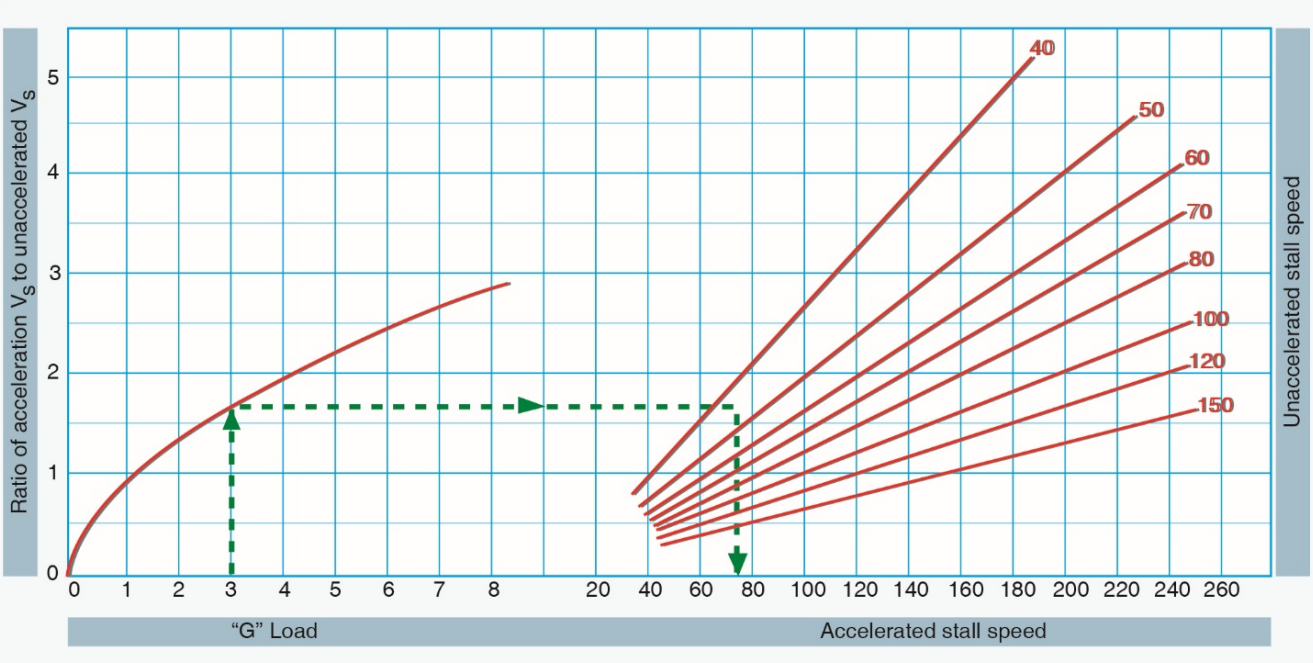 Load Factor Graph | Source:

Add Your Comment