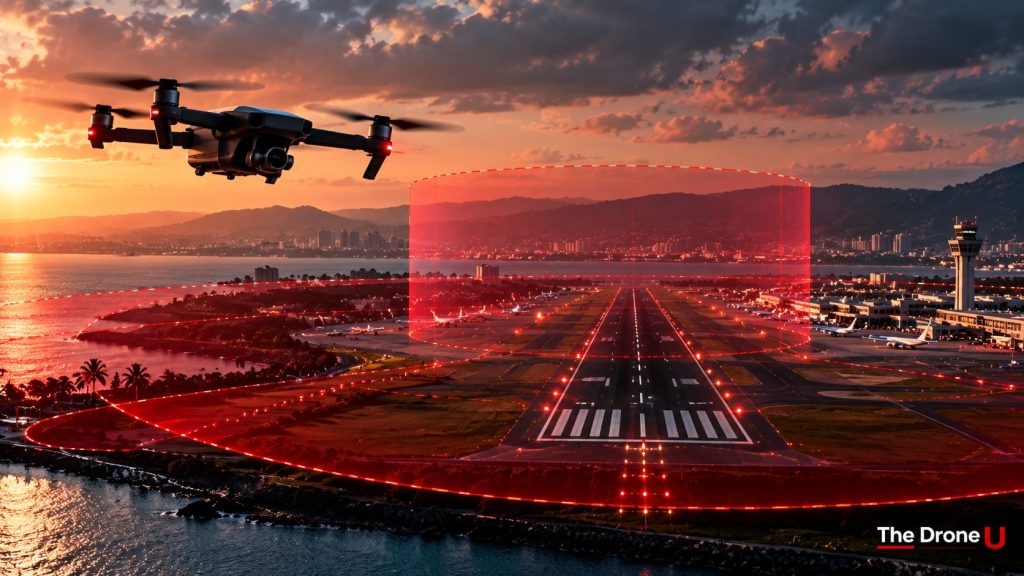
In Puerto Rico, a drone flight near an airport runway or a military installation can now end with a federal citation from the FBI. The FBI’s San Juan Field Office says the U.S. Attorney’s Office for the District of Puerto Rico gave it authority on October 8 to issue citations for several drone-related federal offenses. Special Agent in Charge Carlos R. Goris announced the change this week, and Puerto Rico outlets including NotiCel, El Vocero and Telemundo Puerto Rico reported it.
What the FBI can now cite
In a social media post, FBI San Juan said the citations are “federal violation notices that could have serious consequences.” It listed these offenses, adding that the list is not complete:
- 18 U.S.C. 39B: unsafe operation of an unmanned aircraft, including flying in a runway exclusion zone.
- 18 U.S.C. 796: using an aircraft to photograph defense installations.
- 18 U.S.C. 1752: operating a drone in or above restricted buildings or grounds.
- 49 U.S.C. 46307: violating national defense airspace and flight restrictions.
Telemundo Puerto Rico reported that the citation authority covers first offenses where no weapons were involved and no one was hurt, and that citations will be processed through the federal Central Violations Bureau. “Unauthorized drone operations in these areas pose real risks to public safety and to ongoing federal and military operations,” Goris said in a written statement (translated from Spanish), adding that people who ignore the restrictions will be held accountable.
What those laws say
Each of these offenses is already a federal crime. The citation authority gives agents a faster way to charge them. According to the statute text:
- Section 39B makes it a crime to knowingly fly a drone without authorization in a runway exclusion zone. That zone is a rectangle half a statute mile wide that extends 1 statute mile past each end of an active runway at airports with Class B, C or D airspace at the surface. The section also covers knowingly or recklessly interfering with a manned aircraft. The base penalty is up to one year in prison and a fine, with much higher penalties if someone is hurt.
- Section 796 carries up to one year for photographing vital military or naval installations from the air that the President has designated as requiring protection.
- Section 1752 makes it a crime to knowingly and willfully fly a drone into or over areas restricted for people under Secret Service protection or for special events of national significance. The base penalty is up to one year.
- Section 46307 covers violations of airspace the FAA has designated as national defense airspace, which includes VIP and many security TFRs. A first offense carries up to one year, and a recent amendment allows up to five years for repeat offenses.
A federal violation notice works something like a ticket, but it is still a federal charge. Depending on the court’s rules, a person may be able to resolve it by paying a set amount, or may have to appear before a federal magistrate judge. A citation is a quicker option than a full criminal complaint, which could mean more low-level drone cases get charged.
What this means for drone pilots
- Enforcement is getting faster. This order applies only in Puerto Rico. But federal agencies are clearly looking for quicker ways to deal with low-level drone violations near airports, bases and protected events, and other districts could follow.
- Check restrictions before every flight. The FBI’s own advice was to check active flight restrictions before you fly. Use tfr.faa.gov, B4UFLY or a LAANC app, and pay extra attention around military sites and airports.
- Know where the runway zone is. Near towered airports, the runway exclusion zone extends a mile past each runway end. Flying there without authorization is a federal crime even if no manned aircraft is around.
- Be careful with cameras near bases. Photographing military installations from the air can be a separate offense from the airspace violation.
- Airspace knowledge protects you. Our Part 107 course teaches you how to read sectional charts, find Class B, C and D airspace and spot TFRs before you launch.
Sources: NotiCel; El Vocero; Telemundo Puerto Rico; PuertoRico.com; statute text via Cornell LII: 18 U.S.C. 39B, 18 U.S.C. 796, 18 U.S.C. 1752, 49 U.S.C. 46307.
 0