
FCC Clears 23 Drone Companies From Its Foreign-Drone Ban as FlyingBasket’s Heavy-Lift FB3 Joins the List

November 23, 2026
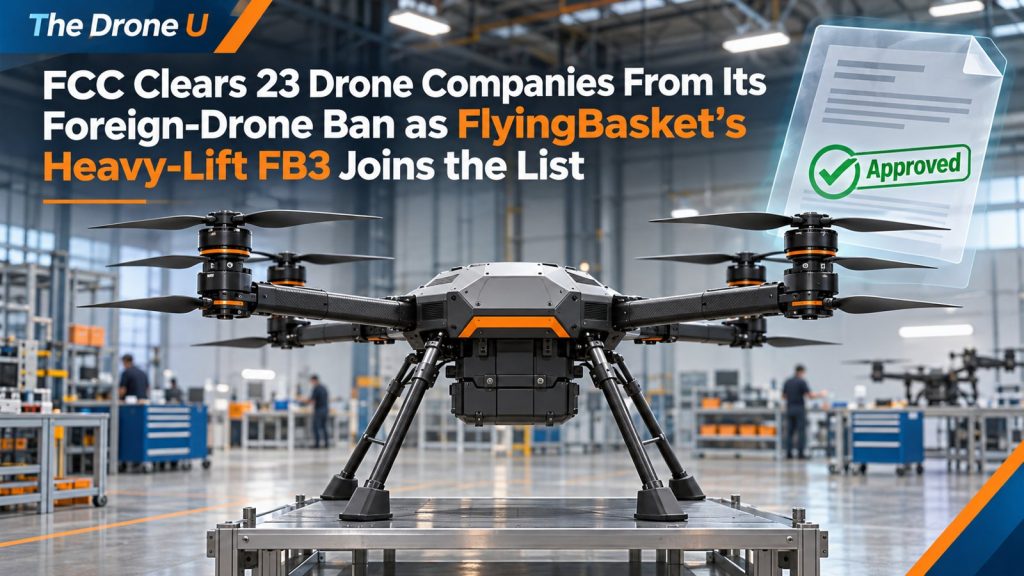
The Federal Communications Commission has now cleared 23 drone and drone-component companies to keep selling equipment that its foreign-drone ban would otherwise block. The newest addition is FlyingBasket’s FB3, an Italian heavy-lift drone that can carry up to 100 kilograms (220 pounds). It received its conditional approval on Nov. 18.
The FCC announced the latest round in a public notice dated Nov. 18 and a news release on Nov. 20. This week’s five approvals covered the FB3, two Wi-Fi router makers (EnGenius and Zyxel) and two robotics companies (Syncrobotic and Bluepath Robotics). Across all categories, 71 companies have now received conditional approvals: 23 in drones, 24 in routers, 17 in advanced robotics and seven in power inverters.
On Dec. 22, 2025, the FCC added all foreign-produced drones and critical drone components to its Covered List, which bars new equipment authorizations for listed gear. The notice left room for the Department of War or Department of Homeland Security to determine that a specific drone or component doesn’t pose an unacceptable risk.
That’s what a conditional approval is. A company submits information on its ownership, its cybersecurity and a plan to move production to the United States. The Department of War and DHS review the file, and the FCC then updates the Covered List to exempt the product. According to the FCC, the average review has dropped from 40 days to 24 days over the past three months.
The conditions matter. Drone approvals carry no expiration date, but they last only as long as the company sticks to its onshoring plan and its products pass updated vetting. A missed plan or a false statement in the application can send the equipment back onto the Covered List. The router approvals in the same notice, by contrast, expire in May 2028. FlyingBasket says on its FB3 product page that the aircraft is made in Europe and that U.S. production starts in early 2027.
The appendix shows how broad the cleared group has become. Alongside the FB3, it includes Percepto’s Air Max inspection system (Nov. 6), Voliro’s T drone (Oct. 30), Manna’s delivery drones (Oct. 23), the Dronus K500L and its docking station (Oct. 2), Flock Safety’s Alpha (June 12), ABZ Innovation’s L50 (June 12), the VEX AIR classroom drone (June 4), Exedy’s Ayre CX and Parallel Flight’s Firefly (both July 24), and early approvals for SiFly, ScoutDI, Verge and Mobilicom on March 17. No DJI or Autel product appears. Those companies are covered under a separate Covered List entry tied to Section 1709 of the fiscal 2025 defense authorization law.
The FCC’s release says $6 billion has been invested in U.S. drone manufacturing since December, with 5,700 jobs, but it doesn’t say which companies or projects make up that figure. Across all four categories, the 71 approved companies have promised $4.4 billion and 4,700 jobs. Chairman Brendan Carr said the Covered List “has also generated a surge in investment in American manufacturing.”
The approvals came during the same week the commission unanimously adopted new drone spectrum rules for 450 MHz command-and-control links and 24 GHz detection radar, which DroneLife covered on Nov. 20. We explained that order in our FCC spectrum story.
If you already own a drone with a valid FCC authorization, nothing here grounds it. The FCC’s release repeats that previously authorized equipment can still be used, imported, marketed and sold. The Covered List affects new models seeking authorization. For the ongoing DJI fight, see our explainer Is DJI banned in the US? and our coverage of DJI’s mandamus petition.
For working pilots, the list is a preview of where non-DJI enterprise options are growing: heavy lift, delivery, spraying, docks and inspection. Some of that hardware falls outside basic Part 107. A 220-pound payload pushes the FB3 well past the 55-pound limit for small drones, so those operations need additional FAA approvals, and agricultural spraying brings Part 137 into play. Part 107 is still the starting point for every one of those careers. Drone U’s Part 107 course gets you certified so you’re ready when your company’s fleet changes.
Sources: FCC news release (Nov. 20, 2026); FCC Public Safety and Homeland Security Bureau Public Notice DA 26-1243 (Nov. 18, 2026); FCC Covered List; FlyingBasket FB3 product page; DroneLife (Miriam McNabb, Nov. 20, 2026).
 0