

Can the FCC Ban Drones It Already Approved? A Federal Court May Decide.

October 8, 2026
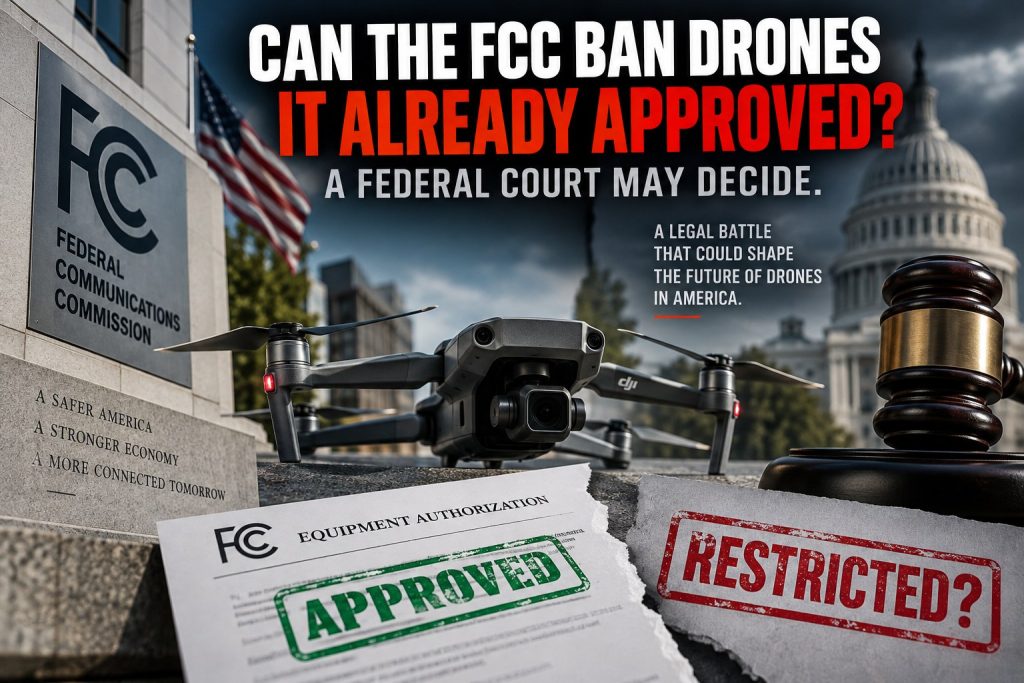
A legal battle involving Chinese surveillance cameras could determine the future of foreign-made drones in America.
What happens when the federal government approves a product, then decides it no longer wants that product sold in America? That’s the question at the center of the FCC drone ban fight, and it’s now in front of a federal appeals court.
The answer could have enormous consequences for DJI, drone manufacturers, and thousands of American businesses.
On October 6, the U.S. Court of Appeals for the D.C. Circuit heard arguments in Hikvision USA v. FCC, a case challenging the Federal Communications Commission’s authority to restrict equipment it previously authorized.
Hikvision manufactures surveillance technology. But this fight isn’t really about cameras.
It’s about whether the FCC can effectively reverse its own approvals.
The FCC is considering new restrictions on certain foreign-made drones and components already approved for the U.S. market.
Under the proposal, qualifying equipment could be prohibited from future importation and marketing, even if it previously received FCC authorization.
That distinction matters.
The government isn’t proposing to ground drones already in your fleet. Instead, the proposed FCC drone ban could prevent additional covered equipment from entering the American marketplace.
For commercial operators, that raises serious questions about future equipment availability, fleet expansion, and long-term investments.
Hikvision argues that the FCC lacks the statutory authority to impose these restrictions on previously approved equipment.
The FCC disagrees, maintaining that its equipment authorization powers allow it to address national security threats, including by limiting existing approvals.
The central question: Does the authority to deny a new approval also include the authority to restrict an old one?
The court’s interpretation could have implications far beyond surveillance cameras, including for the FCC drone ban proposal.
The proposed FCC drone ban could affect certain foreign-produced drones that the FCC labels “military-grade,” including those equipped with technologies commonly used in commercial operations:
These aren’t exclusively military technologies. They’re essential tools for infrastructure inspections, public safety, agriculture, surveying, and mapping.
And that’s where the controversy intensifies.
When does protecting national security become restricting the very industries America is trying to strengthen?
The court has not issued a decision.
Importantly, the Hikvision case does not directly challenge the FCC’s drone proposal. A ruling also wouldn’t automatically invalidate or approve future drone restrictions.
But it could establish important legal boundaries governing the FCC’s authority over previously approved equipment.
For DJI, foreign manufacturers, and American operators relying on their technology, those boundaries could be consequential.
America wants a stronger domestic drone industry. National security is a legitimate concern.
But there’s a fundamental difference between preventing new equipment from entering the market and changing the rules for equipment the government already approved.
The courts may now help determine just how far the FCC can go.
And for the American drone industry, the stakes of the FCC drone ban fight extend well beyond DJI.
Fly for a living? Hardware rules will keep shifting, but your skills transfer to any airframe. Start with our Part 107 certification course. Training a team or planning a fleet transition? Talk to us through our Enterprise Drone Programs.
Sources: DRONELIFE, “FCC Drone Restrictions Face Federal Court Test” (Oct 7, 2026); FCC brief, Hikvision USA, Inc. v. FCC, No. 25-1274 (D.C. Cir.); FCC Public Notice, PS Docket No. 26-189 (Federal Register).
 1
1
