

FEMA’s Second $250 Million Counter-Drone Grant Round Closes November 16: What It Funds and What It Means for Pilots

November 2, 2026
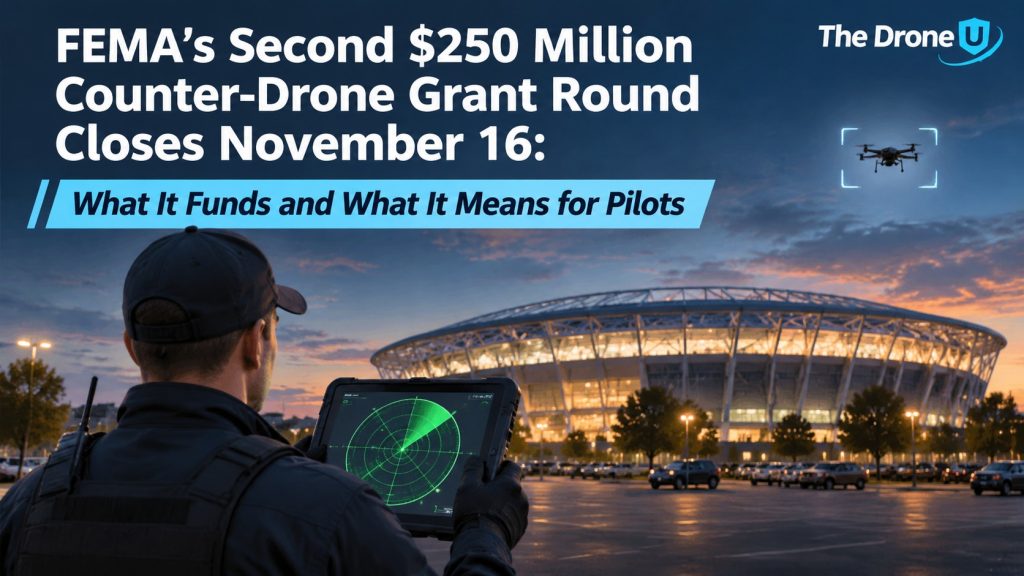
States have two weeks left to apply for the second $250 million round of federal counter-drone money. FEMA’s Fiscal Year 2027 Counter-Unmanned Aircraft Systems (C-UAS) Grant Program closes at 5 PM Eastern on November 16, 2026, according to the Grants.gov listing. DroneLife flagged the deadline this weekend. The program will put drone detection gear, and in some places drone mitigation gear, into the hands of police and sheriff’s offices nationwide. That makes it worth a look for anyone who flies near stadiums, concerts or critical infrastructure.
The first $250 million went out in FY 2026 to the 11 states hosting FIFA World Cup matches plus the National Capital Region. This second round is open to all 56 states and territories. Only each state’s State Administrative Agency can apply directly to FEMA. Local law enforcement, corrections and other public safety agencies have to go through their state, and states can set their own earlier internal deadlines.
The Notice of Funding Opportunity guarantees each state, Puerto Rico and the District of Columbia at least $3.325 million. American Samoa, Guam, the Northern Mariana Islands and the U.S. Virgin Islands get at least $760,000 each. Money above those floors is allocated using DHS’s terrorism risk formula and how effective each proposed project looks. FEMA expects to pick recipients around December 2 and issue awards around December 10.
This round also leans heavily toward the 2028 Los Angeles Olympics and Paralympics. The Games are a National Special Security Event, and FEMA says the money should help secure the Olympic torch relay as it crosses the country. Recipients have to agree to provide mutual aid to other grantees, including Olympic support.
The grant covers detection, identification, monitoring, tracking and mitigation technology. FEMA calls the category DIMT-M. A few requirements stand out:
DroneLife points out the scale problem. There are roughly 20,000 law enforcement agencies in the U.S., and a layered counter-drone setup with equipment, training and upkeep is expensive. Regional sharing will probably be how many smaller departments get access at all.
Sources: FEMA FY 2027 C-UAS Grant Program NOFO; Grants.gov opportunity DHS-27-GPD-161-01-99; FEMA C-UAS Grant Program fact sheet; DroneLife
 0