

Germany’s Military Will Stop Using Chinese-Made Drones, Including DJI, on Its Bases

November 12, 2026
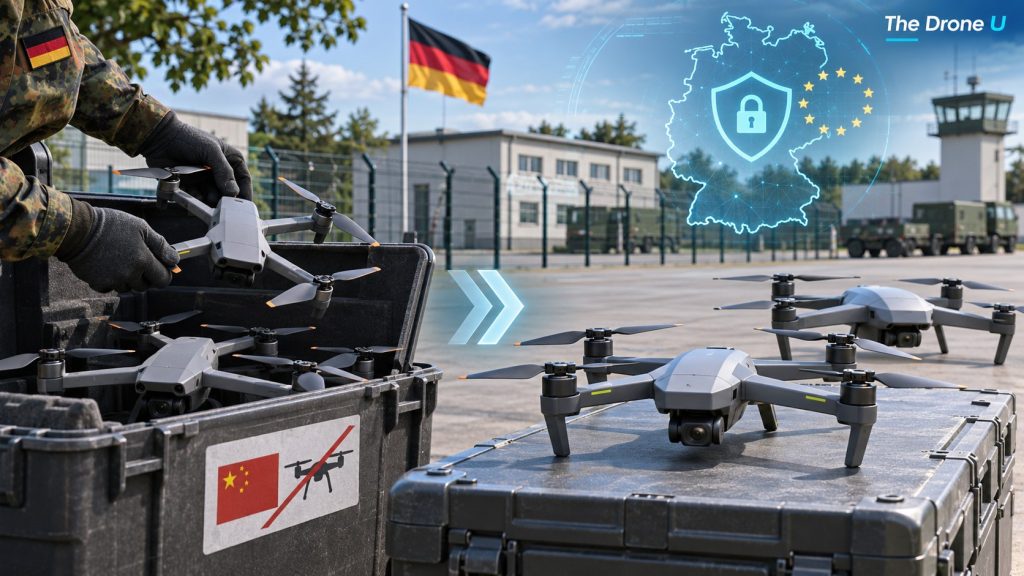
Germany’s military will stop using Chinese-made drones, including models from DJI, and replace them with German or other European aircraft, the Defense Ministry confirmed this week. Der Spiegel first reported that the Bundeswehr is pulling commercially available Chinese drones out of use at military installations over espionage concerns. The ministry later confirmed the change. This is a policy for the armed forces and their bases, not a ban on civilians buying or flying DJI drones in Germany.
In a Nov. 10 report, Spiegel said Bundeswehr commanders had been allowed to buy off-the-shelf Chinese drones for training, and that those systems are now being retired because they are treated as a security risk. The paper framed the move as a ban on Chinese drones and vehicles from barracks. A caption on the story described a mid-November drone exercise in Husum where, Spiegel said, Chinese aircraft were already no longer being used. When The Guardian wrote up that report on Nov. 11, it noted the Defense Ministry was not immediately available for comment.
Later on Wednesday, the ministry made the policy official. In an emailed statement reported by the Associated Press and Reuters, officials said that “in order to strengthen the Bundeswehr’s self-sufficiency and technological sovereignty,” Chinese-made models will no longer be used and will be replaced by domestic or other European-made drones. Reuters reported that Chinese drones had been allowed as a lower-cost option for target practice and training. The AP account said commanders can still buy commercial off-the-shelf drones for training and some exercises, but only after a risk assessment and only when no “security-relevant information” is at risk. The ministry did not say how many Chinese-made drones are in service, the AP reported.
The spokesperson also told Reuters there is no blanket ban on systems from specific countries, and that decisions rest on individual risk assessments aimed at protecting military, IT and data security. That wording sits alongside the clear statement that Chinese-made drone models will no longer be used. China’s foreign ministry told Reuters it opposed Germany’s “discriminatory practice” targeting Chinese products. DJI has repeatedly said its drones do not pose a security risk. In May, Reuters reported, the company told U.S. lawmakers that an independent review had found “no evidence of data transmission outside the United States.”
Reuters, citing Spiegel, reported that local commanders had been allowed to buy the aircraft under a 2024 strategy that included a “white list” of approved systems, including several DJI models. A Correctiv investigation published in August traced that path in more detail. In November 2023, then-Inspector of the Joint Support Service Martin Schelleis had expressly barred the use of Chinese-made drones in the Bundeswehr. In 2024, according to Correctiv, a “White List” that included eight DJI models was approved, and a ministry spokesperson told the outlet that off-the-shelf drones could be bought only for use in settings where there was no risk to sensitive infrastructure or information.
U.S. readers will recognize the argument, if not the exact rule. In the United States, the FCC has added DJI to its Covered List, which blocks new federal equipment authorizations for covered drones and certain components. That is a civilian equipment rule, not a military-installation policy, and it is not a total ban on every DJI aircraft already in the field. Germany’s decision is narrower still: it applies to the armed forces, not to the German consumer market.
If you fly in the United States, this does not change Part 107 or the airspace over your local park. It does show how quickly government customers are revisiting Chinese-made hardware, even after earlier approvals. Public-safety and defense work in the U.S. has been moving in the same direction for years, and pilots who want those jobs are increasingly expected to know the difference between a recreational aircraft, a Covered List restriction and a lawful commercial operation. A Part 107 certificate is still the foundation. Drone U’s Part 107 test prep course covers airspace, operations and the regulations you will be tested on, and students have been known to take the online course in 3 days and pass the test.
Sources: Der Spiegel; Associated Press, via The Independent; Reuters, via The Hindu; The Guardian; Correctiv.
 0
