

No Pilot License Required? The HayesX-250 Personal eVTOL Debuts at SEMA Under Part 103 Rules

November 3, 2026
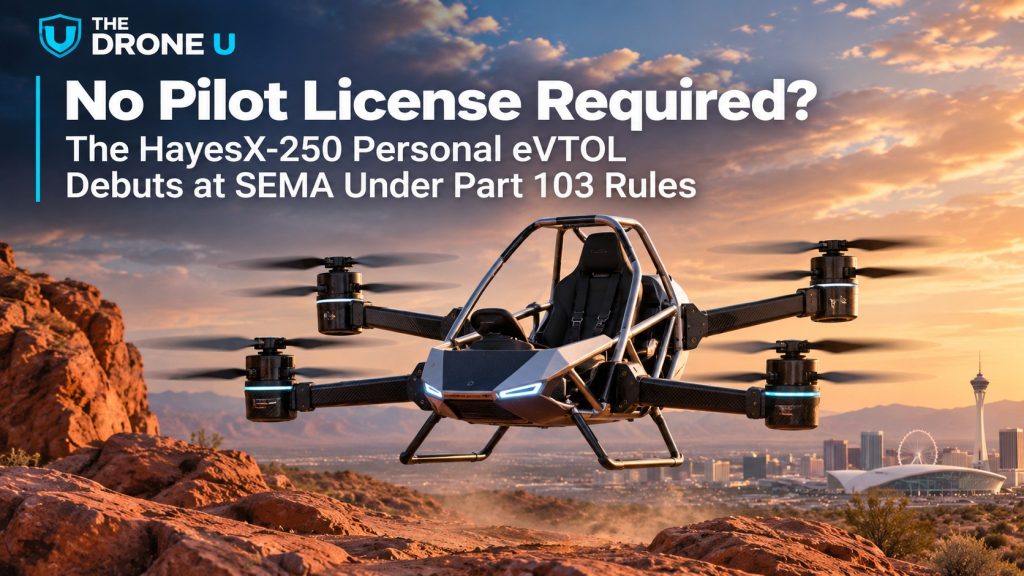
The biggest aftermarket car show in the country has a new kind of vehicle on the floor this week. HayesX, a personal aviation startup based near Las Vegas, is bringing its HayesX-250 single-seat electric aircraft to the 2026 SEMA Show, which runs November 3 to 6 at the Las Vegas Convention Center. The company says the aircraft is designed to fit the FAA’s Part 103 ultralight rules. That would mean, in the U.S., no pilot certificate is needed to fly it.
That claim is why the debut is trending among personal air vehicle fans, and also why drone pilots should understand exactly what Part 103 does and does not allow.
According to the company’s announcement, the HayesX-250 is a single-seat eVTOL that takes off and lands vertically, so it needs no runway. Four arms fold to shrink the aircraft to about 4.25 by 9.1 feet, small enough to haul in a suitable pickup bed or trailer. HayesX lists the weight at 245 pounds including batteries and the top speed at 62 mph. The frame combines aviation-grade aluminum with carbon fiber parts.
For redundancy, HayesX says the aircraft uses eight electric motors, dual power and control buses and dual inertial measurement units. It also has a whole-aircraft ballistic parachute. The company’s FAQ says the pilot flies with two joysticks and that the aircraft holds a hover when the sticks are released. It also lists flight time at up to 25 minutes and about 150 hours of flight testing so far.
Reservations are open at a listed price of $146,600. HayesX says a $6,600 deposit holds an order and that it is taking a limited number of orders for 2026 delivery. The public unveiling and press conference are scheduled for Wednesday, November 4, at the company’s booth in Central Hall.
Part 103 is one of the shortest rule sets in the federal aviation regulations. A powered ultralight must carry a single occupant and be used only for recreation or sport. It must weigh less than 254 pounds empty, not counting floats or emergency safety devices like a parachute. It can carry no more than 5 gallons of fuel, can’t exceed 55 knots at full power in level flight, and must have a power-off stall speed of 24 knots or less. HayesX’s published 62 mph works out to about 54 knots, just under that cap.
If a vehicle meets those limits, the FAA doesn’t require pilot certification, aircraft registration or an airworthiness certificate. The FAA also doesn’t certify ultralights, though. Meeting Part 103 is the builder’s and operator’s responsibility, so the HayesX claim is the company’s own until owners and regulators see production aircraft.
The operating rules matter as much as the weight limits. Ultralights generally fly only between sunrise and sunset, with limited twilight exceptions. They can’t fly over congested areas of a city, town or settlement or over open-air crowds. They need ATC authorization to enter Class B, C or D airspace or a Class E surface area, and they must yield right of way to all other aircraft. In other words, “no license” does not mean “no rules,” and it definitely does not mean a backyard commute across town.
For drone pilots, the HayesX-250 is a reminder that the categories are getting blurry. A personal eVTOL with eight motors and joystick control looks a lot like a giant multirotor. Legally, though, it is a crewed ultralight, and it can’t be used for business. Part 103 is recreation and sport only. Fly a camera drone for a client and you are under Part 107, which does require an FAA remote pilot certificate.
The airspace knowledge carries over directly. Reading a sectional chart, knowing where Class B, C and D boundaries sit, and understanding when you need ATC permission are core skills for any ultralight owner and any commercial drone pilot. If you want to learn them properly, Drone U’s Part 107 course covers airspace, weather and regulations for the FAA knowledge test, and students have been known to take the online course in three days and pass.
Watch SEMA week for real-world flight demonstrations and independent hands-on reports. Those will say more about the aircraft than any spec sheet.
Sources: HayesX (PR Newswire); HayesX FAQ; SEMA Show; 14 CFR Part 103; HoverNews
 0
