
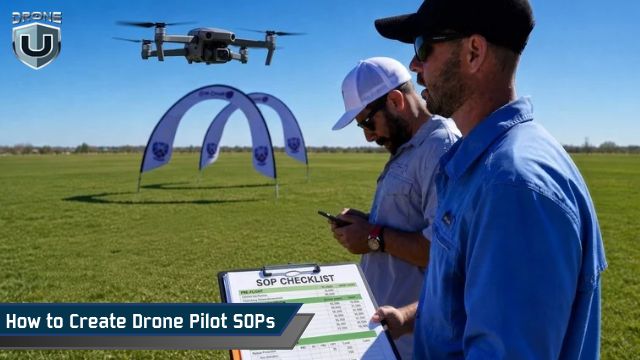
How to Create Drone Pilot SOPs: Step-by-Step

November 23, 2026
Quick AnswerTo create drone pilot SOPs:
|
Drone pilot SOPs are written instructions that help you plan, conduct, and complete drone operations safely and consistently. They explain what pilots must do before, during, and after each flight.
This guide explains how to create practical drone pilot SOPs. It also includes a sample SOP template and a pre-flight checklist you can adapt to your operations.
First, let’s look at why drone pilot SOPs matter.
Drone operations involve several risks. Consider weather, airspace restrictions, equipment condition, battery performance, and people near the flight area. You also need to meet client expectations and deliver consistent results.
Without written procedures, pilots may approach the same task differently. This can create gaps in safety, communication, and quality control.
Drone pilot SOPs give your team a consistent process to follow. Here are five reasons to create them.
Every safe flight starts with proper planning and equipment checks.
Before takeoff, pilots need to inspect the aircraft, check the weather, review airspace restrictions, and identify potential hazards. Missing these steps can put the aircraft, people, or property at risk.
Your SOPs should explain how pilots complete these checks. For example, include instructions for inspecting propellers, checking battery condition, reviewing wind conditions, and identifying obstacles around the flight area.
These procedures help pilots identify problems before launch.
Commercial drone operations must follow the regulations that apply to their operating location.
In the United States, for example, pilots operating under FAA Part 107 must meet applicable requirements for pilot certification, aircraft registration, airspace, and flight operations.
Your SOPs should explain how pilots check these requirements before each mission. Include procedures for reviewing airspace restrictions, obtaining required authorizations, and maintaining flight records.
An SOP does not replace aviation regulations. It helps you turn applicable requirements into practical steps your team can follow.
If you need help preparing for the FAA knowledge test, explore Drone U’s Part 107 Certification Course.
Your clients expect consistent results, regardless of which pilot handles their project.
Without SOPs, pilots may use different flight settings, inspection methods, or data collection practices. These differences can affect the quality of your deliverables.
For example, a drone surveying company may have several pilots who use different approaches to plan mapping flights. This can produce inconsistent datasets.
A mapping SOP can standardize flight planning, image overlap, camera settings, and data collection. Your team can then follow the same process across similar projects.
New pilots need to learn more than basic drone controls. They must understand your organization’s procedures, equipment requirements, communication practices, and safety standards.
Written SOPs give new team members a reference during training. You can use them to guide supervised flights and practical exercises.
Experienced pilots can also refer to these documents when they operate unfamiliar aircraft or equipment.
Clients want to know that you can complete their projects safely and deliver reliable results.
Documented procedures show that you take flight safety, equipment maintenance, and quality control seriously. They also help you maintain accurate operational records.
If an incident occurs, you can review your SOPs, flight logs, and maintenance records to understand what happened. You can then identify gaps and improve your procedures.
Next, let’s identify the procedures your SOPs need to cover.
Your drone pilot SOPs should cover the entire mission lifecycle. Start with the initial client request and continue through flight planning, execution, and post-flight reporting.
You do not need to put every procedure into one lengthy document. Create a general operations manual and separate SOPs for specific aircraft and mission types when necessary.
Include these seven areas.
Your SOP should explain how pilots prepare for a mission before arriving at the site.
Include procedures for:
For example, a roof inspection requires pilots to consider nearby buildings, rooftop access, power lines, and possible signal interference. Your SOP should explain how they assess these conditions before starting the mission.
Equipment problems can interrupt a mission and create safety risks.
Your SOP should explain how pilots inspect and prepare their equipment. Cover the aircraft frame, propellers, motors, landing gear, batteries, controllers, communication links, and payloads.
Include battery management procedures as well. Explain how pilots check battery health, charge levels, temperature, and physical condition.
For example, pilots should not use batteries that show swelling, leakage, or physical damage. Your SOP should explain how they remove damaged batteries from service and report the problem.
Always follow the manufacturer’s instructions for battery charging, storage, and handling.
Before each mission, pilots should review the flight plan and confirm individual responsibilities.
Your briefing procedure should cover:
Define operating limits for weather, wind, visibility, and battery reserves. Base these limits on applicable regulations, aircraft specifications, and your organization’s risk assessment.
Your SOP should explain how pilots conduct each stage of the flight.
Divide the procedure into three stages:
Before takeoff
During flight
During landing
Adapt these procedures to each aircraft and mission type. A mapping flight may require different operating steps from a close-range infrastructure inspection.
Every drone operation needs a clear emergency response plan.
Your SOP should explain how pilots respond to situations such as:
For each situation, document the immediate actions pilots must take, who they need to contact, and how they should report the incident.
For example, your lost-link procedure should explain the aircraft’s configured failsafe behavior. It should also tell pilots what to do if the aircraft does not respond as expected.
Do not assume every drone uses the same failsafe settings. Document model-specific instructions and test them during controlled training.
Your responsibilities do not end when the drone lands. Your post-flight SOP should explain how pilots inspect equipment, manage collected data, and record mission details.
Include procedures for:
If you handle client information or sensitive imagery, include data management procedures. Explain where pilots should store files, who can access them, and how they should transfer and delete data.
Your SOPs should identify who handles each task during a mission.
For example:
A small organization may assign several responsibilities to one person. However, every critical task needs a clearly defined owner.
Let’s look at how you can organize these procedures into a document your team can follow.
Use a consistent template to document your procedures. This makes it easier for pilots to understand each SOP and find the information they need.
You can adapt the following structure to your aircraft, mission requirements, and operating environment.
Document Information
1. Purpose
Explain why you need this SOP and what it should help your team achieve.
2. Scope
Identify the operations, aircraft, locations, and team members covered by this procedure.
3. Roles and Responsibilities
List the people involved and explain their responsibilities.
4. Required Equipment
List the aircraft, controller, batteries, payloads, communication devices, and other equipment required for the mission.
5. Pre-Flight Requirements
Explain the checks pilots must complete before takeoff. Refer to the relevant pre-flight checklist.
6. Flight Procedures
Document the steps pilots must follow before takeoff, during flight, and during landing.
7. Emergency Procedures
Explain how pilots should respond to communication failures, low battery warnings, flyaways, and equipment problems.
8. Post-Flight Procedures
List the inspection, battery management, data backup, flight logging, and reporting requirements.
9. Required Records
Identify the checklists, flight logs, maintenance records, and incident reports pilots must complete.
10. Revision History
| Version | Date | Changes Made | Approved By |
| 1.0 | Add date | Initial release | Add name |
| 1.1 | Add date | Initial release | Add name |
Use this template as a starting point. Create separate SOPs for operations such as mapping, roof inspections, and aerial photography when their procedures differ.
Here’s an example of a pre-flight checklist you can use.
A pre-flight checklist is one practical tool you can include in your SOP manual. It helps pilots confirm that they have completed the required checks before takeoff.
Before arriving at the site
Confirm mission details and flight objectives.
Review airspace restrictions and authorization requirements.
Check weather conditions and forecasts.
Confirm that the drone, batteries, and payload are ready.
Check that required documents and permissions are available.
At the flight site
Before takeoff
Pilot sign-off
The pilot must resolve any safety issue before takeoff. A completed checklist does not replace the pilot’s responsibility to assess changing conditions.
You can also explore the Drone U Resources page for additional checklists and training materials to support your pre-flight preparation.
Now, let’s explore the steps you need to follow to create your SOPs.
You do not need to create a complicated operations manual from scratch. Start with the missions your team performs regularly.
Follow these seven steps to develop practical drone pilot SOPs.
Identify the drone operations your team performs most often. Your list may include aerial photography, roof inspections, land surveying, construction monitoring, agricultural inspections, and infrastructure inspections.
Each mission involves different equipment, operating conditions, and safety requirements.
For example, a mapping mission may need specific procedures for flight planning, image overlap, and data collection. An infrastructure inspection may require more detailed obstacle assessments.
Start with your most frequent or highest-risk operations.
Your experienced pilots already follow processes that help them complete missions safely.
Observe them during actual flights or review their mission records. Pay attention to how they assess sites, prepare equipment, communicate with team members, and respond to changing conditions.
Ask why they follow certain steps. Document their practices and identify which procedures your entire team should follow.
Identify the risks associated with each mission before writing your SOP. Consider equipment failure, weather changes, airspace conflicts, people entering the flight area, and data loss.
For each risk, ask:
Use your answers to create procedures that address real operating conditions.
Use short sentences, numbered steps, and clear instructions.
For example, avoid writing:
“Battery condition should be verified before the commencement of flight operations.”
Instead, write:
“Check the battery condition before takeoff. Do not use damaged batteries.”
The second version tells pilots exactly what to do.
Add photographs, diagrams, or screenshots when they make instructions easier to understand. Keep the language consistent across your documents.
A procedure may look complete on paper but still create confusion during an actual mission.
Ask a pilot who did not write the document to follow it during a supervised practice flight. Check whether they understand each instruction, find the required information, and complete the steps in the correct order.
For example, a pilot may not know which battery threshold applies to a particular aircraft. Add specific instructions to address that gap.
Update the document based on what you observe.
Ask pilots, operations managers, and maintenance personnel to review your draft.
Pilots can check whether the procedures work in the field. Maintenance personnel can review equipment instructions. Operations managers can check responsibilities and recordkeeping requirements.
Once you address their feedback:
Make sure your pilots know where to find the latest version.
Your SOPs should change as your operations evolve.
Review each document every six to twelve months as a starting point. Also review it when you introduce new aircraft, change equipment or software, add mission types, or identify gaps after an incident or near miss.
Check for relevant regulatory changes as well. Update procedures whenever they become outdated or create a safety concern.
Let’s look at some common mistakes you can avoid when creating drone pilot SOPs.
Even a well-written SOP manual can fail when pilots find it difficult to use. Avoid these common mistakes.
Long, technical documents can discourage pilots from using them. Focus on essential actions. Move supporting information into separate reference documents when necessary.
A generic template gives you a starting point, not a complete solution. Your procedures must reflect your aircraft, equipment, mission types, operating environment, and applicable regulations.
Do not assume experienced pilots can handle every emergency without written guidance. Document immediate response steps, communication responsibilities, and reporting requirements.
An untested SOP may contain unclear instructions or impractical steps. Test your procedures during supervised practice flights before approving them for regular operations.
Outdated procedures can confuse pilots and introduce unnecessary risks. Assign someone to manage revisions and make sure your team receives updates.
Your pilots use these procedures in the field. Encourage them to report unclear instructions, missing steps, and procedures that do not match actual operating conditions.
Drone pilot SOPs help your team plan and conduct operations safely and consistently. They define how pilots prepare for missions, inspect equipment, manage flight operations, respond to emergencies, and complete post-flight tasks.
Start by documenting the missions your team performs most often. Identify operational risks, define responsibilities, and write clear procedures that pilots can follow in the field. Test each procedure before approving it, and review your documents whenever your equipment, operations, or regulatory requirements change.
You do not need to document every operation at once. Start with one mission type and expand your SOPs as your operations grow. A practical, well-tested SOP is more useful than a lengthy manual that pilots rarely consult.
Explore Drone U’s Safe Drone Operations Course to strengthen your mission planning, risk management, and emergency response skills.
 0